Lesson 01 — Correlation Is Not Causation
Learners meet the most important idea in reading evidence: two things happening together (correlation) does not prove one causes the other (causation). They learn to look for a hidden third variable, and sort everyday pairs into "correlation" and "causation" — building the habit of asking "what else could be going on?"
Objectives
Objectives
- D06.S1.07.01 Distinguish correlation from causation and explain why a pattern alone does not prove a cause.
Essential question
When two things happen together, how do I know whether one causes the other?
Key vocabulary
Materials
Standard materials
- Correlation-or-causation card set · 1 set per pair Pairs of events that move together (ice cream sales & drownings; stork nests & births; shoe size & reading) to sort as correlation or causation
- Third-variable page · 1 per learner A page with three boxes — effect A, effect B, and a blank third box — for drawing the hidden common cause
- Pencils and highlighters · per learner
Low-tech / no-cost
- Found-object pairs Name two real things that change together where you live (hot days and dust, rain and frogs); say them aloud and sort them by ear — no cards or page needed
- Voice and body Act out "both rise together" with two hands moving up, then one hand "causing" the other versus a third hand "causing both"
Enriched / lab & device
- A device to browse a spurious-correlation gallery · 1 per group View a few real, silly examples (e.g., from Tyler Vigen's Spurious Correlations) to practice spotting third variables
- A shared 'correlation board' · 1 A display where learners pin news headlines that confuse correlation with causation across the unit
Works in different contexts
- large-group Sort two examples together on a chart, then have pairs sort the card set and defend one choice each to the group
- multi-age Younger learners name two things that happen together; older learners identify the third variable that could cause both
- self-directed A learner works the card set alone, drawing each example as three boxes and checking against the worked example
- level-grouped Learners ready to extend distinguish a common cause (third variable) from reverse causation (which thing came first) using one example
- outdoor-only Observe two things that move together outdoors (shade and cooler ground; wind and moving leaves) and ask whether a third thing causes both; no paper needed
Lesson 1 — Correlation Is Not Causation
Summary
Learners meet the most important idea in reading evidence: two things happening together (correlation) does not prove one causes the other (causation). They learn to look for a hidden third variable, and sort everyday pairs into “correlation” and “causation” — building the lifelong habit of asking “what else could be going on?”
Objectives
- Distinguish correlation from causation and explain why a pattern alone does not prove a cause. (D06.S1.07.01)
Connection
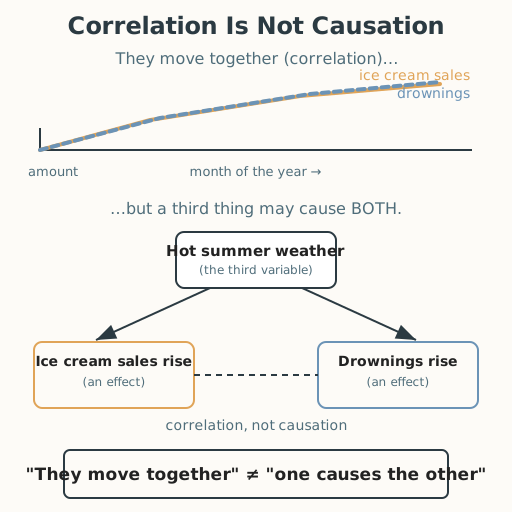
Every summer, in cities all over the world, two numbers rise together: ice cream sales and the number of people who go swimming in rivers and lakes — and, sadly, sometimes drownings. Does ice cream cause drowning? Of course not. Both rise because of a third thing: hot weather sends people to buy ice cream and to the water. The two numbers are correlated — they move together — but neither causes the other. Telling the difference is a skill you will use every day, from reading a headline to deciding whether a medicine actually works.
Materials
- Correlation-or-causation card set
- Third-variable page
- Pencils and highlighters
Preparation
- Copy the correlation-or-causation card set for pairs and the third-variable page for each learner.
- Have the worked example ready: ice cream sales and drownings both rise in summer; the third variable is hot weather.
- Recall from Grade 6: distinguishing evidence, inference, and opinion (D06.S1.05.02), and spotting bias in an investigation (D06.S1.06.02).
Facilitator note
This lesson is written to the learner (“you”). The idea to land is precise: correlation
(two things move together) is not causation (one makes the other happen), because a third
variable may cause both. Because this is a foundational reasoning skill, use explicit
instruction and a worked example first (Kirschner, Sweller & Clark, 2006): model the
ice-cream-and-drowning example aloud, then guide one more before independent sorting.
Watch for the common slip of assuming “they happen together, so one must cause the other.”
The distinction between correlation and causation is a foundational principle of statistics
and scientific reasoning, taught across the world’s science curricula; the “spurious
correlation” idea (a shared third cause) is its heart. The ethical and egalitarian lenses
(docs/philosophy.md §4): confusing correlation with causation is how people get blamed
unfairly — a neighborhood blamed for a trend it did not cause, a group blamed for an
outcome driven by poverty or history. Questioning the pattern is a tool of fairness.
The global lens: the ice-cream example works because hot weather is universal, but adapt
it — in some places it is mango season, monsoon, or a festival, not ice cream, that marks
the “third variable.”
Procedure
- Gather (5 min). Think of two things you have noticed happening together. Did one cause the other? Today you learn to tell the difference — and when to say “not enough evidence.”
- Meet the two words (10 min). Correlation = two things change together (when one goes up, the other goes up). Causation = one thing makes the other happen. Worked example: ice cream sales and drownings rise together (correlation). Does ice cream cause drowning? No — a third variable, hot summer weather, causes both.
- The rule (5 min). A pattern alone — even a strong one — does not prove a cause. Before you say “X causes Y,” ask: Could a third thing cause both? If yes, the pattern is spurious — it looks like a cause but is not.
- Sort with a partner (20 min). Take your card set. For each pair, draw three boxes on your page: effect A, effect B, and the possible third cause. Decide together: correlation or causation? (Examples: stork nests and human births rise together in some old records — is it the storks? Or does a third thing — countryside with more farms — explain both?)
- Defend one (5 min). Pick one pair and say in one sentence: “These are correlated because ___, but ___ might cause both, so I need more evidence to say one causes the other.”
- Close (5 min). The habit: when two things move together, ask “what else could be going on?” You will use this every day of your life.
Differentiation
- Support: Use only the ice-cream example and two simple pairs; describe each aloud so learners with low vision can follow by listening, and draw the three boxes together.
- Extension: For one example, also consider reverse causation (could B cause A?) and say which explanation the pattern alone cannot decide.
Assessment
- Formative (observation/self): Can the learner sort a new pair as correlation or causation and name a possible third variable?
- Self-check: The learner asks, “Did I name a third thing that could cause both? Does my answer say why the pattern alone is not enough?”
Home connection
Find a headline, ad, or claim you hear this week that says one thing causes another. Ask at home: could a third thing cause both? Bring your example to share next time.
Resources
- The distinction between correlation and causation is foundational to statistics and
scientific reasoning; a classic, accessible collection of real spurious correlations is
Tyler Vigen, Spurious Correlations (spuriouscorrelations.com). The ice-cream/drowning
example is a standard illustration of a common cause (confounding). The value claim that
questioning a pattern protects people from unfair blame is a value commitment, not a
statistical fact (
docs/philosophy.md§5). - On modeling a new skill before independent practice: Kirschner, Sweller & Clark (2006), https://doi.org/10.1207/s15326985ep4102_1