Lesson 02 — Why a Pattern Alone Does Not Prove a Cause
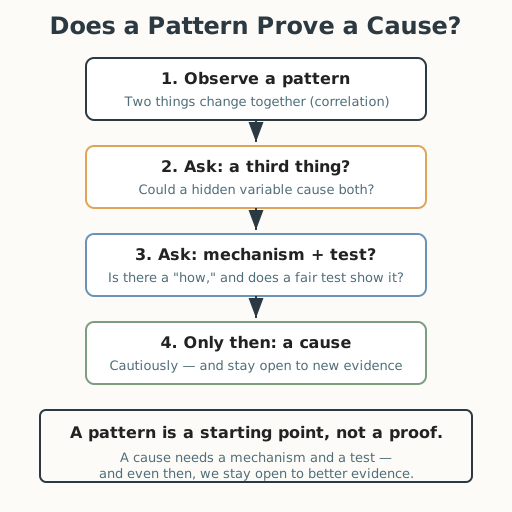
Learners go deeper: a pattern is only a starting point. To call something a cause, they learn to check for a third variable, then ask for a mechanism (a "how") and a fair test — and to stay open to new evidence. They run real claims through a four-step checklist.
Objectives
Objectives
- D06.S1.07.01 Distinguish correlation from causation and explain why a pattern alone does not prove a cause.
Essential question
What would it actually take to show that one thing causes another?
Key vocabulary
Materials
Standard materials
- Causation-checklist page · 1 per learner A four-step checklist (pattern → third variable? → mechanism + test? → cautious cause) for evaluating a claim
- Claim cards · 1 set per pair Short claims with only a pattern as evidence ("More umbrellas sold → more rain that day," "Sleepy students and late nights") to run through the checklist
- Highlighters · per learner
Low-tech / no-cost
- Voice and body Walk the checklist aloud for one claim, step by step, with a partner; no paper needed
- Found examples Use two real co-occurring things from the learner's own day and run the four questions aloud
Enriched / lab & device
- A short video on a classic confounded study · 1 A brief, age-appropriate clip illustrating a study where a third variable was later discovered
- A class causation board · 1 A shared display where learners post a claim, its pattern, and whether a mechanism or test exists
Works in different contexts
- large-group Run one claim through the checklist together on the board, then have pairs work claim cards and report one step each
- multi-age Younger learners do steps 1–2 (pattern and third variable); older learners add steps 3–4 (mechanism and test)
- self-directed A learner runs two claim cards through the checklist alone, writing one sentence per step, and checks against the worked example
- level-grouped Learners ready to extend weigh two competing explanations for the same pattern and say what evidence would decide between them
- outdoor-only Observe a pattern outdoors (wet ground after rain) and run the four questions aloud — what is the pattern, the third thing, the mechanism, the test?
Lesson 2 — Why a Pattern Alone Does Not Prove a Cause
Summary
Learners go deeper than “correlation is not causation.” A pattern is only a starting point. To call something a cause, they check for a third variable, then ask for a mechanism (a “how”) and a fair test — and learn to stay open to new evidence. They run real claims through a four-step checklist.
Objectives
- Distinguish correlation from causation and explain why a pattern alone does not prove a cause. (D06.S1.07.01)
Connection
An umbrella shop notices that on the days it sells the most umbrellas, it rains the most. Do the umbrellas cause the rain? No — rain causes umbrella sales, and the pattern alone cannot tell you which way the cause runs, or whether a third thing (a coming storm) drives both. Every day, people make decisions — what to buy, what to believe, how to vote — on patterns just like this. Knowing what it would take to show a real cause is what protects you from being fooled.
Materials
- Causation-checklist page
- Claim cards
- Highlighters
Preparation
- Copy the causation-checklist page and claim cards.
- Have the worked example ready: “umbrella sales rise on rainy days” — the pattern does not prove umbrellas cause rain; the mechanism (rain → people buy umbrellas) and the order in time point the other way.
- Retrieval: recall from Lesson 1 what a third variable is and the ice-cream example.
Facilitator note
This lesson is written to the learner (“you”). The idea to land: a pattern is necessary
but never sufficient — a cause also needs a plausible mechanism and, where possible, a fair
test, and all causal claims stay revisable. Use explicit instruction with the umbrella
worked example first, then guided practice on one claim card before independent work
(Kirschner, Sweller & Clark, 2006). The checklist is a simplified, learner-friendly version
of the “Hill criteria” for causation used in epidemiology (e.g., strength, consistency,
plausible mechanism, temporality — which came first). Keep it simple: pattern, third
variable, mechanism, test. The egalitarian lens (docs/philosophy.md §4): the demand for a
mechanism and a test is what stopped false blame — for example, in old medicine, illnesses
were blamed on a person’s character or group until careful tests found real microbial causes;
the pattern “these people are sick” was real but the cause was mis-assigned. The global lens:
different peoples developed careful causal reasoning independently — trial-and-error
agriculture (which crop, which soil), traditional medicine, and navigation all demanded
“what actually causes this?” — so the skill is a human universal, not one culture’s.
Procedure
- Gather (5 min). Last time you met correlation and causation. Quick recall: what is a third variable? Say one example from memory.
- The checklist (10 min). To decide if a pattern proves a cause, ask four questions in order: (1) Is there a real pattern? (2) Could a third thing cause both? (3) Is there a mechanism — a “how” that explains it? (4) Does a fair test (or many tests) show it, with a control and repeated trials?
- Worked example (10 min). Claim: “Selling umbrellas causes rain.” (1) Yes, a pattern: umbrella sales and rain rise together. (2) Third thing? A coming storm causes both. (3) Mechanism? None — umbrellas have no way to change the weather. (4) Test? A fair test would fail. Verdict: correlation, not causation — and the cause actually runs the other way (rain → umbrella sales).
- Run your own (20 min). Take your claim cards. For each, walk the four questions and write one line per step. Mark the verdict: pattern only or supported cause. Check with your partner — did you both check for a third thing and a mechanism?
- Close (5 min). Remember: a cause needs more than a pattern. It needs a “how” and a test — and even then, science stays open to better evidence.
Differentiation
- Support: Provide the checklist as a sentence starter (“The pattern is ___. A third thing could be ___. The mechanism would be ___. A test would ___.”); work one card together.
- Extension: For one claim, weigh two competing explanations and name one piece of evidence that would decide between them.
Assessment
- Formative (observation/self): Can the learner run a claim through the four questions and explain why a pattern alone is insufficient?
- Self-check: The learner asks, “Did I check for a third variable AND a mechanism AND a test before calling anything a cause?”
Home connection
Ask someone at home about a rule or remedy they follow (“this makes my plants grow,” “this makes me sleepy”). Run the four questions together, kindly — and see whether it is a pattern or a supported cause.
Resources
- The idea that causation requires more than correlation (plausible mechanism, temporality,
and, where possible, experimental evidence) underlies modern epidemiology and statistics;
its classic statement is Sir Austin Bradford Hill’s “The Environment and Disease:
Association or Causation?” (1965, Proceedings of the Royal Society of Medicine). The
umbrella/rain example is a standard illustration of reverse causation. The value that
demanding evidence protects people from false blame is a value commitment
(
docs/philosophy.md§5). - On explicit instruction for novice reasoning skills: Kirschner, Sweller & Clark (2006), https://doi.org/10.1207/s15326985ep4102_1