Lesson 06 — Species in Relationship
Learners map the three great relationships among species — predation, competition, and symbiosis — and see how they weave communities together into food webs. They build a web (with string and bodies), classify real pairs, and trace a ripple when one species changes.
Objectives
Objectives
- D06.S2.07.02 Describe relationships among species (such as predation, competition, and symbiosis) and how they shape communities.
Essential question
How do predation, competition, and symbiosis shape the communities of living things?
Key vocabulary
Materials
Standard materials
- Relationship card set · 1 set per pair Pairs of species (fox/rabbit, rabbit/deer, bee/flower, clownfish/anemone, lion/gazelle) to classify as predation, competition, or symbiosis
- Community web page · 1 per learner A page of blank circles and arrows for building a small food web of a local or world ecosystem
- String and clips · per group For building a physical web where each learner is a species and string shows who eats or helps whom
Low-tech / no-cost
- Voice and body Act out the three relationships — chase (predation), grab the same food (competition), help each other (symbiosis) — with partners; no cards needed
- Found examples Name real pairs from the learner's own place (a bird eating an insect, two animals eating the same fruit, a bee and a flower)
Enriched / lab & device
- A short video of a real symbiosis · 1 A brief clip of a clownfish and anemone, or lichen, or oxpeckers on a large mammal
- A class community web poster · 1 A large shared food web the class builds and revisits as it learns each relationship type
Works in different contexts
- large-group Build one class web with string where each learner holds a species; then pairs classify the card set
- multi-age Younger learners identify who eats whom; older learners classify the three relationship types and add a symbiosis example
- self-directed A learner classifies the card set and builds a small web on the page alone, checking against the worked example
- level-grouped Learners ready to extend trace what happens to a food web when one species is removed (a "ripple" effect)
- outdoor-only Observe a real relationship outdoors (an insect on a flower, a bird catching prey) and classify it aloud; no paper needed
Lesson 6 — Species in Relationship
Summary
Learners map the three great relationships among species — predation, competition, and symbiosis — and see how they weave communities together into food webs. They build a web (with string and bodies), classify real pairs, and trace a ripple when one species changes.
Objectives
- Describe relationships among species (predation, competition, symbiosis) and how they shape communities. (D06.S2.07.02)
Connection
In a coral reef, a clownfish hides among the stinging arms of a sea anemone; the fish is protected and the anemone is cleaned and fed — both benefit. A few metres away, two kinds of fish chase the same shrimp: that is competition. And a reef shark eats a smaller fish: that is predation. A forest, a savanna, a rice paddy, a city park — every community of living things is stitched together by these three kinds of relationships, and a change to one ripples through the rest.
Materials
- Relationship card set
- Community web page
- String and clips
Preparation
- Copy the relationship card set and the community web page; gather string and clips.
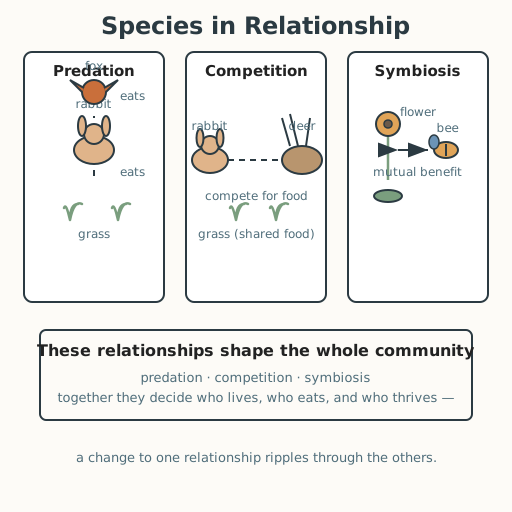
- Have the worked example ready: grass → rabbit → fox (predation); rabbit and deer on the same grass (competition); bee and flower (symbiosis/mutualism).
- Retrieval: recall from Grade 5–6 (D06.S2.05.01, D06.S2.06.02) how energy moves through a food web.
Facilitator note
This lesson is written to the learner (“you”). The ideas to land: (1) predation — one
species eats another; (2) competition — two species use the same limited resource; (3)
symbiosis — two species live closely together, and in mutualism both benefit; and (4) these
relationships, together, structure a community. Use explicit instruction with the
grass–rabbit–fox worked example first, then the string-web for embodied practice (Kirschner,
Sweller & Clark, 2006). These are standard concepts in ecology; classic examples are real:
lichens (a fungus and algae living together), clownfish and sea anemones, oxpeckers and large
mammals, nitrogen-fixing bacteria in legume roots. The environment lens (docs/philosophy.md
§4): removing one species can cascade — wolves were wiped out of Yellowstone by the 1920s, and
their return in 1995–1996 reduced elk numbers and browsing, helping some willows and aspen
recover (a real, well-studied — though complex and still-contested — trophic cascade; the
simplified “wolves changed the rivers” story overstates it). The egalitarian and global lens:
cooperation is as real in nature as competition; symbiosis shows
that “nature red in tooth and claw” is only half the story — living things also depend on
each other. This counters the misuse of “competition” as a social rule.
Procedure
- Gather (5 min). Quick recall: what three ingredients make populations change over time? (Variation, inheritance, selection.) Today we zoom out: how do species relate to each other?
- Meet the three relationships (10 min). Predation: one species eats another (fox → rabbit → grass). Competition: two species use the same limited resource (rabbit and deer both eat grass). Symbiosis: two species live closely together; in mutualism, both benefit (bee gets nectar, flower gets pollinated).
- Worked example (5 min). Classify aloud: a lion and a gazelle (predation); two birds eating the same berries (competition); a clownfish and an anemone (symbiosis, mutualism).
- Build the web (20 min). With string, each learner becomes a species in a small community. Pass string from food to eater (predation), tie two species to the same food (competition), and join two helpers (symbiosis). Now pull one string: what ripples?
- Classify (5 min). Sort your relationship cards into the three types with a partner, and name one real example of each from your own place.
- Close (5 min). Predation, competition, and symbiosis are the threads that weave a community together — and a change to one thread pulls on the rest.
Differentiation
- Support: Use only “who eats whom” (predation) first, then add one competition and one symbiosis example; describe the web aloud so learners with low vision can follow.
- Extension: Trace a trophic cascade (e.g., wolves in Yellowstone): explain how removing wolves let elk over-browse willows and aspen, and how their return reduced elk and helped some of those plants recover.
Assessment
- Formative (observation/self): Can the learner classify a species pair into predation, competition, or symbiosis and describe one ripple effect of a change?
- Self-check: The learner asks, “Did I name the relationship precisely (who eats whom, who shares a resource, who helps whom) and connect it to the wider community?”
Home connection
Find one real species relationship near you — a bird eating an insect, two animals eating the same fruit, a bee on a flower. Name which of the three it is and share it next time.
Resources
- Predation, competition, and symbiosis are standard concepts in ecology; documented examples
include lichens (fungus + algae), clownfish and sea anemones, oxpeckers and large mammals,
and nitrogen-fixing bacteria in legume roots. The wolf–Yellowstone case is a real,
well-studied trophic cascade: wolves were extirpated by the 1920s and reintroduced in
1995–1996; their return reduced elk numbers and browsing, and willow/aspen recovery followed
in places — though the ecosystem’s response has been complex and the simplified “wolves
changed the rivers” story is contested in the ecological literature. The value that
cooperation is as real in nature as competition is a value commitment, not an ecological
claim (
docs/philosophy.md§4–5). - On explicit instruction for novice content: Kirschner, Sweller & Clark (2006), https://doi.org/10.1207/s15326985ep4102_1