Lesson 05 — Natural Selection Shapes Populations
Learners assemble the complete engine of change: variation + inheritance + selection = populations change over time. They order the four steps, then apply them to the classic peppered-moth case and a simple seed hunt — learning that the environment selects without choosing on purpose.
Objectives
Objectives
- D06.S2.07.01 Explain how variation, inheritance, and natural selection shape populations over time using evidence.
Essential question
How do variation, inheritance, and the environment combine to change a population over time?
Key vocabulary
Materials
Standard materials
- Selection sequence cards · 1 set per pair The four steps of natural selection (variation → environment selects → survivors reproduce → population shifts) to order and explain
- Peppered-moth page · 1 per learner A page with light and dark moths on light and sooty bark, for predicting which survive in each environment
- Highlighters · per learner
Low-tech / no-cost
- Bean or seed hunt Scatter mixed seeds (some matching the ground) and "hunt" the ones that stand out; see which are left — no cards needed
- Voice and body Act out the four steps with partners — vary, select, reproduce, shift — and chant the sequence together
Enriched / lab & device
- A short video on a real case of selection · 1 A brief clip on Darwin's finches or peppered moths showing selection in real populations
- A class selection timeline · 1 A shared display where learners add a real example of selection (beaks, moths, bacteria) across the unit
Works in different contexts
- large-group Order the four steps together on the board, then have pairs work the moth page and report one prediction each
- multi-age Younger learners do the seed hunt (selecting by hand); older learners explain why the surviving trait becomes more common
- self-directed A learner orders the sequence cards and completes the moth page alone, checking predictions against the worked example
- level-grouped Learners ready to extend compare two real cases (finch beaks and peppered moths) and name the selective pressure in each
- outdoor-only Run the seed hunt outdoors on real ground; discuss which colors are "hidden" and which "stand out" to a searching eye
Lesson 5 — Natural Selection Shapes Populations
Summary
Learners assemble the complete engine of change: variation + inheritance + selection = populations change over time. They order the four steps, then apply them to the classic peppered-moth case and a simple seed hunt — learning that the environment selects without choosing on purpose.
Objectives
- Explain how variation, inheritance, and natural selection shape populations over time using evidence. (D06.S2.07.01)
Connection
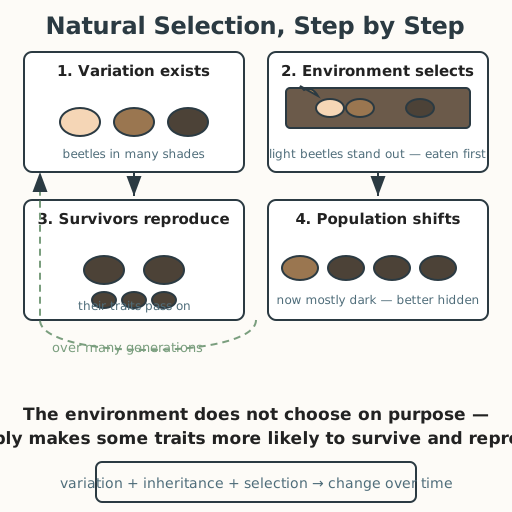
Imagine a field of beetles in many shades living on dark tree bark. A bird hunts them. The light beetles stand out and are eaten first; the dark ones blend in and survive to leave offspring. After many generations, most of the beetles are dark. Nothing “decided” this — the environment simply made one trait more likely to survive and reproduce. This same quiet process shapes fish in coral reefs, plants in deserts, and bacteria in our bodies, everywhere on Earth.
Materials
- Selection sequence cards
- Peppered-moth page
- Highlighters
Preparation
- Copy the selection sequence cards and the peppered-moth page.
- Have the worked example ready: light and dark peppered moths on light vs. sooty bark; the soot (from industry) changed which moths were hidden, so the dark form became more common.
- Retrieval: recall variation and inheritance from Lesson 4 — selection needs both.
Facilitator note
This lesson is written to the learner (“you”). The idea to land: natural selection is not
random choice and not a “goal” — it is the result of (1) variation, (2) inheritance, and (3)
different survival/reproduction in an environment, repeated over generations. Use explicit
instruction and the moth worked example first (Kirschner, Sweller & Clark, 2006). The
peppered moth (Biston betularia) is a real, documented case: dark (“carbonaria”) moths
became much more common in sooty industrial areas in 19th–20th century England, then declined
again as air was cleaned (Kettlewell’s classic experiments, later refined; the pattern of
change is well established). Darwin’s finches in the Galápagos show real, measured beak-size
shifts across drought years (Grant & Grant, Princeton). Hold origins lightly: natural
selection describes how populations change, not what life “means” — that is a different
question, held open alongside other ways of knowing (docs/philosophy.md §11). The ethical
lens: “survival of the fittest” was often misused to justify cruelty toward people — a misuse
we reject; selection describes beetles and finches, not a rule for how humans should treat
each other. The global lens: the same process is visible in crops and livestock people have
shaped on every continent.
Procedure
- Gather (5 min). Quick recall: what two facts did we meet last time? (Variation; inheritance.) Today we add the third ingredient that makes change happen.
- The four steps (10 min). Order the sequence: (1) Variation exists. (2) The environment selects — some traits survive and reproduce more. (3) Survivors pass their traits on. (4) Over generations, the population shifts toward those traits.
- Worked example (10 min). The peppered moth: on light, lichen-covered bark, light moths are hidden and dark moths stand out; on sooty bark, it flips. When industry darkened the bark, dark moths survived and reproduced more, and became common. When the air was cleaned, light moths returned. The environment changed, so which trait was favored changed.
- Predict (15 min). On your peppered-moth page, predict which moth survives on light bark and which on dark bark, and say why. Then run the seed hunt: scatter mixed seeds, hunt the ones that stand out, and see which are “left” — the hidden ones.
- Apply (5 min). Name the four steps for a real case: finches with different beaks on an island where the main food changed — which beak survived and reproduced more?
- Close (5 min). Variation + inheritance + selection, over many generations, is how populations change. The environment selects without choosing on purpose.
Differentiation
- Support: Use the seed hunt as the main activity and describe each step aloud; provide the four steps as a sentence starter to order.
- Extension: Compare two real cases (finch beaks and peppered moths) and state the selective pressure (food type, predation) in each, and what changed.
Assessment
- Formative (observation/self): Can the learner order the four steps and predict which variant becomes more common in a given environment, with a reason?
- Self-check: The learner asks, “Did I connect variation to survival to reproduction to a shift over generations — not just one individual’s luck?”
Home connection
Look for variation in a plant or animal near you and imagine one small change in the environment (more shade, a new predator, drier soil). Which variant would survive and reproduce more, and why?
Resources
- Natural selection is a foundational, well-evidenced explanation in biology: Charles Darwin,
On the Origin of Species (1859). The peppered moth case (Biston betularia) is a
documented example of selection (Kettlewell’s mid-20th-century experiments and later
refinements); Darwin’s finches show measured beak-size change across drought years (Peter
and Rosemary Grant, Princeton University). The value that “survival of the fittest” must
not be misused against people is a value commitment, not a biological claim
(
docs/philosophy.md§4–5). - On explicit instruction for novice content: Kirschner, Sweller & Clark (2006), https://doi.org/10.1207/s15326985ep4102_1