Lesson 08 — Forces in Everyday Motion
Learners apply force, mass, and acceleration to everyday motion: balanced forces mean steady motion (or rest), unbalanced forces mean speeding up or slowing down. They meet the two everyday forces — gravity and friction — and classify real scenes.
Objectives
Objectives
- D06.S3.07.01 Explain force, mass, and acceleration and use them to describe everyday motion.
Essential question
Why do some things stay still or move steadily, while others speed up or slow down?
Key vocabulary
Materials
Standard materials
- Everyday-forces scenario cards · 1 set per pair Scenes (a box at rest, a sliding sled, a car braking, a falling leaf, a book on a table) to classify as balanced or unbalanced
- Force-arrow page · 1 per learner A page of objects with blank arrows for drawing push, friction, and gravity
- Objects to slide · per group A book, a bottle, and a rough/smooth surface to feel friction
Low-tech / no-cost
- Found objects and body Slide a stone or shoe across rough and smooth ground; push a wall (balanced) and a light object (unbalanced) — no cards needed
- Voice and body Act out balanced (push both ways, no move) and unbalanced (one wins) with a partner
Enriched / lab & device
- A force sensor or spring scale · 1 per group To measure the push needed to start sliding on different surfaces (friction)
- A video on gravity and friction in sport · 1 A short clip of sliding, braking, and free-fall to connect forces to real motion
Works in different contexts
- large-group Demonstrate a balanced and an unbalanced force for all, then have pairs classify the scenario cards
- multi-age Younger learners feel friction and say "it stops it"; older learners name balanced vs. unbalanced and the forces involved
- self-directed A learner slides objects on rough and smooth surfaces and fills the force-arrow page alone, checking against the worked example
- level-grouped Learners ready to extend combine F = ma with balanced/unbalanced forces — a bigger net force on the same mass gives a bigger acceleration
- outdoor-only Slide a stone on gravel and on smooth stone outdoors; push a heavy and light object and name the balanced and unbalanced cases
Lesson 8 — Forces in Everyday Motion
Summary
Learners apply force, mass, and acceleration to everyday motion: balanced forces mean steady motion (or rest), unbalanced forces mean speeding up or slowing down. They meet the two everyday forces — gravity and friction — and classify real scenes.
Objectives
- Explain force, mass, and acceleration and use them to describe everyday motion. (D06.S3.07.01)
Connection
A book sits still on a table; a sled glides then stops; a car brakes at a crossing; a leaf falls and drifts. Why does the book not move, the sled slow down, and the leaf speed up then settle? The answer is always the same: when forces balance, motion stays steady; when they do not, motion changes. Gravity pulls things down; friction resists sliding. These two forces — and whether they balance — explain nearly every movement you make today.
Materials
- Everyday-forces scenario cards
- Force-arrow page
- Objects to slide
Preparation
- Copy the scenario cards and force-arrow page; gather objects and rough/smooth surfaces.
- Have the worked example ready: a box pushed with a force equal to friction stays still (balanced); push harder than friction and it speeds up (unbalanced).
- Retrieval: recall F = m × a from Lesson 7 — acceleration happens only when a net force acts.
Facilitator note
This lesson is written to the learner (“you”). The ideas to land: (1) balanced forces → no
change in motion (steady or at rest); (2) unbalanced forces → change in motion (speed up or
slow down); (3) gravity and friction are the two everyday forces, and (4) this is just F = ma
in action — a net force causes acceleration. Use explicit instruction with the pushed-box
worked example first, then hands-on sliding (Kirschner, Sweller & Clark, 2006). This extends
Newton’s first and second laws (Newton, Principia, 1687), foundational physics. The
technology lens (docs/philosophy.md §4): understanding friction and gravity is why brakes,
tires, ramps, and roads work — and why engineers shape surfaces the way they do; this is
applied physics, not abstract. The egalitarian lens: these ideas describe a bicycle in a
village and a satellite in orbit alike; no learner is excluded from understanding them. The
global lens: friction was mastered (sleds, sledges, bearings) and gravity harnessed (ramps,
water wheels, plumb lines) in many ancient cultures before the laws were named.
Procedure
- Gather (5 min). Quick recall: what is the rule that links force, mass, and acceleration? (F = m × a.) Today you use it to explain everyday motion.
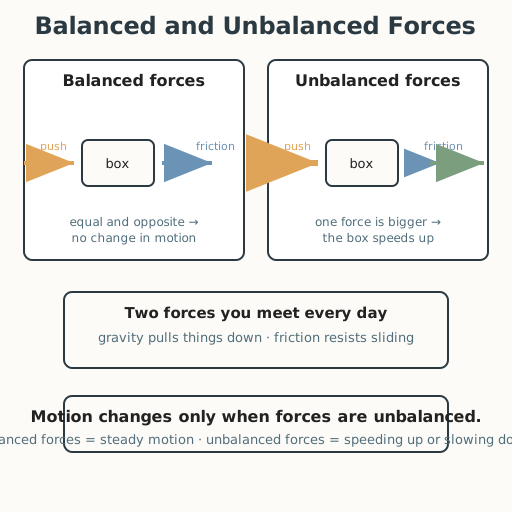
- Meet balanced and unbalanced (10 min). Balanced forces: equal pushes/pulls in opposite directions cancel — motion stays the same (a book at rest, a sled gliding at steady speed). Unbalanced forces: one force is bigger — motion changes (the sled slowing as friction wins, a car speeding up).
- Two everyday forces (5 min). Gravity pulls things toward the ground. Friction resists sliding between surfaces. They are the forces you meet constantly.
- Worked example (5 min). A box on the floor: push it with exactly the force of friction → balanced → it stays still (or moves steadily). Push harder → unbalanced → it speeds up.
- Feel and classify (20 min). Slide a book on a smooth and a rough surface — where is friction greater? Then sort your scenario cards as balanced or unbalanced, and draw the force arrows on your page for each.
- Close (5 min). Motion changes only when forces are unbalanced. Balanced = steady; unbalanced = speed up or slow down. That is the everyday law of motion.
Differentiation
- Support: Use only the sliding activity and two scenario cards; describe each aloud so learners with low vision can follow.
- Extension: Combine the two lessons: given a net force and a mass, predict whether the acceleration is large or small (F = ma), for one simple number pair.
Assessment
- Formative (observation/self): Can the learner classify a scene as balanced or unbalanced and name the forces (push, friction, gravity) at work?
- Self-check: The learner asks, “Did I say whether the forces cancel or not, and did I connect that to a change (or no change) in motion?”
Home connection
Find one balanced and one unbalanced force at home today (a book at rest vs. a door being pushed open). Name the forces in each and share what you found.
Resources
- Balanced/unbalanced forces and their link to motion are Newton’s first and second laws:
Isaac Newton, Principia Mathematica (1687). Gravity and friction are everyday forces
described in the same framework. The claim that friction and gravity were harnessed across
ancient cultures (sledges, ramps, water wheels, plumb lines) is documented history. The value
that physics is for everyone is a value commitment, not a physical law (
docs/philosophy.md§4). - On explicit instruction for novice content: Kirschner, Sweller & Clark (2006), https://doi.org/10.1207/s15326985ep4102_1