Lesson 09 — Waves Carry Energy
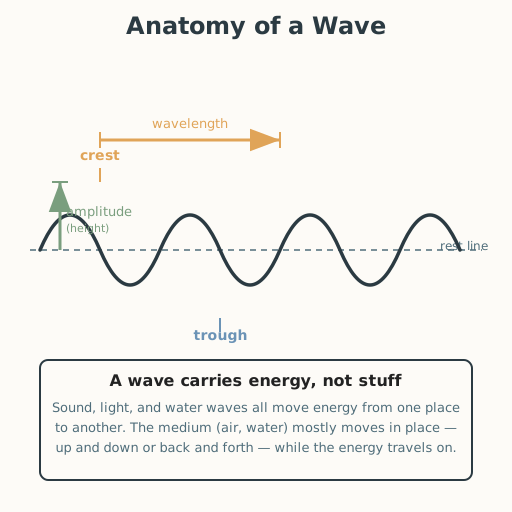
Learners meet the central fact about waves: they carry energy without carrying the medium along. With ropes, water, and their own bodies, they make waves, watch a floating object bob in place, and label the parts — crest, trough, amplitude, wavelength.
Objectives
Objectives
- D06.S3.07.02 Describe how waves (such as sound, light, and water) carry energy and relate wave properties to what we observe.
Essential question
How do sound, light, and water waves carry energy from one place to another?
Key vocabulary
Materials
Standard materials
- Rope or spring for wave-making · 1 per group A rope (or slinky) for making transverse and longitudinal waves to see energy travel
- Wave-anatomy page · 1 per learner A page with a blank wave to label crest, trough, amplitude, and wavelength
- A shallow tray of water · 1 per group For observing water waves and a floating object bobbing in place
Low-tech / no-cost
- Body waves Make a "stadium wave" with partners — each person rises and falls in place while the wave travels along; no rope or tray needed
- Voice and hand Pluck or speak to feel vibration; describe how energy travels while the air (or string) moves in place
Enriched / lab & device
- A slinky and a wave simulator app · 1 per group To compare transverse and longitudinal waves and see amplitude and wavelength change
- A video of ocean waves and a floating buoy · 1 Shows a buoy bobbing in place while waves pass — energy travels, the water mostly does not
Works in different contexts
- large-group Do one group rope-wave and one stadium wave together, then have groups label the wave on their page
- multi-age Younger learners feel the wave and say "energy moved"; older learners label crest, trough, amplitude, and wavelength
- self-directed A learner makes a rope wave, observes a floating object bob in place, and labels the wave page alone
- level-grouped Learners ready to extend distinguish transverse (up-and-down) from longitudinal (back-and-forth) waves with the slinky
- outdoor-only Use a rope or a line of people outdoors; drop a leaf in moving water and watch it bob in place as ripples pass
Lesson 9 — Waves Carry Energy
Summary
Learners meet the central fact about waves: they carry energy without carrying the medium along. With ropes, water, and their own bodies, they make waves, watch a floating object bob in place, and label the parts — crest, trough, amplitude, wavelength.
Objectives
- Describe how waves (sound, light, water) carry energy and relate wave properties to what we observe. (D06.S3.07.02)
Connection
Drop a leaf on a pond and watch a ripple pass. The leaf bobs up and down but does not travel with the ripple — the energy travels across the water while the water itself mostly stays put. A guitar string vibrates and the air carries the sound to your ear; sunlight crosses empty space to warm your face. Sound, light, and water waves are all the same trick: energy moving from one place to another while the medium — air, water, string — moves in place.
Materials
- Rope or spring for wave-making
- Wave-anatomy page
- A shallow tray of water
Preparation
- Gather ropes (or slinkies) and a shallow tray of water; float a small object (a leaf, a cork) in it.
- Have the worked example ready: a rope wave with labeled crest, trough, amplitude, and wavelength.
- Retrieval: recall from Grade 2–4 (D06.S3.02.02, D06.S3.04.01) that sound, light, and heat are forms of energy that move.
Facilitator note
This lesson is written to the learner (“you”). The ideas to land: (1) a wave transfers
energy, not matter — the medium moves in place while the energy travels; (2) waves have parts:
crest (high), trough (low), amplitude (height), wavelength (distance between repeats); and (3)
sound, light, and water are all wave-carried energy. Use explicit instruction with the rope
worked example first, then embodied practice (Kirschner, Sweller & Clark, 2006). These are
standard concepts in physics (wave mechanics). The environment lens (docs/philosophy.md §4):
waves are how Earth moves energy around — ocean waves shape coastlines, and the Sun’s light
(an electromagnetic wave) powers nearly all life. The global lens: every coastal people has
read waves to fish, sail, and navigate; the physics is one, the uses are many. The egalitarian
lens: a wave in a bucket and a wave on the open ocean obey the same rules — understanding is
not reserved for the rich or the few.
Procedure
- Gather (5 min). Think of a wave you have seen or heard today — a ripple, a sound, a breeze. What actually travels in a wave?
- Meet the key idea (10 min). A wave is energy moving through a medium. The medium itself moves in place — up and down (a rope) or back and forth (a sound in air) — while the energy travels onward. Sound, light, and water are all waves in this sense.
- Label the parts (10 min). On a wave: the crest is the highest point, the trough the lowest. Amplitude is the height from rest to crest. Wavelength is the distance from one crest to the next. Label these on your page.
- Make waves (20 min). Work with a partner: shake a rope and watch the wave travel while your hands stay put. Do a “stadium wave” — each person rises in place while the wave moves around. Drop a leaf in your water tray: does it travel with the ripple, or bob in place? Write what you observe.
- Close (5 min). Waves carry energy, not stuff. Tomorrow you will see how wave properties become what you observe — pitch, loudness, and color.
Differentiation
- Support: Use only the rope and stadium wave; describe the leaf’s bobbing aloud so learners with low vision can follow.
- Extension: With a slinky, distinguish a transverse wave (up-and-down, like a rope) from a longitudinal wave (back-and-forth, like sound in air).
Assessment
- Formative (observation/self): Can the learner explain that a wave carries energy while the medium moves in place, and label amplitude and wavelength?
- Self-check: The learner asks, “Did I say energy travels while the medium stays put — and did I point to the crest, trough, amplitude, and wavelength?”
Home connection
Watch a ripple in water or a rope, or feel a sound’s vibration. Notice that energy travels while the medium moves in place. Describe what you observed.
Resources
- Waves transfer energy without transferring matter — a foundational result in physics (wave
mechanics). The electromagnetic nature of light and the mechanical nature of sound and water
waves are standard science; light (an electromagnetic wave) powers photosynthesis, the basis
of nearly all life. The value that understanding waves belongs to everyone is a value
commitment, not a physical claim (
docs/philosophy.md§4). - On explicit instruction for novice content: Kirschner, Sweller & Clark (2006), https://doi.org/10.1207/s15326985ep4102_1