Lesson 12 — Reading Deep Time
Learners read Earth's deep past through three kinds of evidence — fossils, rock layers, and ice cores — and meet deep time: the Earth is about 4.6 billion years old. They build and read a layer stack, order the evidence, and hold origins as models with evidence, alongside other ways of knowing.
Objectives
Objectives
- D06.S4.07.02 Explain how evidence (such as fossils, rock layers, and ice cores) tells the story of deep time and past life.
Essential question
How do fossils, rock layers, and ice cores tell the story of deep time and past life?
Key vocabulary
Materials
Standard materials
- Deep-time evidence cards · 1 set per pair Cards for fossils, rock layers (stratigraphy), and ice cores, each showing what it reveals about the past
- Layered-past page · 1 per learner A page with a blank stack of layers (and an ice-core column) to label oldest-to-youngest and place a fossil
- Layered sand or paper strips · per group To build a physical stack of "layers" and bury a small object, then read it oldest-to-youngest
Low-tech / no-cost
- Found layers Look at a real cut in soil or rock, or stack different-colored soils/leaves; read it oldest (bottom) to youngest (top)
- Voice and body Line up as "layers" with the oldest at the back, and tell the story of what each layer holds; no cards needed
Enriched / lab & device
- Photos of real fossils, strata, and ice cores · 1 set Images of the Grand Canyon's layers, a fossil bed, and a real ice core to discuss
- A short video on geologic time · 1 A brief clip compressing Earth's 4.6-billion-year history to help feel deep time
Works in different contexts
- large-group Build one class layer-stack with learners as layers, then have pairs order the evidence cards oldest-to-youngest
- multi-age Younger learners build and read the physical layer stack; older learners explain how ice cores record past air
- self-directed A learner orders the evidence cards and labels the layered-past page alone, checking against the worked example
- level-grouped Learners ready to extend compare two kinds of evidence (fossils vs. ice cores) and say what each is best at revealing
- outdoor-only Find a real exposure of soil or rock layers outdoors and read it bottom (oldest) to top (youngest); note any change in color or texture
Lesson 12 — Reading Deep Time
Summary
Learners read Earth’s deep past through three kinds of evidence — fossils, rock layers, and ice cores — and meet deep time: the Earth is about 4.6 billion years old. They build and read a layer stack, order the evidence, and hold origins as models with evidence, alongside other ways of knowing.
Objectives
- Explain how evidence (fossils, rock layers, ice cores) tells the story of deep time and past life. (D06.S4.07.02)
Connection
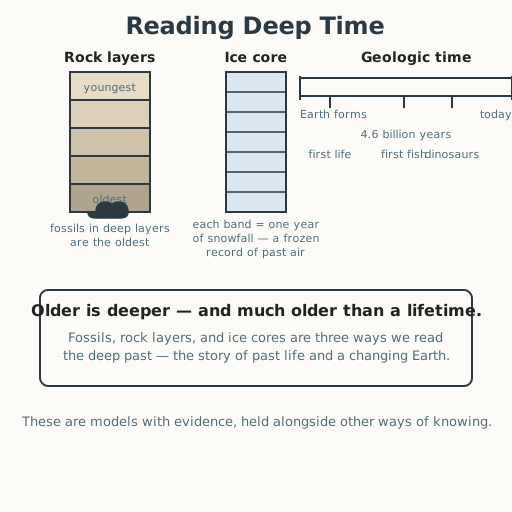
Stand at a cliff cut by a river and you may see stripes of rock, one on top of another — the deeper stripes are older. Crack open the right rock and you may find the shape of a shell or a leaf that lived long ago. Drill into a great ice sheet and each annual band of ice holds a bubble of the air that year. Together these are a book the Earth has been writing for billions of years. Reading it — oldest at the bottom, newest at the top — is how we know about dinosaurs, ice ages, and life far older than any human.
Materials
- Deep-time evidence cards
- Layered-past page
- Layered sand or paper strips
Preparation
- Copy the evidence cards and the layered-past page; gather sand/paper strips for layer stacks.
- Have the worked example ready: a stack of layers, a fossil in the deepest layer — the fossil is older than the layers above it (the principle of superposition).
- Retrieval: recall from Grade 4 (D06.S4.04.02) that fossils and rock layers give clues about Earth’s long history.
Facilitator note
This lesson is written to the learner (“you”). The ideas to land: (1) in undisturbed rock,
deeper layers are older (superposition); (2) fossils in those layers tell us what lived then;
(3) ice cores record past air, year by year; and (4) all together they reveal deep time — an
Earth about 4.6 billion years old. Use explicit instruction with the layer-stack worked
example first, then hands-on building (Kirschner, Sweller & Clark, 2006). The superposition
principle, the fossil record, and ice-core science (e.g., the Vostok and Greenland cores) are
established geology, summarized by the USGS and IPCC. Critically, hold origins as the Overview
directs: these are models with evidence, held as inquiry alongside other ways of knowing,
never as creed (docs/philosophy.md §11). Different peoples hold different stories of how the
world and life began; this lesson teaches how scientists read evidence, not what anyone
must believe. The global lens: every culture has looked at fossils (found shells on
mountaintops, bones in the earth) and wondered; science gives one rigorous way to read them.
The environment lens: deep time gives perspective on how slowly — and how fast — Earth can
change, which matters for how we care for it now.
Procedure
- Gather (5 min). Think of the oldest thing you have ever held — a stone, a shell, a grandparent’s story. How do we know how old the Earth itself is?
- Three kinds of evidence (10 min). (1) Rock layers: in undisturbed rock, the deeper a layer, the older it is. (2) Fossils: the shapes of past life trapped in those layers. (3) Ice cores: long columns of ice whose yearly bands trap bubbles of past air.
- Worked example (5 min). A stack of layers: top = youngest, bottom = oldest. A fossil in the deepest layer is older than everything above it. Draw this on your page.
- Build and read (20 min). Layer your sand or paper strips, bury a small “fossil” in one layer, then “read” your stack oldest-to-youngest. Order your evidence cards: which tells us about deep past life? about past air? Check with a partner.
- Deep time (5 min). The Earth formed about 4.6 billion years ago. On that scale, all of human history is the last sliver. Add the milestones (first life, first fish, dinosaurs) to your time bar.
- Close (5 min). Fossils, layers, and ice are a book the Earth wrote. We read it as a model with evidence — one story among the many peoples tell about beginnings.
Differentiation
- Support: Use only the layer-stack activity and describe each step aloud so learners with low vision can follow; provide “older” and “younger” labels to place.
- Extension: Compare two kinds of evidence — fossils (reveal past life) and ice cores (reveal past air and temperature) — and state what each is best at showing.
Assessment
- Formative (observation): Can the learner order layers oldest-to-youngest and explain what a fossil or ice band reveals?
- Artifact (portfolio): The completed layered-past page (labeled layers + placed fossil), kept as the unit’s deep-time evidence note.
Home connection
Find a place where layers show (a riverbank, a road cut, a stack of old papers or sediment). Read it oldest-to-youngest and describe one thing each layer might hold.
Resources
- The principle of superposition, the fossil record, and ice-core science are established
geology: the USGS explains rock layers and geologic time
(https://www.usgs.gov/), and ice-core records of past atmosphere are summarized by the
IPCC (https://www.ipcc.ch/). The age of Earth (~4.6 billion years) is standard, well-evidenced
geology. The framing that origins are models with evidence held alongside other ways of
knowing is a value commitment, not a geological fact (
docs/philosophy.md§11). - On explicit instruction for novice content: Kirschner, Sweller & Clark (2006), https://doi.org/10.1207/s15326985ep4102_1