Lesson 11 — Atmosphere, Oceans, and Land Shape Climate
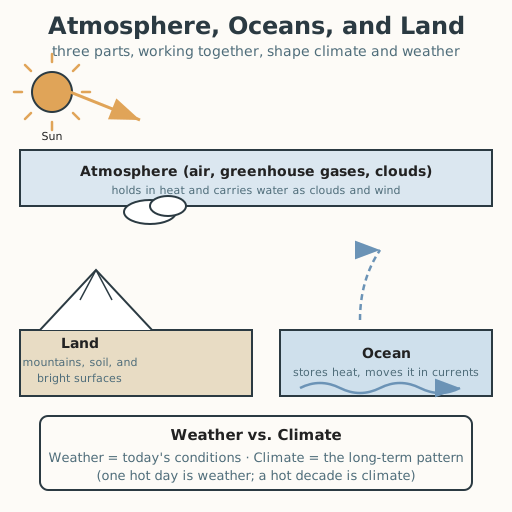
Learners assemble Earth's climate machine: the Sun heats the land and ocean unevenly; the atmosphere holds heat and carries water; the ocean stores and moves heat in currents. They learn the crucial difference between weather (today) and climate (the long-term pattern).
Objectives
Objectives
- D06.S4.07.01 Explain how the atmosphere, oceans, and land interact to shape climate and weather.
Essential question
How do the atmosphere, oceans, and land work together to create weather and climate?
Key vocabulary
Materials
Standard materials
- Climate-system diagram cards · 1 set per pair Cards for the Sun, atmosphere, ocean, and land with arrows (heat, water, wind) to assemble into a system
- Weather-vs-climate page · 1 per learner A page to sort everyday statements as weather (today) or climate (long-term pattern)
- A shallow pan of water and a warm spot · per group To watch evaporation (water to air) and connect it to the water cycle
Low-tech / no-cost
- Body and found objects Act out the Sun, air, ocean, and land moving heat and water; sort statements aloud as weather or climate — no cards needed
- Local weather memory Compare today's weather with the climate learners know for their region (rainy season, dry season, monsoons)
Enriched / lab & device
- A climate-zone map · 1 A map of world climate zones (tropical, temperate, polar, dry) to connect the system to real places
- A video of ocean currents and weather · 1 A short clip showing how ocean currents move heat and shape rainfall
Works in different contexts
- large-group Assemble the system diagram together on the board, then have pairs sort weather-vs-climate statements
- multi-age Younger learners sort "today" vs. "most years"; older learners explain how ocean and land move heat to shape climate
- self-directed A learner assembles the diagram cards and sorts the statements alone, checking against the worked example
- level-grouped Learners ready to extend explain why a coastal place and an inland place at the same latitude can have different climates (ocean's moderating effect)
- outdoor-only Observe today's weather outdoors and name what part of the system (sun, wind, water, land) is making it; compare with the region's climate
Lesson 11 — Atmosphere, Oceans, and Land Shape Climate
Summary
Learners assemble Earth’s climate machine: the Sun heats land and ocean unevenly; the atmosphere holds heat and carries water; the ocean stores and moves heat in currents; the land shapes how heat and rain fall. They learn the crucial difference between weather (today) and climate (the long-term pattern).
Objectives
- Explain how the atmosphere, oceans, and land interact to shape climate and weather. (D06.S4.07.01)
Connection
Why is a coastal town cooler in summer than an inland town at the same latitude? Why does a mountain’s windward side get rain while the other side is dry? Why is one hot day not the same as a hot decade? The answers live in one system: the Sun heats the Earth unevenly, the ocean stores and carries that heat, the atmosphere holds heat and moves water, and the land — mountains, soil, bright ice — shapes what happens. Weather is the day-to-day mood of this system; climate is its long-term personality.
Materials
- Climate-system diagram cards
- Weather-vs-climate page
- A shallow pan of water and a warm spot
Preparation
- Copy the diagram cards and the weather-vs-climate page; set up the evaporation pan.
- Have the worked example ready: “It rained yesterday” is weather; “it rains every summer in the monsoon” is climate.
- Retrieval: recall from Grade 4 (D06.S4.04.01) the water cycle — evaporation, condensation, rain.
Facilitator note
This lesson is written to the learner (“you”). The ideas to land: (1) the climate system is
the Sun + atmosphere + ocean + land interacting; (2) weather is short-term, climate is the
long-term pattern; and (3) oceans move huge amounts of heat, so they shape climate far beyond
their shores. Use explicit instruction with the weather-vs-climate worked example first, then
hands-on assembly (Kirschner, Sweller & Clark, 2006). These are established Earth-science
facts; the greenhouse effect (atmospheric gases holding heat) is described by the
Intergovernmental Panel on Climate Change (IPCC) and NOAA. The environment lens
(docs/philosophy.md §4): this is the system human activity is now warming — the same
greenhouse layer that keeps Earth livable can be thickened by burning fuels (a Grade 9 topic,
introduced lightly here). The global lens: climate looks different everywhere — monsoons in
South Asia, wet and dry seasons in the tropics, cold winters in high latitudes — but it is all
one connected system. The egalitarian lens: the people least responsible for climate change are
often hit hardest by it; understanding the system is a step toward fairness and care.
Procedure
- Gather (5 min). Quick recall: what carries energy in sound and light? (Waves.) Today we look at how Earth itself moves energy around — and makes weather and climate.
- Meet the system (10 min). Four players: the Sun heats unevenly; the ocean stores heat and carries it in currents; the atmosphere holds heat (greenhouse gases) and moves water as clouds and wind; the land (mountains, soil, ice) shapes heat and rain. Assemble your diagram cards to show heat and water moving among them.
- Weather vs. climate (10 min). Weather = today’s conditions (rain, wind, heat). Climate = the long-term pattern (a rainy season, a hot decade). Worked example: “It rained yesterday” is weather; “the monsoon comes every year” is climate.
- Sort and observe (20 min). Sort your statements as weather or climate. Then set your pan of water in a warm spot and watch evaporation — water leaving the ocean for the air, the first step of rain.
- Close (5 min). One system — Sun, atmosphere, ocean, land — makes both today’s weather and the climate of whole regions. Tomorrow you will read the deep story this Earth has written.
Differentiation
- Support: Use only weather-vs-climate sorting with sentence starters (“___ happened today = weather; ___ happens every year = climate”); describe the diagram aloud.
- Extension: Explain the ocean’s moderating effect: water warms and cools slowly, so coastal places have milder climates than inland places at the same latitude.
Assessment
- Formative (observation/self): Can the learner sort weather from climate and name the roles of atmosphere, ocean, and land in the system?
- Self-check: The learner asks, “Did I distinguish today’s weather from the long-term climate, and did I connect heat and water to all three parts of the system?”
Home connection
Note today’s weather at home, then ask someone older what the climate (the usual pattern) is for your region across the year. Compare the two.
Resources
- The climate system (Sun + atmosphere + ocean + land) and the greenhouse effect are
established Earth science, summarized authoritatively by the Intergovernmental Panel on
Climate Change (https://www.ipcc.ch/) and NOAA. The claim that the oceans store and
transport large amounts of heat, moderating coastal climates, is standard oceanography. The
value that those least responsible for climate change are often most affected is a value
commitment, not a geophysical fact (
docs/philosophy.md§4). - On explicit instruction for novice content: Kirschner, Sweller & Clark (2006), https://doi.org/10.1207/s15326985ep4102_1