Lesson 01 — Art with a Message: Finding My Personal Voice
Learners identify a personal message they want to communicate and plan how to carry it through an artwork using a symbol, color, and composition. They meet the idea that art carries messages in living traditions around the world — adinkra cloth symbols are Akan proverbs worn on cloth — then choose their own message and begin the artwork they will revise after feedback in the next lesson.
Objectives
Objectives
- D07.S1.07.01 Create an artwork that communicates a personal message and revise it after feedback.
Essential question
What do I want to say, and how can an artwork carry that message to another person?
Key vocabulary
Materials
Standard materials
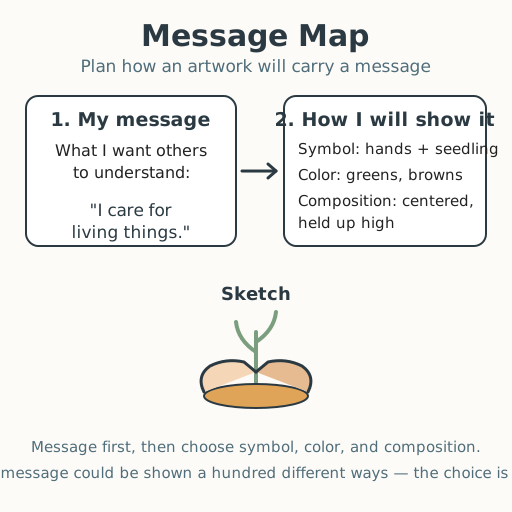
- Message-map poster · 1 The worked example from the message-map graphic: 'I care for living things' planned into a symbol, color, and composition
- Message-map page · 1 per learner A blank two-step page — '1. My message' and '2. How I will show it (symbol, color, composition)' — with space for a sketch
- Drawing paper and mark-makers · per learner Paper and anything that marks — pencil, charcoal, crayon, pastel, ink — for the artwork begun today and revised next lesson
Low-tech / no-cost
- Ground, sand, or chalk and a stick Plan the message map in earth or with chalk on stone; no paper or purchased marks needed
- Voice and body Say the message aloud and 'draw' the symbol in the air with a finger, explaining the choice; no paper needed
Enriched / lab & device
- Examples of message-carrying art · 1 set Printed or projected images of adinkra cloth symbols (Akan, Ghana), a street mural, and a protest poster — each carrying a clear message — to discuss what each is 'saying'
- Digital sketch tool · 1 per learner A tablet or laptop app for planning the composition and trying color choices before the final artwork
Works in different contexts
- large-group Work one message-map example together on the board, then have learners plan their own in pairs and share one sentence each in a whip-around
- multi-age Younger learners state a message and one symbol; older learners name the message, symbol, color, and composition and explain how the three work together
- self-directed A learner fills the message map for one real, safe message of their own and sketches the plan alone, then begins the artwork
- level-grouped Learners ready to extend choose two different symbols for the same message and explain which one is stronger and why
- outdoor-only Gather found objects — a leaf, a stone, a seed — and arrange one that could stand for the learner's message, then say the message aloud; no paper needed
Lesson 1 — Art with a Message: Finding My Personal Voice
Summary
Learners identify a personal message they want to communicate and plan how to carry it through an artwork using a symbol, color, and composition. They meet the idea that art carries messages in living traditions around the world — adinkra cloth symbols are Akan proverbs worn on cloth — then choose their own message and begin the artwork they will revise after feedback in the next lesson.
Objectives
- Create an artwork that communicates a personal message and revise it after feedback. (D07.S1.07.01 — the “create and plan” half; revision comes in Lesson 2)
Connection
Messages travel in pictures everywhere you look. A symbol on a door says welcome; a mural on a wall tells a neighborhood’s story; a badge on a uniform names a role. Among the Akan peoples of Ghana and Côte d’Ivoire, stamped cloth called adinkra carries a whole sentence in each symbol — one stamp means unity, another memory, another wisdom. The maker isn’t decorating; they are speaking. Today you become that kind of maker: you choose what you want to say, then choose the symbol, color, and composition that will carry it to another person’s eyes.
Materials
- Message-map poster (the worked example)
- Message-map page (one per learner)
- Drawing paper and mark-makers
Preparation
- Print or draw the message-map poster, including the worked example (“I care for living things” → hands holding a seedling).
- Copy a message-map page for each learner.
- Recall Grade 6: learners used line, shape, color, balance, and contrast deliberately to express an idea or feeling. This unit adds the message — a meaning meant for another person.
Facilitator note
This lesson is written to the learner (“you”). The one idea to land is that art is a
message with a maker, not decoration: a learner should be able to say what they want to
communicate and name at least one visual choice (symbol, color, or composition) that carries
it. Model the message-map worked example fully before learners plan their own (explicit
instruction for a novice skill — Kirschner, Sweller & Clark, 2006). Frame adinkra as a
living tradition to honor with respectful questions, never as a specimen to copy — the
curriculum’s standing commitment (see docs/facilitation.md). A learner’s message may be
private; invite, never require, sharing of anything personal, and offer the wonder-box or a
written slip for messages they want held quietly. Keep the artworks safe — they will be
revised after feedback next lesson.
Procedure
- Gather and recall (5 min). Last year you made pictures that carried a feeling, using line, shape, color, balance, and contrast on purpose. This year you add a message — something you want another person to understand. Think: what is one thing you believe, hope, or want people to remember about you?
- Meet the message map (10 min). Look at the poster. Here is a worked example. The message is “I care for living things.” To carry it, the maker chose a symbol (two hands holding a seedling), a color (greens and browns — life and earth), and a composition (centered, held up high). Same message, a hundred possible pictures — the choice is the maker’s. People everywhere make this same move: one adinkra stamp says unity, another memory, and the cloth wears the message like a sentence.
- Find your message (10 min). Choose your message. Prompts if you need one: something I believe · something I hope for the world · something I want people to remember about me · a thank-you · a warning · a dream I am working toward. Write it in one sentence. Say it to a partner — does it sound like you?
- Plan it (10 min). Fill your message-map page: choose a symbol (an object, animal, place, or mark that stands for your message), a color or value (and why), and a composition (centered or off-center? big or small? close or far?). Sketch the plan lightly.
- Begin making (10 min). Start your artwork from the plan. You do not have to finish today — you will look at it with fresh eyes and a partner’s feedback next lesson.
- Close (5 min). You did what makers do in every culture and time: you chose something to say and began finding the shape for it. Keep your plan and your artwork safe for Lesson 2.
Differentiation
- Support: Provide a message stem — “I believe ___” or “I hope ___” — and a symbol bank (heart, tree, hands, path, bird, seed, star) to choose from.
- Extension: Plan two different symbols for the same message and write one sentence naming which carries the message more strongly and why.
Assessment
- Formative (observation/self): Can the learner state their message in one sentence and name at least one visual choice — symbol, color, or composition — that carries it?
- Artifact (portfolio): The completed message-map page (message + plan + sketch), kept for the unit portfolio.
- Self-check: The learner asks, “Could a stranger look at my plan and guess, at least roughly, what I care about? If not, what one change would make it clearer?”
Home connection
Find one message-carrying image in your day — a symbol on clothing, a sign, a mural, a poster — and tell someone what you think it is “saying” and how it shows it.
Resources
- Adinkra cloth of the Akan peoples of Ghana and Côte d’Ivoire, whose stamped symbols encode proverbs and values: Smithsonian National Museum of African Art, https://africa.si.edu/ (general authority; the adinkra-proverb framing is standard).
- The Metropolitan Museum of Art’s Heilbrunn Timeline for classroom framing of how artists across cultures put meaning into images: https://www.metmuseum.org/toah/
- Kirschner, Sweller & Clark (2006), “Why Minimal Guidance Does Not Work,” on modeling a worked example before independent practice.