Lesson 06 — Performing a Scene or Dance: Timing, Expression, Ensemble — and Revising by Feedback
Learners devise and perform a short scene or dance with attention to timing (together versus staggered, pauses, shared cues), expression (face and body carrying feeling), and ensemble (everyone fitting the scene, supporting rather than stealing it). They perform a first run, receive specific feedback, choose one revision, and perform again. Performance is open to every body: movement, sign, gesture, and written or spoken words are all welcome channels.
Objectives
Objectives
- D07.S3.07.01 Perform a scene or dance with attention to timing, expression, and ensemble, and revise after feedback.
Essential question
How do I perform a scene or dance with attention to timing, expression, and ensemble — and use feedback to revise it?
Key vocabulary
Materials
Standard materials
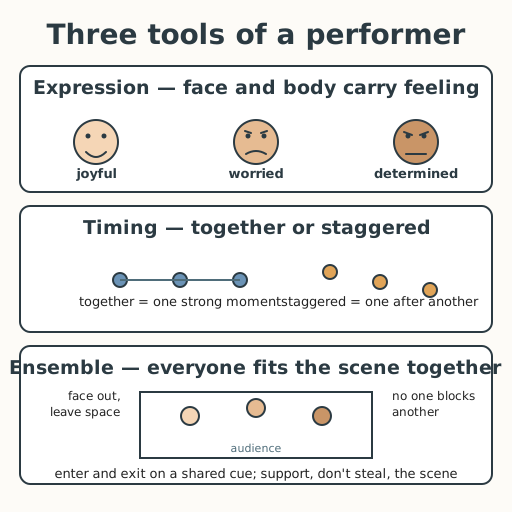
- Performer-tools poster · 1 The 'three tools of a performer' graphic — expression (joyful, worried, determined), timing (together vs staggered), and ensemble (a stage plan where everyone fits)
- A short scene or movement phrase · 1 per group A simple, devisable moment — a meeting, a farewell, a celebration, a stand — that can be performed with movement, gesture, sign, and voice as each performer chooses
- Feedback slip · 1 per learner Two prompts — 'One moment I could read clearly was ___' and 'One thing that would make the scene stronger is ___'
Low-tech / no-cost
- Bodies, voices, and the room Perform the scene with movement, sign, gesture, and spoken or imagined words; no props or device needed
- A listening-and-watching partner A partner who watches the first run and describes back, in words, what read clearly and what to sharpen
Enriched / lab & device
- Simple props, music, or lighting · per group A scarf, a chair, a single light or music cue to support the scene, used only if it serves the meaning
- Camera or phone · 1 per group Record the first run and the revised run so the group can see the change itself
Works in different contexts
- large-group Have groups perform for one another; each audience member writes one specific, kind note on a feedback slip, and groups choose one fix to make and re-run
- multi-age Younger learners hold a simple part or a cue; older learners carry timing and blocking and coach the younger ones through the revision
- self-directed A learner devises a short solo movement phrase, performs it, writes their own feedback note, and re-runs it with one change
- level-grouped Learners ready to extend add a deliberate timing choice (a held pause, a synchronized entrance) and explain the effect it creates
- outdoor-only Use the ground as a stage — a path, a slope, a clearing — and perform with the space itself as a prop; a watching partner gives the feedback
Lesson 6 — Performing a Scene or Dance: Timing, Expression, Ensemble — and Revising by Feedback
Summary
Learners devise and perform a short scene or dance with attention to timing (together versus staggered, pauses, shared cues), expression (face and body carrying feeling), and ensemble (everyone fitting the scene, supporting rather than stealing it). They perform a first run, receive specific feedback, choose one revision, and perform again. Performance is open to every body: movement, sign, gesture, and written or spoken words are all welcome channels.
Objectives
- Perform a scene or dance with attention to timing, expression, and ensemble, and revise after feedback. (D07.S3.07.01)
Connection
Watch any group of people do something together — a dance at a wedding, players entering a field, friends acting out a story — and you are watching three skills at once. They move on the same timing (everyone lands the beat together, or one after another on purpose); they wear the scene on their faces and bodies (expression); and they fit each other — no one blocks the view, no one steals the moment (ensemble). A great scene is not one star and a background; it is a group breathing together. Today your group becomes that group — and uses feedback, not guesswork, to make the scene land.
Materials
- Performer-tools poster (expression / timing / ensemble)
- A short scene or movement phrase
- Feedback slip
Preparation
- Print or draw the performer-tools poster.
- Offer groups a simple, devisable prompt (a meeting, a farewell, a celebration, a stand) that each can perform with the channels their bodies and voices allow.
- Copy a feedback slip for each learner.
Facilitator note
This lesson is written to the learner (“you”). The idea to land is that timing, expression,
and ensemble are chosen and can be revised — a learner should be able to name one deliberate
choice in each and one change made after feedback. Model the three tools with the poster
(explicit instruction for a novice skill — Kirschner, Sweller & Clark, 2006). Keep performance
open to every body: no one must stand, leap, speak, or move in a way their body does not
do — offer signed, seated, gestural, and written parts, and let each performer choose their
channel. Frame other cultures’ performance traditions (dance, drama, ritual) as living
traditions to learn about with respect, not to imitate for a grade — learners perform the
scene they devise. Feedback stays about the work and is always specific and kind; a group
chooses which note to act on (see docs/assessment.md).
Procedure
- Gather and recall (5 min). Last lesson you read and spoke the silent language of gesture, posture, and spacing. Today you add timing, expression, and ensemble — and put it all into a scene you perform and revise.
- Meet the three tools (15 min). Look at the poster. Expression — the face and body carry feeling: a joyful face, a worried one, a determined one. Timing — three moves together make one strong moment; three moves staggered arrive one after another; a held pause makes the next move land harder. Ensemble — everyone faces out, leaves space so no one is blocked, enters and exits on a shared cue, and supports the scene instead of stealing it. Say each with a partner: point to where expression, timing, and ensemble would live in a simple scene.
- Devise the scene (10 min). In your group, choose your prompt and devise a short scene — about 30–60 seconds — deciding together: what feeling do we show and how (expression)? which moments are together and which staggered, and where do we pause (timing)? who stands where, who enters when, and how do we support each other (ensemble)?
- First run (5 min). Perform it once for a watching partner or another group. This is not a test — it is a first draft.
- Get feedback and revise (10 min). Read your feedback slips. Look for one note you can act on — “we couldn’t see the back person’s face,” “the entrance was late,” “the feeling didn’t show.” Choose one change, rehearse just that part, and put it back together.
- Second run (5 min). Perform again. Notice what the revision did — that is craft growing in real time.
- Close (5 min). You made a scene with others, read feedback honestly, and made it stronger. That loop — devise, perform, revise — is how every troupe on Earth rehearses.
Differentiation
- Support: Limit the scene to one beat of action and one expression each, with a partner giving a single, spoken feedback note.
- Extension: Add one deliberate timing choice — a synchronized entrance or a held pause — and write one sentence naming the effect it created.
Assessment
- Formative (observation/peer): Can the learner demonstrate one expression, one timing choice, and staying in ensemble with the group — and name one change made after feedback?
- Artifact (performance): The two runs (or a partner’s written description of the change), showing a revision made after feedback.
- Self-check: The learner asks, “Can I point to one thing I changed after feedback and say why it made the scene clearer or stronger?”
Home connection
Watch one group moment today — people greeting, playing, or leaving together — and name one timing, one expression, and one ensemble choice you saw.
Resources
- International Drama/Theatre and Education Association (IDEA), for classroom-friendly framing of devised performance: https://www.idea-org.net/
- Kennedy Center Education, for movement and dance pedagogy that presents traditions with respect: https://www.kennedy-center.org/education/
- Kirschner, Sweller & Clark (2006), “Why Minimal Guidance Does Not Work,” on modeling each skill before independent practice.