Lesson 05 — Gesture, Posture, Spacing: Speaking Without Words
Learners discover that gesture, posture, and spacing carry meaning without a single word — open palms welcome, crossed arms close off, a lean forward shows interest, and nearness reads as intimate while distance reads as formal. They learn that these cues differ across cultures, that sign languages are full languages (not mere gestures), and that precise gesture vocabularies such as Bharatanatyam mudras are living traditions. They then read and perform meaning with their bodies alone.
Objectives
Objectives
- D07.S3.07.02 Explain how gesture, posture, and spacing communicate meaning without words, using examples from performance or daily life.
Essential question
How do gesture, posture, and spacing communicate meaning without words — in performance and in daily life?
Key vocabulary
Materials
Standard materials
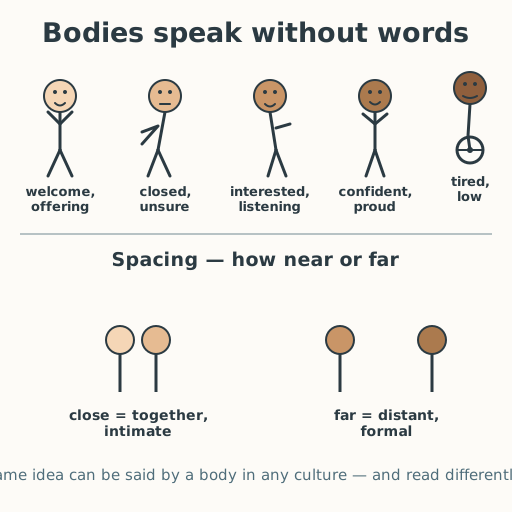
- Bodies-speak poster · 1 Five labeled poses (welcome, closed, interested, confident, tired) plus a spacing strip (close = together, far = distant)
- Gesture-matching cards · 1 set per pair Cards pairing a pose with its likely meaning, for a matching and 'read the room' game
- Meaning slips · per learner Short prompts — 'you welcome a guest,' 'you are upset but trying to hide it,' 'you are far above a crowd' — to act out with body only
Low-tech / no-cost
- Bodies only Act out each meaning with posture, gesture, and where you stand; no cards or poster needed
- A doorway or open space Use real spacing — stand near the door versus far across the room — to feel how distance changes the message
Enriched / lab & device
- Short silent film or dance clips · 1 set Brief scenes of a silent film, a mime, or a dance with expressive gesture and posture, for guided reading of meaning without words
- Camera or phone · 1 per group Record a short 'silent scene' the learners devise and play it back to check whether the meaning reads without words
Works in different contexts
- large-group Act out the five poses together, then have pairs play a 'freeze and read' game where the room guesses each pose's meaning before the pair names it
- multi-age Younger learners match a pose to a feeling; older learners also explain *why* (lean = interest, crossed arms = closed) and note where the meaning might differ by culture
- self-directed A learner matches each pose to a meaning, then invents one of their own and writes a sentence naming the gesture, posture, and spacing that carry it
- level-grouped Learners ready to extend explore a precise hand-gesture vocabulary, such as Bharatanatyam mudras or a signed language's signs, and note how specific gesture systems differ from everyday body language
- outdoor-only Use real space and distance — stand near and far, high and low — to feel how posture and spacing change a message; no paper needed
Lesson 5 — Gesture, Posture, Spacing: Speaking Without Words
Summary
Learners discover that gesture, posture, and spacing carry meaning without a single word — open palms welcome, crossed arms close off, a lean forward shows interest, and nearness reads as intimate while distance reads as formal. They learn that these cues differ across cultures, that sign languages are full languages (not mere gestures), and that precise gesture vocabularies such as Bharatanatyam mudras are living traditions. They then read and perform meaning with their bodies alone.
Objectives
- Explain how gesture, posture, and spacing communicate meaning without words, using examples from performance or daily life. (D07.S3.07.02)
Connection
Think how much you already say without words. A friend opens their arms and you feel welcomed before they speak; a classmate crosses theirs and you give them space; someone leans in and you know they are really listening. Across a room, standing close feels like “us” and standing far feels like “them.” Bodies do this everywhere — in a market, a greeting, a celebration, a quiet argument. Today you learn to read that silent language and to speak it on purpose — and to remember that not every body reads it the same way.
Materials
- Bodies-speak poster (five poses + spacing)
- Gesture-matching cards
- Meaning slips
Preparation
- Print or draw the bodies-speak poster.
- Copy the gesture-matching cards and meaning slips.
- Recall Grade 6: learners told a story with movement, voice, and one more element. This lesson isolates the silent channel — gesture, posture, and spacing — and reads it precisely.
Facilitator note
This lesson is written to the learner (“you”). The idea to land is that the body is a language, and like any language its meanings are learned, not universal — a learner should be able to name a gesture, a posture, and a spacing choice and the meaning each carries, and to note that the same cue can mean different things to different people. Model the five poses and the spacing strip (explicit instruction for a novice skill — Kirschner, Sweller & Clark, 2006). Hold two careful distinctions: (1) sign languages are complete languages with their own grammar, not “just gestures,” and are the first language of millions of people — never reduce them to pantomime; (2) gesture meanings differ across cultures — a thumbs-up or a head-shake is not the same everywhere, and eye contact, personal space, and bowing all vary — so keep the stance “we ask, we don’t assume” (global/anthropological lens). Performance here is open to every body: meaning can be shown from a seated position, with one hand, or with the eyes, and no learner must stand, leap, or move in a way their body does not do.
Procedure
- Gather and recall (5 min). You have made images speak and sound make mood. Now the body itself — the instrument you carry everywhere — becomes the message.
- Meet the silent language (15 min). Look at the poster. Gesture — open palms up says welcome, offering; arms crossed says closed, unsure. Posture — leaning forward with a lifted face says interested, listening; standing tall with chin up says confident, proud; slouched with head down says tired, low. Spacing — standing close says together, intimate; standing far says distant, formal. Read each with a partner, then freeze in one pose and let a partner guess it.
- Name the limits (10 min). Two honest notes. First, sign languages — American Sign Language, Lengua de Señas Mexicana, Nicaraguan Sign Language, and hundreds more — are complete languages with their own grammar, not “just gestures”; millions of people use them as a first language. Second, these cues are not universal: in some cultures a thumbs-up is rude, eye contact means different things, and comfortable personal space differs. And in Bharatanatyam, a classical dance of South India, a dancer’s precise hand gestures (mudras) each carry a named meaning — a whole vocabulary in the fingers. When you meet a meaning you are not sure of, you ask.
- Read the room (10 min). With your pair, match each gesture card to its meaning. Then trade one real example: a time a body told you something the words did not — a friend’s shoulders, a stranger’s step back, a crowd’s hush.
- Speak silently (10 min). Draw a meaning slip and show it with body only — gesture, posture, and where you stand — while a partner guesses. Then switch.
- Close (5 min). You now read and speak a language everyone uses and few people name. Next lesson you put it together with timing and a group into a real performance.
Differentiation
- Support: Give a two-choice prompt (“does this read as welcome or closed?”) and a sentence frame: “This body says ___ because the ___ (arms/lean/spacing) is ___.”
- Extension: Choose one precise gesture system — a mudra or a sign — and write one sentence on how it differs from everyday body language.
Assessment
- Formative (observation/self): Can the learner demonstrate one gesture, one posture, and one spacing choice, and name the meaning each carries — in a given example or one of their own?
- Artifact (performance): The silent-meaning guess-and-show, observed or self-noted.
- Self-check: The learner asks, “Can I show a meaning with my body alone and say which channel — gesture, posture, or spacing — carries it, and note that it might read differently to someone else?”
Home connection
Watch one quiet moment today — a greeting, a queue, a goodbye — and name one gesture, one posture, and one spacing choice you saw, and what each said.
Resources
- Kennedy Center Education, for classroom-friendly framing of movement, gesture, and dance traditions: https://www.kennedy-center.org/education/
- Ekman & Friesen (1969), “The Repertoire of Nonverbal Behavior,” for the foundational idea that nonverbal behavior is patterned, learned, and varies — the basis for “we ask, we don’t assume.”
- Kirschner, Sweller & Clark (2006), “Why Minimal Guidance Does Not Work,” on modeling each pose before independent practice.