Lesson 01 — Media Images & Body Image: What Are We Really Seeing?
Learners discover that most media images of bodies are chosen, edited, filtered, and repeated — not snapshots of real people — and begin to see how this can shape how a person feels about their own body. Every body is named as real and worthy; no learner's body is compared or judged.
Objectives
Objectives
- D03.S1.07.02 Analyze how media images can shape how a person feels about their body and describe a healthy response.
Essential question
How do media images shape how a person feels about their body, and how can I tell what is really there?
Key vocabulary
Materials
Standard materials
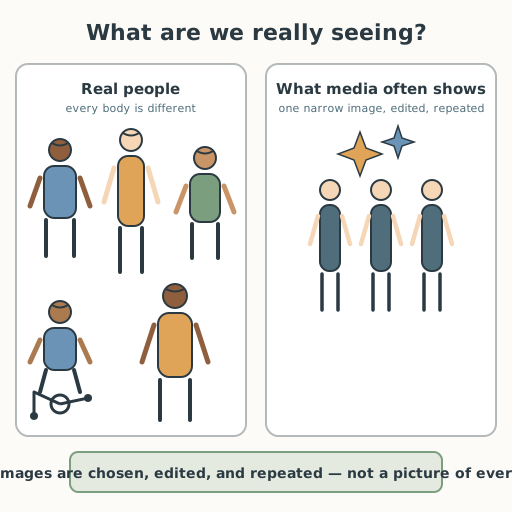
- Real-people vs media-image diagram · 1 Two panels — many different real bodies versus one narrow, edited image repeated — with the caption "media images are chosen, edited, and repeated"
- A few printed or shown ads/images · 4–6 Age-appropriate images from magazines, posters, or screens showing bodies (verify no shaming content; choose varied and global examples)
Low-tech / no-cost
- Voice and description Describe a familiar ad aloud — what the body in it looks like, how it was probably edited — with no printed images needed
- Memory as the gallery Learners recall images they have seen on screens, billboards, or packages and describe them aloud
Enriched / lab & device
- A shared screen or projector · 1 To show a side-by-side of an unedited and edited photo (a "retouch before/after") from a reliable media-literacy source
- Media-literacy video clip · 1 A short clip on how advertising images are digitally altered (verify accuracy and shame-free tone)
Works in different contexts
- large-group Show the diagram large; invite the whole group to name one edit they have spotted in an image, keeping all comments about images, never about any learner's body
- multi-age Older learners can explain editing tools (filters, retouch) to younger ones; keep the focus on "images are made, bodies are real"
- self-directed A learner studies the diagram, lists three ways a media image can be changed, and writes one sentence about what this means for how they feel about their own body
- level-grouped Learners ready to extend distinguish a fact ("images are edited") from a value ("every body deserves respect"), labeling each
- outdoor-only Talk through the diagram from memory and description; find three things in the world around you that are not edited — a tree, a cloud, your own hands — and name the difference
Lesson 1 — Media Images & Body Image: What Are We Really Seeing?
Summary
Learners discover that most media images of bodies are chosen, edited, filtered, and repeated — not snapshots of real people — and begin to see how this can shape how a person feels about their own body. Every body is named as real and worthy; no learner’s body is compared or judged.
Objectives
- Analyze how media images can shape how a person feels about their body. (D03.S1.07.02)
Connection
Think of the pictures you see every day — on screens, on packages, on walls, on the bottles and boxes in a market. Almost none of them are plain snapshots. Someone chose the person, chose the pose, chose the lighting, and then a computer or an app changed it: skin smoothed, shape altered, colors pushed, parts removed. Then that one edited image is copied thousands of times, until a person can start to feel that their real, unedited body is the one that is wrong. It is not. The image is the thing that is not real — and noticing that is a skill you can build.
Materials
- Real-people vs media-image diagram
- A few printed or shown ads/images (age-appropriate, varied, global)
Preparation
- Print or draw the real-people vs media-image diagram.
- Gather a few images of bodies from magazines, posters, or screens — choose varied and global examples, and check that none shame any body.
- Prepare to keep every comment about images, never about any learner’s own body.
Facilitator note
This lesson is written to the learner (“you”). Hold it with care: no learner’s body is
ever compared, ranked, or commented on — every example is about images, never about a
person in the room. The factual ground to land: media images of bodies are routinely
constructed — subjects are selected for a narrow “ideal,” then digitally altered
(retouched, filtered, re-proportioned) and repeated at scale, so the images people see
over-represent one body type that most real bodies do not match (UNESCO media and
information literacy; WHO adolescent health). The value held as value, distinct from
that fact: every body is real and worthy, and no one’s body is a problem to fix. Heavy
exposure to idealized, edited images is linked in research to body dissatisfaction, and
the WHO notes that media influence can widen the gap between how adolescents see
themselves and the ideals they are shown (WHO adolescent mental health) — name this as a
risk to notice, not as fear. Watch for distress; keep the closing
private and never require disclosure. See docs/facilitation.md.
Procedure
- Gather and wonder (5 min). Where do you see pictures of bodies every day — screens, walls, packages, markets? List a few places silently. Today’s question: are the bodies in those pictures real, or made?
- Meet the diagram (10 min). Look at the two panels. On the left, real people — every body a different height, width, shape, and color, and every one real. On the right, what media often shows — one narrow shape, edited and repeated three times over. What is different between the two sides? (Talk about the images, not any person.)
- Name the tools (10 min). Images are changed with tools you can name: choosing (only certain bodies get shown), filtering (color and texture changed), retouching (parts smoothed, slimmed, or removed), and repeating (one image copied everywhere). For each tool, say what it does and why a company might use it.
- Spot it in a real ad (15 min). With a partner, look at one of the images. Say out loud what was probably chosen, filtered, or retouched. Ask the key question: is this a picture of a real person, or a picture of an idea someone is selling?
- Close (5 min). Your body is real; many images of bodies are not. That is not a reason to hate the images — it is a reason to stop measuring yourself against them.
Differentiation
- Support: Use the sentence frame “This image was probably ___ (chosen / filtered / retouched / repeated), so it is not a plain photo.” Focus on naming one tool.
- Extension: Write one fact about media images (they are edited) and one value about bodies (every body deserves respect), and label which is which.
Assessment
- Formative (observation): Can the learner name at least two ways a media image is changed and explain that an edited image is not a plain snapshot of a real body?
- Portfolio: A short note (three ways images are changed + one sentence on what this means for how they feel about their own body), kept as a portfolio artifact.
Home connection
If it feels safe, talk with a trusted adult about an image you both see often. Together, name one way it was probably chosen or edited. You do not need to share anything personal about your own body.
Resources
- UNESCO — Media and Information Literacy (a global framework for reading images and messages critically): https://www.unesco.org/en/media-information-literacy
- WHO — Adolescent health (growth, health, and wellbeing in the teen years): https://www.who.int/health-topics/adolescent-health
- WHO — Mental health of adolescents (media influence on how adolescents see themselves): https://www.who.int/news-room/fact-sheets/detail/adolescent-mental-health