Lesson 02 — A Healthy Response: Reading Media Without Losing Myself
Learners build a healthy response to media images — a pause-and-question habit, kind self-talk, curating what they follow, and talking to a trusted adult — so that an edited image no longer has power over how they feel about their own real body. No learner is ever asked to judge or disclose their own body.
Objectives
Objectives
- D03.S1.07.02 Analyze how media images can shape how a person feels about their body and describe a healthy response.
Essential question
What is a healthy response when a media image makes me feel bad about my body?
Key vocabulary
Materials
Standard materials
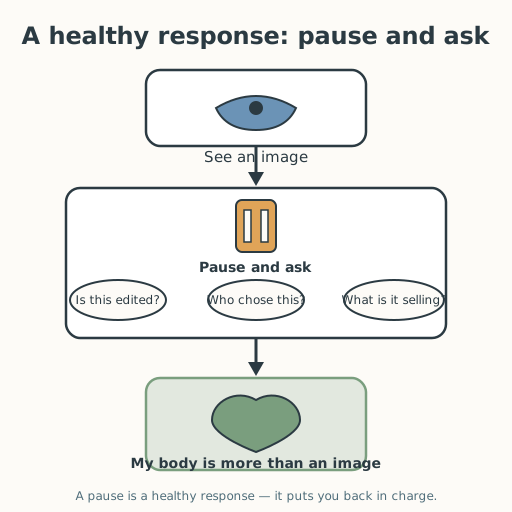
- Pause-and-question diagram · 1 A three-step flow — see an image, pause and ask (Is this edited? Who chose this? What is it selling?), respond (my body is more than an image)
- Healthy-response cards · 1 set Cards naming healthy responses (pause and question; talk to a trusted adult; curate what I follow; speak to myself like a friend; remember bodies differ and that is normal)
Low-tech / no-cost
- Voice and memory Say the pause-and-question steps aloud; practice a kind sentence to say to yourself, with no cards or paper
- Hand-drawn flow Draw the three steps on scrap paper or in the air as you say them
Enriched / lab & device
- A shared screen or projector · 1 To show positive, varied body-representation accounts or campaigns (check they are authentic and non-shaming)
- Curating practice on a device · 1 per learner (optional) Learners review who they follow and practice choosing to follow, mute, or unfollow accounts that make them feel worse — always their own choice, never required
Works in different contexts
- large-group Practice the pause-and-question steps together; keep the self-talk practice private so no learner is pressured to disclose feelings
- multi-age Older learners model a kind self-talk sentence; younger learners repeat it — everyone practices saying something kind about a body in general, never a specific peer
- self-directed A learner reads the diagram, writes one healthy response they will use, and practices one kind sentence about their own body privately
- level-grouped Learners ready to extend write a short "media response" that names the image tactic and a healthy reply, without naming any real person
- outdoor-only Walk and talk: name the three questions aloud, then find one thing your body can do right now (walk, balance, breathe) and say it kindly — no paper needed
Lesson 2 — A Healthy Response: Reading Media Without Losing Myself
Summary
Learners build a healthy response to media images — a pause-and-question habit, kind self-talk, curating what they follow, and talking to a trusted adult — so that an edited image no longer has power over how they feel about their own real body. No learner is ever asked to judge or disclose their own body.
Objectives
- Describe a healthy response to media images that could shape how a person feels about their body. (D03.S1.07.02)
Connection
Last lesson you saw that media images are made — chosen, edited, and repeated. The question now is what to do with that. When an image makes you feel smaller or less-than, you do not have to simply feel it and carry on. You can pause, ask three questions, and answer back. This is a healthy response: it is a skill, like any other, and it puts you back in charge of your own feelings about your own body.
Materials
- Pause-and-question diagram
- Healthy-response cards
Preparation
- Print or draw the pause-and-question diagram.
- Copy and cut the healthy-response cards.
- Prepare to keep self-talk practice private; never require a learner to share feelings about their body.
Facilitator note
This lesson is written to the learner (“you”). The goal is a usable skill, not a lecture
on self-esteem. The facts to land: a person’s body image — how they feel about their body —
is shaped in part by the images around them, and a person can respond in ways that protect
their wellbeing (UNESCO media and information literacy; WHO adolescent health). The
healthy responses to teach: pause and question (is it edited? who chose it? what is it
selling?), kind self-talk (speak to yourself as you would to a friend), curating
(choose what and who you follow), and talking to a trusted adult when it feels heavy.
These are framed as self-care, never as blame, and never as pressure to “love” a body. Hold
body neutrality as a valid option: it is enough to respect your body and treat it well
without feeling positive about it every day. Never comment on any learner’s body, never
compare learners, and keep all practice general. See docs/facilitation.md.
Procedure
- Gather and recall (5 min). What did you learn last time? (Images are chosen, filtered, retouched, repeated.) Today you learn what to do when an image gets under your skin.
- Meet the pause-and-question (10 min). Look at the diagram. When an image makes you feel less-than, pause. Then ask: Is this edited? Who chose this? What is it selling? Saying the questions out loud gives you a moment between the image and the feeling.
- Build your healthy responses (15 min). Sort the response cards and practice each: pause and question; speak to yourself like a friend (“my body is allowed to look like my body”); curate what you follow (you can choose, mute, or unfollow accounts that make you feel worse); and talk to a trusted adult if it ever feels too heavy. Choose the one that fits you best and say why.
- Practice your answer (10 min). Pick one image you often see. Write or say a healthy reply to it using the three questions and one kind sentence. Example: “This photo is edited, and it is selling a product — not telling me what my body should look like.”
- Close (5 min). You cannot control every image you see, but you can control your response to it. Pausing is power.
Differentiation
- Support: Use the frame “When I see a hard image, I will pause, ask ___, and say ___.” Practice one question and one kind sentence.
- Extension: Write a short “media response” that names the tactic an image uses (edited, chosen, repeated) and offers a healthy reply — then share it with a partner.
Assessment
- Formative (observation): Can the learner name the pause-and-question steps and describe at least one healthy response (pause, self-talk, curating, or asking an adult)?
- Portfolio: A written healthy-response note (one image + the three questions + one kind sentence), kept as a portfolio artifact.
Home connection
If it feels safe, tell a trusted adult about the pause-and-question habit. You might even practice it together on an image you both see. You do not need to share anything personal about your body.
Resources
- UNESCO — Media and Information Literacy: https://www.unesco.org/en/media-information-literacy
- WHO — Adolescent health: https://www.who.int/health-topics/adolescent-health