Lesson 08 — My Social Media Boundaries: A Plan for Healthy Use
Learners set personal boundaries for healthy social-media use across four areas — time, content, notifications, and people — and write a plan they can keep. Boundaries are framed as self-care and choice, never as punishment or shame, and every plan is private.
Objectives
Objectives
- D03.S4.07.02 Analyze how social media can affect mental health and set personal boundaries for healthy use.
Essential question
What personal boundaries help me use social media in a way that protects my mental health?
Key vocabulary
Materials
Standard materials
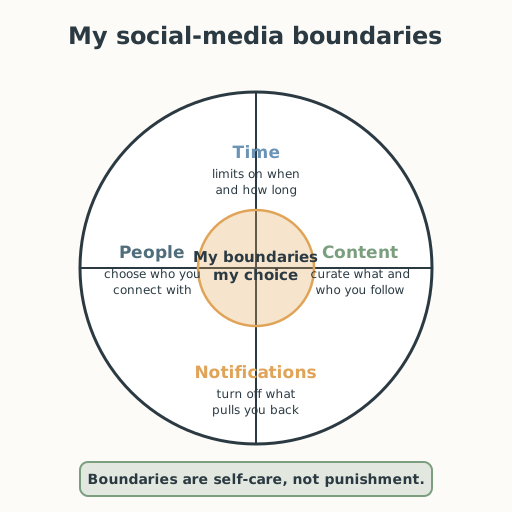
- Social-media boundary wheel · 1 A circle divided into four — time, content, notifications, people — around a center reading "my boundaries, my choice"
- My-boundary-plan page · 1 per learner A page where each learner writes one boundary for each of the four areas and one trusted adult to talk to — private
Low-tech / no-cost
- Voice and a drawn wheel Draw a circle, divide it into four, and write or say one boundary for each area — no printed page needed
- A spoken promise Say one boundary aloud to yourself or a partner, with no writing at all
Enriched / lab & device
- A device to practice settings · 1 per learner (optional) Learners turn off one notification, set a time limit, or mute/unfollow one account — always their own choice, never required
- A shared screen or projector · 1 To show where screen-time and notification settings live, so learners can find them later
Works in different contexts
- large-group Build the wheel together, then have learners write their own plan privately; share only general examples, never personal plans
- multi-age Older learners demonstrate finding a setting; younger learners choose one boundary to try — everyone names boundaries as self-care
- self-directed A learner studies the wheel, writes one boundary for each of the four areas, and keeps the plan where they can see it
- level-grouped Learners ready to extend add a "check-in" step to their plan — how they will notice whether the boundary is helping — and explain why it matters
- outdoor-only Say one boundary for each area aloud while walking; note that a boundary is a promise to yourself — no paper needed
Lesson 8 — My Social Media Boundaries: A Plan for Healthy Use
Summary
Learners set personal boundaries for healthy social-media use across four areas — time, content, notifications, and people — and write a plan they can keep. Boundaries are framed as self-care and choice, never as punishment or shame, and every plan is private.
Objectives
- Set personal boundaries for healthy social-media use. (D03.S4.07.02)
Connection
Last lesson you saw what social media can lift and what it can weigh down. Now you do the part that turns awareness into action: you set boundaries. A boundary is not a rule someone else forces on you — it is a promise you make to yourself, because you are worth taking care of. Like closing a door to sleep, or turning a page down to rest your eyes, a boundary protects the things that keep you well.
Materials
- Social-media boundary wheel
- My-boundary-plan page
Preparation
- Print or draw the social-media boundary wheel.
- Copy a “My-boundary-plan page” for each learner.
- Prepare to keep all personal plans private; share only general examples.
Facilitator note
This lesson is written to the learner (“you”). The goal is a private, personal plan,
not a set of class rules. The four areas: time (limits on when and how long), content
(curating what and who you follow), notifications (turning off what pulls you back),
and people (choosing who you connect with). The facts to land: healthy digital habits —
including protecting sleep and curbing mindless use — support adolescent mental health
(WHO adolescent mental health; UNESCO media and information literacy). The values held
as values: boundaries are self-care and choice, never punishment; there is no “correct”
amount of social media, only what protects each learner’s wellbeing. Frame boundaries as
a promise to oneself, revisit them without judgment, and remind learners that a trusted
adult can help them keep a boundary. Never require a learner to disclose their plan or
their habits; keep plans private. See docs/facilitation.md.
Procedure
- Gather and recall (5 min). Recall last lesson: what can social media lift, and what can it weigh down? Today you turn that into a plan you choose for yourself.
- Meet the boundary wheel (10 min). Look at the wheel. A healthy plan touches four areas: time (limits on when and how long), content (curate what and who you follow), notifications (turn off what pulls you back), and people (choose who you connect with). The center says it all: my boundaries, my choice.
- Write your plan (15 min). On your page, write one boundary for each of the four areas — small, doable, and yours. Examples (choose your own): “I won’t scroll after dinner,” “I’ll mute accounts that make me feel less-than,” “I’ll turn off non-essential notifications,” “I’ll only share with people I trust.” This is private — you do not have to share it.
- Add a check-in (10 min). Pick one way you will notice whether your boundary is helping — a moment each week to ask, “how do I feel after using it?” Write one trusted adult you could talk to if it ever feels hard to keep your boundary.
- Close (5 min). A boundary is not a cage; it is a fence around a garden. It keeps the good in and the harm out — and it is yours to set, change, and keep.
Differentiation
- Support: Use the frame “My boundary for ___ is ___.” and write one boundary for one or two areas rather than all four.
- Extension: Add a “check-in” step to the plan — how and when you will notice whether the boundary is helping — and explain why check-ins make a boundary more likely to last.
Assessment
- Formative (observation): Can the learner name the four areas of a boundary plan and write one personal boundary in at least two areas, framed as self-care?
- Portfolio: The private boundary plan (one boundary per area + one check-in + one trusted adult), kept as a portfolio artifact.
Home connection
If it feels safe, share one boundary from your plan with a trusted adult — you do not need to share the whole plan. A boundary is easier to keep when someone you trust knows about it.
Resources
- WHO — Mental health of adolescents: https://www.who.int/news-room/fact-sheets/detail/adolescent-mental-health
- UNESCO — Media and Information Literacy: https://www.unesco.org/en/media-information-literacy