Lesson 01 — Why Historians Divide Time into Periods
Learners discover that the human past is one long, unbroken story, and that historians divide it into periods — "chapters" — to make it easier to hold, compare, and talk about. They learn that dividing lines are human choices, drawn differently by different peoples, and practice placing and defending lines of their own.
Objectives
Objectives
- D08.S1.07.01 Explain why historians divide time into periods and compare two different calendars or ways of counting years used by different peoples.
Essential question
Why do historians divide the long human story into periods, and what do those dividing lines do?
Key vocabulary
Materials
Standard materials
- Timeline strips · 1 per learner A blank left-to-right arrow to mark dividing lines on
- Period cards · 1 set per pair Cards naming broad periods (deep past, ancient, middle, recent) with a one-line hint
Low-tech / no-cost
- A stick and sand, or a rope on the ground Draw the time-arrow in soil or lay a rope and place stones as dividing lines; no paper needed
- Your own life line Use the learner's own life as the "story" — before birth, early childhood, now, ahead — with no printed cards
Enriched / lab & device
- A printed world-history timeline poster · 1 A shared visual of periods across world regions, so learners see different peoples divide time differently
- A short video on how historians periodize · 1 A brief clip showing that periods are choices historians make and revise
Works in different contexts
- large-group Build one big timeline on the board; invite the whole group to propose where dividing lines should go and defend them
- multi-age Younger learners divide their own life into chapters; older learners debate where a world-history dividing line belongs and why
- self-directed A learner divides their own life line and a world timeline, then writes one sentence about why the lines are choices
- level-grouped Learners ready to extend compare how two different regional timelines (e.g., East Asian and European) periodize the same centuries
- outdoor-only Draw the time-arrow in soil with a stick and place stones or leaves as dividing lines; discuss aloud
Lesson 1 — Why Historians Divide Time into Periods
Summary
The human past is one long, unbroken story. Historians divide it into periods — “chapters” — to make it easier to hold, compare, and talk about. Learners see that dividing lines are human choices, drawn differently by different peoples, and practice placing and defending lines of their own.
Objectives
- Explain why historians divide time into periods, and recognize that periodization is a choice different peoples make differently. (D08.S1.07.01)
Connection
Think about a book you love, or a TV season, or your own life so far. A story that never paused would be impossible to hold in your head. So we cut it into chapters — “the part before I moved,” “the year we got the dog,” “this year, now.” Historians do the same thing with the whole human story: they cut one endless line into chapters so they can hold it, compare it, and talk about it. The trick is remembering that we draw the lines.
Materials
- Timeline strips
- Period cards
Preparation
- Copy the timeline strips and period cards.
- Retrieval: recall from Grade 6 the difference between a primary and a secondary source (D08.S1.06.01); today builds on that by asking how historians arrange time.
Facilitator note
This lesson is written to the learner (“you”). The ideas to land: (1) the past is
one continuous line; (2) periods are chapters historians choose to make it manageable;
(3) the lines are choices, not facts — different peoples draw them differently, and
that is worth noticing. Use explicit instruction with the book-chapter worked example
first, then let learners draw their own lines (Kirschner, Sweller & Clark, 2006). The
global lens (docs/philosophy.md §4): periodization is not universal — “ancient,
middle, modern” is a mostly European frame; other traditions divide time by dynasties,
by lunar cycles, by eras of a people’s own story. The egalitarian lens: no people’s way
of slicing time is the “correct” one; calling one period scheme “the” timeline silently
centers one perspective. The critical-thinking lens: question the answer — a period is
a tool for thinking, not a fact about the world. The ethics lens: who gets to name the
periods shapes whose story is remembered; naming is a small act of power, handled with
care.
Procedure
- Gather (5 min). Quick recall: what is the difference between a primary and a secondary source? (A primary source comes from the time; a secondary source comments on it later.) Today we ask a new question: how do historians arrange time itself?
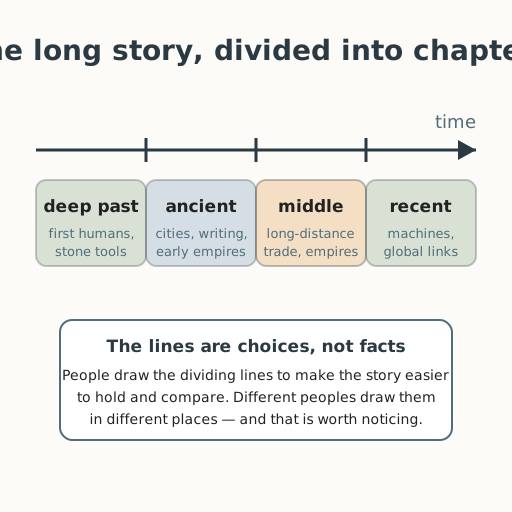
- One long line (10 min). The human past is one continuous line — it has no real breaks. Look at the timeline diagram. Then think of a book: where would you put the chapter breaks, and why? That is exactly what historians do with time.
- Meet “periods” (10 min). A period (or era) is a stretch of time grouped together because people see something shared in it. Look at the period cards: deep past, ancient, middle, recent. Notice: these are not written on the Earth — people chose them.
- Draw your own lines (20 min). On your timeline strip, draw dividing lines and name the periods. First divide your own life into chapters. Then, with a partner, try dividing a world story — where would you put the lines, and what would you name each stretch? Defend one choice aloud: “I put a line here because…”
- Close (5 min). A period is a tool, not a fact. Different peoples divide time differently — and tomorrow we will see how they count the years differently, too.
Differentiation
- Support: Start only with the learner’s own life line; offer three starter labels (“before school,” “now,” “ahead”) to choose from.
- Extension: Compare two schemes — e.g., a European “ancient/middle/modern” frame against a dynasty-based or era-based frame — and name one thing each makes visible and one thing each hides.
Assessment
- Formative (observation/self): Can the learner explain why a line was placed and name the period? Do they describe the line as a choice rather than a fact?
- Self-check: The learner asks, “Did I explain why the line goes where it does, and did I notice that another person might draw it somewhere else?”
Home connection
Ask someone at home to tell you the “chapters” of your family’s or community’s story — the big turning points they remember. Notice where they put the dividing lines, and why.
Resources
- The idea that periodization is a human convention rather than a fact of nature is standard historiography; see, for example, the entry “historiography” in Encyclopaedia Britannica (which treats the periodizing of history as a historians’ method and convention, not a fact of nature). The claim that “ancient/middle/modern” is a European frame, while other traditions periodize by dynasty or era, is well documented and treated here as a global-egalitarian caution, not a ranking.
- On explicit instruction for novice content: Kirschner, Sweller & Clark (2006), https://doi.org/10.1207/s15326985ep4102_1