Lesson 02 — Calendars: Many Ways to Count the Years
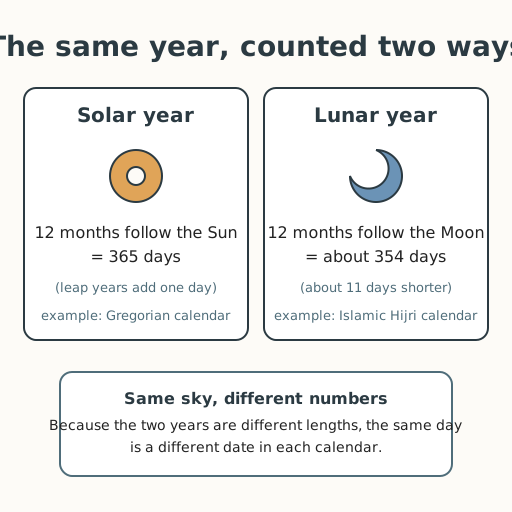
Learners compare two ways of counting the years: a solar calendar (the Gregorian year of 365 days) and a lunar calendar (the Islamic Hijri year of about 354 days). They see that the same day has different numbers in different calendars, and that a calendar's "year one" is a choice a people makes — not a fact written in the sky.
Objectives
Objectives
- D08.S1.07.01 Explain why historians divide time into periods and compare two different calendars or ways of counting years used by different peoples.
Essential question
How do different peoples count the years, and why does the same day have different numbers in different calendars?
Key vocabulary
Materials
Standard materials
- Calendar comparison page · 1 per learner Two columns to record a solar calendar and a lunar calendar side by side
- Sun and Moon cards · 1 set per pair A sun card and a moon card to sort what each calendar follows
Low-tech / no-cost
- Voice and sky-watching Track the Sun's yearly path and the Moon's monthly phases by observing the sky; count days aloud — no cards needed
- A sand or chalk year-line Draw two year-lines of different lengths (365 and about 354) in sand or chalk to feel the difference
Enriched / lab & device
- A world-calendars chart · 1 A chart showing Gregorian, Hijri, Hebrew, Chinese, and Maya year counts for the same day
- A calendar app or website with multiple calendars · 1 per pair Switch a date between calendar systems and watch the year number change
Works in different contexts
- large-group Build both year-lines on the board and mark the same "today" on each, so the whole group sees the numbers differ
- multi-age Younger learners sort sun vs. moon; older learners explain why the two years are different lengths and what that does to dates
- self-directed A learner records today's date in two calendars (from the chart or a trusted adult) and writes why the numbers differ
- level-grouped Learners ready to extend explain a lunisolar calendar's leap month and why it keeps months in their seasons
- outdoor-only Observe the Sun and Moon outdoors; model the two year-lengths as two ropes of different lengths laid on the ground
Lesson 2 — Calendars: Many Ways to Count the Years
Summary
Learners compare two ways of counting the years: a solar calendar (the Gregorian year of 365 days) and a lunar calendar (the Islamic Hijri year of about 354 days). They see that the same day has different numbers in different calendars, and that a calendar’s “year one” is a choice a people makes — not a fact written in the sky.
Objectives
- Compare two different calendars or ways of counting years used by different peoples, and explain why the same day can carry different numbers. (D08.S1.07.01)
Connection
If you and a friend each count the same pile of stones — one of you by tens, the other by sevens — you finish with different numbers, but the stones did not change. Calendars work like that. People everywhere watch the same sky, but they count its cycles in different ways: some follow the Sun, some follow the Moon. So the very same day can be called different years and months, depending on whose calendar you are using. Neither is “wrong” — they are different rulers for the same sky.
Materials
- Calendar comparison page
- Sun and Moon cards
Preparation
- Copy the comparison page and cards.
- Retrieval: recall from Lesson 1 that periods are human choices; today, the numbers of the years are choices, too.
Facilitator note
This lesson is written to the learner (“you”). The ideas to land: (1) a solar calendar counts by the Sun’s year (about 365 days); (2) a lunar calendar counts by the Moon’s cycles (about 354 days, roughly 11 days shorter); (3) because the two years are different lengths, the same day has different numbers in each; and (4) “year one” is a choice each people makes. Use the worked example (Gregorian vs. Hijri) with explicit instruction first, then let learners sort and compare (Kirschner, Sweller & Clark, 2006). These are established facts: the Gregorian calendar is a solar calendar (introduced 1582, year counted from a traditional Christian starting point); the Islamic Hijri calendar is lunar (twelve lunar months, year 1 = the Hijra of 622 CE in the Gregorian calendar). The global lens: the same sky holds many calendars — Hebrew, Chinese, Buddhist, Maya, and others — none is the “real” one. The egalitarian lens: saying “the year is 2026” quietly centers one tradition; other peoples are living in different years right now, and their calendars are equally real. The critical-thinking lens: a calendar’s starting point is a value-laden choice, not a discovery. The ethics lens: how we count shared time can include or exclude people; honoring many calendars is a small act of care.
Procedure
- Gather (5 min). Quick recall: what is a “period,” and who chooses its lines? (People choose them.) Today: people also choose how to count the years.
- Meet two calendars (15 min). A solar year follows the Sun: about 365 days — the Gregorian calendar, used widely today. A lunar year follows the Moon: twelve months of about 29.5 days, about 354 days total — the Islamic Hijri calendar, used by Muslims worldwide. Because 354 is about 11 days shorter than 365, the two calendars drift apart, and the same day lands on a different date in each.
- Same sky, different numbers (10 min). On your comparison page, record the same “today” twice — once in each calendar (your facilitator or a chart can help). What is different: the year? the month? the day? What stayed the same?
- Sort sun and moon (10 min). With a partner, sort the calendar facts: which belong to a solar calendar, which to a lunar one? Check each other’s sorts.
- Close (10 min). A calendar’s “year one” is a choice — one people counts from a founder’s journey, another from a birth, another from a creation. The sky does not say “year one.” People do. Tomorrow we will see that big changes, like calendars, have many causes.
Differentiation
- Support: Use only the Sun/Moon sort; offer the two year-lengths as “longer (Sun)” and “shorter (Moon)” to begin.
- Extension: Explain a lunisolar calendar (such as the Hebrew or Chinese calendar), which adds a leap month so lunar months stay in their seasons, and compare it with the two calendars above.
Assessment
- Formative (observation/self): Can the learner state why a solar and a lunar year differ in length, and show the same day recorded differently in each?
- Self-check: The learner asks, “Did I explain that the same day has different numbers in different calendars, and that a calendar’s starting point is a choice?”
Home connection
Ask someone at home what calendar or year-count their family or community uses — for festivals, seasons, or faith — and compare its year with the Gregorian year.
Resources
- The lengths of the solar (≈365.24 days) and lunar (≈354 days, twelve synodic months) years, the Gregorian reform of 1582, and the Hijri calendar’s start in 622 CE are standard, widely documented facts (see Encyclopaedia Britannica entries “calendar,” “Gregorian calendar,” and “Islamic calendar”). The claim that many calendars coexist (Hebrew, Chinese, Buddhist, Maya, and others) is likewise standard; it is held here as a global-egalitarian commitment, not a ranking.
- On explicit instruction for novice content: Kirschner, Sweller & Clark (2006), https://doi.org/10.1207/s15326985ep4102_1