Lesson 06 — The Canon of Medicine and the Bimaristans
Learners analyze a second non-European achievement: medicine and hospitals in the Islamic world. They meet Ibn Sina's Canon of Medicine (c. 1025 CE), an encyclopedia used as a standard medical text for centuries, and the bimaristans — hospitals that offered care, teaching, and pharmacy. They explain how this knowledge spread and shaped medicine far beyond its home.
Objectives
Objectives
- D08.S2.07.01 Analyze a scientific or technological achievement from a non-European civilization, such as in mathematics, astronomy, medicine, or engineering, and its effect on the world.
Essential question
How did medicine and hospitals developed in the Islamic world shape the wider world?
Key vocabulary
Materials
Standard materials
- Knowledge-journey cards · 1 set per pair Cards naming Ibn Sina, the Canon of Medicine, hospitals, and the text's use in European universities, to sequence and connect
- Compare-then-and-now page · 1 per learner Two columns to compare a bimaristan with a hospital or clinic today
Low-tech / no-cost
- Voice and a shared board Retell the journey aloud and draw a two-column comparison on any surface — no printed cards needed
- A health worker or elder visit Invite someone who cares for the sick to describe care today, then compare with the bimaristan
Enriched / lab & device
- A short documentary on medieval Islamic hospitals · 1 A clip showing bimaristans' care, teaching, and pharmacy to make the achievement vivid
- An excerpt from a history of medicine · 1 A short, age-appropriate reading on the Canon of Medicine's long use
Works in different contexts
- large-group Sequence the journey cards on the board as a class, then compare bimaristan and modern clinic in pairs
- multi-age Younger learners compare a hospital today with the bimaristan picture; older learners explain how the Canon traveled and why it lasted centuries
- self-directed A learner sequences the cards, completes the then-and-now comparison, and writes one paragraph on the Canon's world effect
- level-grouped Learners ready to extend connect this achievement to the wider knowledge-sharing of the Islamic world (translation, libraries) and its debt to earlier Greek and Indian medicine
- outdoor-only Discuss the journey in a circle; draw the comparison in sand with a stick
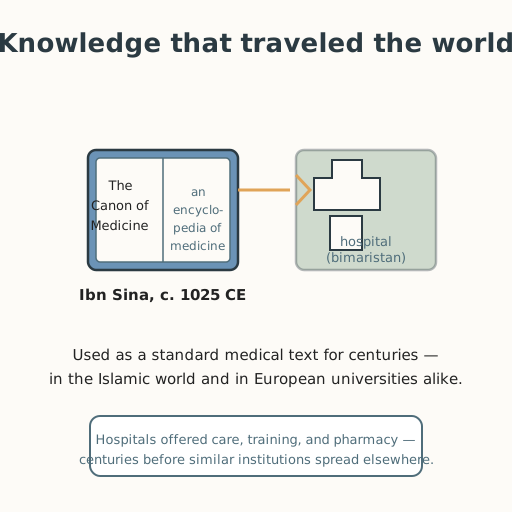
Lesson 6 — The Canon of Medicine and the Bimaristans
Summary
Learners analyze a second non-European achievement: medicine and hospitals in the Islamic world. They meet Ibn Sina’s Canon of Medicine (c. 1025 CE), an encyclopedia used as a standard medical text for centuries, and the bimaristans — hospitals that offered care, teaching, and pharmacy. They explain how this knowledge spread and shaped medicine far beyond its home.
Objectives
- Analyze medicine and hospitals in the Islamic world — the Canon of Medicine and the bimaristan — as a scientific achievement and explain its effect on the wider world. (D08.S2.07.01)
Connection
When you are sick, you might go somewhere for care — a clinic, a health post, a hospital — and the person who treats you learned their craft from others, often from books. That idea — a place for the sick, and a book that gathers what is known about healing — was brought to a high point centuries ago in the Islamic world, in cities like Baghdad, Damascus, and Cairo. Their hospitals and their great book of medicine shaped how much of the world has cared for the sick ever since. That is the achievement we meet today.
Materials
- Knowledge-journey cards
- Compare-then-and-now page
Preparation
- Copy the cards and the comparison page.
- Retrieval: recall from Lesson 5 how zero and the numerals traveled from India through the wider world; today another idea travels from the Islamic world outward.
Facilitator note
This lesson is written to the learner (“you”). The ideas to land: (1) in the Islamic world, hospitals called bimaristans offered care, teaching, and pharmacy — advanced for their time; (2) Ibn Sina (Avicenna, 980–1037, Persian, working in the Islamic world) wrote the Canon of Medicine (al-Qanun fi al-Tibb, c. 1025 CE), a five-volume encyclopedia; (3) it was used as a standard medical text for centuries, in the Islamic world and in European universities alike; (4) its world effect: organized care, the medical encyclopedia, and the link between learning and healing. These are documented facts (see Encyclopaedia Britannica, “Avicenna” and “The Canon of Medicine”). Also worth naming: al-Razi (Rhazes) distinguished smallpox from measles — a landmark of careful observation. Model the journey sequence explicitly, then let learners compare (Kirschner, Sweller & Clark, 2006). The technology lens: hospitals and medical encyclopedias are technologies of care — made things that changed how humans heal and teach. The global lens: this is a Persian-Islamic achievement built on a wider chain — it drew on earlier Greek and Indian medicine, and later shaped European medicine — a story of exchange, not one people’s triumph. The egalitarian lens: naming Ibn Sina’s full context (Persian, Muslim, in a multi-faith world of scholars) restores credit that older Eurocentric tellings often buried under a single Latinized name. The ethics lens: the bimaristan’s idea — that the sick deserve a place and skilled care — is a value we can honor while noticing that not everyone everywhere has such care even today; that gap is a fairness question for us.
Procedure
- Gather (5 min). Quick recall: what did zero give the world? (Place value, easy arithmetic, computing.) Today: another non-European achievement — medicine and hospitals.
- Meet the bimaristan (10 min). In cities of the Islamic world, hospitals called bimaristans offered care for the sick, training for healers, and a pharmacy for medicines — often centuries before similar institutions spread elsewhere.
- Meet the Canon (10 min). Ibn Sina (Avicenna), a Persian scholar, wrote the Canon of Medicine around 1025 CE — a five-volume encyclopedia gathering what was known about health, disease, and treatment. For centuries it was a standard text for healers, in the Islamic world and in European universities alike.
- Trace the journey (10 min). Sequence the knowledge-journey cards: the Canon is written → it travels in translation → it is taught in far-off universities → its ideas become part of medicine everywhere. Notice the chain of many hands.
- Compare then and now (15 min). On your page, compare a bimaristan with a hospital or clinic today: what is alike (a place, skilled people, medicines, teaching) and what is different? Share one likeness and one difference. Close: a great book and a place of care — gifts to the world.
Differentiation
- Support: Use only the then-and-now comparison with a picture of a bimaristan and sentence starters (“Both have ___; today’s also has ___”).
- Extension: Explain how the Canon built on earlier Greek and Indian medicine, and name one way later European medicine built on the Canon — a chain of exchange across peoples.
Assessment
- Formative (observation/portfolio): Can the learner name the Canon and the bimaristan and explain one way each shaped medicine beyond its home?
- Portfolio artifact: The completed then-and-now comparison, kept as evidence of analyzing a non-European achievement.
Home connection
Ask someone who cares for the sick — a nurse, doctor, healer, or elder — where their knowledge comes from, and notice how much of it is passed down through books and training, as the Canon passed down its knowledge.
Resources
- The facts of Ibn Sina (Avicenna, 980–1037), the Canon of Medicine (c. 1025 CE), its five-volume encyclopedic form, and its centuries-long use in the Islamic world and in European universities are documented in Encyclopaedia Britannica (“Avicenna,” “The Canon of Medicine”). The bimaristan as a hospital with care, teaching, and pharmacy is standard in the history of medicine; al-Razi’s distinction of smallpox from measles is likewise documented (Britannica, “al-Razi”). The claim that such care is not equally available to all today is a fairness framing, not a historical finding.
- On explicit instruction and worked examples: Kirschner, Sweller & Clark (2006), https://doi.org/10.1207/s15326985ep4102_1