Lesson 05 — Zero: A Number That Changed the World
Learners analyze a non-European scientific achievement: the idea of zero and the decimal place-value system, developed in India and carried to the wider world through Arabic-speaking scholars. They see that zero is both a placeholder and a number, that it lets ten digits stand for any size of number, and that this idea underpins modern mathematics, science, and computing.
Objectives
Objectives
- D08.S2.07.01 Analyze a scientific or technological achievement from a non-European civilization, such as in mathematics, astronomy, medicine, or engineering, and its effect on the world.
Essential question
What did the idea of zero give the world, and how did it travel?
Key vocabulary
Materials
Standard materials
- Place-value mat · 1 per learner Columns for hundreds, tens, and ones to build numbers and feel where zero holds a place
- Numeral journey cards · 1 set per pair Cards showing the numerals' journey from India, through Arabic-speaking scholars, to Europe
Low-tech / no-cost
- Stones, sticks, or seeds as counters Build place value with found objects and an empty spot for zero — no paper needed
- Voice and a number game Call out numbers and have learners show the empty place with a fist or a gap, feeling what zero does
Enriched / lab & device
- A number-history chart · 1 A chart showing early numeral systems and the Hindu-Arabic system's spread, with dates
- A calculator or spreadsheet · 1 per pair Type numbers with and without zero to see how place value depends on it
Works in different contexts
- large-group Build a large place-value mat on the floor with columns and bodies, and place learners as digits including a zero
- multi-age Younger learners build numbers with counters and an empty spot; older learners explain why zero-as-number is a different idea from zero-as-empty-place
- self-directed A learner builds numbers on the mat and writes why the digit zero lets ten digits stand for any size of number
- level-grouped Learners ready to extend compare a non-positional system (such as tally marks) with place value to feel what positional notation adds
- outdoor-only Draw columns in soil and place stones as digits, leaving an empty column for zero
Lesson 5 — Zero: A Number That Changed the World
Summary
Learners analyze a non-European scientific achievement: the idea of zero and the decimal place-value system, developed in India and carried to the wider world through Arabic-speaking scholars. They see that zero is both a placeholder and a number, that it lets ten digits stand for any size of number, and that this idea underpins modern mathematics, science, and computing.
Objectives
- Analyze the concept of zero and the decimal place-value system as a scientific achievement from India, and explain its effect on the world. (D08.S2.07.01)
Connection
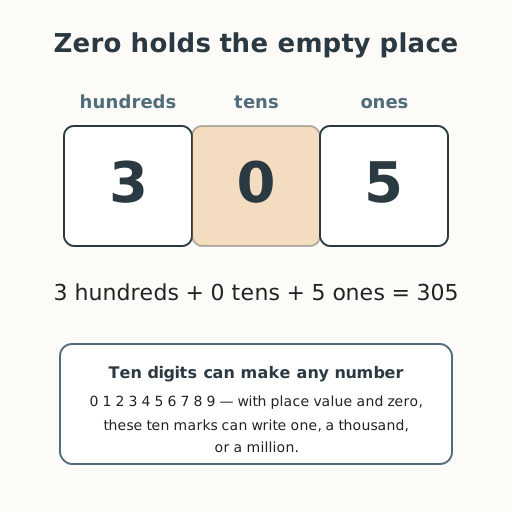
Try writing the number “three hundred five” using only the marks 1 through 9. You can write “3 5,” but how do you know it is three hundred five and not thirty-five? The answer is a little mark that stands for nothing — the zero. Before people treated zero as a real number, counting and calculating were far clumsier. The idea that “nothing” can hold a place, and can even be a number you calculate with, was worked out in India. It is one of the quietest and most powerful ideas in human history, and it traveled the world.
Materials
- Place-value mat
- Numeral journey cards
Preparation
- Copy the place-value mats and journey cards.
- Retrieval: recall from Grade 5/7 mathematics how place value works (hundreds, tens, ones); today we learn where that idea came from.
Facilitator note
This lesson is written to the learner (“you”). The ideas to land: (1) zero has two jobs — a placeholder (keeping 305 apart from 35) and a number in its own right; (2) the decimal place-value system with zero and the ten glyphs 0–9 was developed in India; Brahmagupta (7th century CE) wrote rules for calculating with zero and negatives; (3) the system reached the wider world through Arabic-speaking scholars (hence “Hindu-Arabic numerals”), with al-Khwarizmi’s book on Indian calculation (c. 820 CE) and Fibonacci’s Liber Abaci (1202) among the carriers; (4) its world effect is enormous — modern arithmetic, algebra, science, money, and computing all rest on it. These facts are documented (see Ifrah, The Universal History of Numbers, S-023; and Encyclopaedia Britannica, “zero”). Model the place-value worked example explicitly, then let learners build numbers (Kirschner, Sweller & Clark, 2006). The technology lens: a numeral system is a technology — a tool that changed what humans could compute and know. The global lens: this is a South Asian achievement that moved through many peoples (Persian, Arabic, and later European scholars) — a genuinely global chain of credit, not one nation’s triumph. The egalitarian lens: for centuries a mostly European story-line called these “Arabic numerals” without naming India; naming the full chain of credit is a small act of fairness. The critical-thinking lens: the “obvious” numbers we use daily are not obvious at all — they are a specific, invented, and traveled idea, which we can question and trace.
Procedure
- Gather (5 min). Quick recall: what did paper change as it spread? (Books, literacy, records.) Today: an even quieter invention — a number that changed the world.
- Two jobs of zero (10 min). Look at the diagram. Zero is a placeholder — it keeps 305 apart from 35. And zero is a number you can calculate with (5 − 5 = 0; 0 + 7 = 7). Both ideas had to be invented.
- The achievement in India (10 min). The decimal place-value system, with zero and the ten glyphs 0–9, was developed in India. The mathematician Brahmagupta, in the 7th century CE, wrote rules for calculating with zero (and with negative numbers). Ten marks — 0 through 9 — can now stand for any size of number.
- The journey (10 min). Follow the numeral journey cards: from India, the system traveled through Arabic-speaking scholars (al-Khwarizmi wrote about it around 820 CE), then to Europe (Fibonacci’s Liber Abaci, 1202). That is why they are called Hindu-Arabic numerals — the name keeps the whole chain of credit.
- Build numbers (15 min). On your place-value mat, build 35 and then 305 with counters or digits. Feel what the zero does. Then build a number of your own and explain, aloud or in writing, why the zero matters. Close: this idea runs your calculator, your money, and every computer — a gift from India to the world.
Differentiation
- Support: Build only 35 vs. 305 with counters, focusing on the empty tens place; use the sentence “the zero holds the empty ___ place.”
- Extension: Compare place value with a non-positional system (tally marks or Roman numerals) and explain one thing positional notation makes far easier (e.g., adding large numbers or writing millions).
Assessment
- Formative (observation/portfolio): Can the learner build a number showing zero’s two jobs, and explain why the system is called “Hindu-Arabic”?
- Portfolio artifact: The learner’s place-value build and a one-sentence account of the numerals’ journey.
Home connection
Ask someone at home if they remember when they first met zero, and where they think the digits 0–9 came from. Share the journey: India, through Arabic-speaking scholars, to the world.
Resources
- Georges Ifrah, The Universal History of Numbers (Wiley, 2000) documents that the decimal positional system with zero and the ten glyphs 0–9 originated in India and reached the wider world through Arabic-speaking scholars (registered as S-023). Brahmagupta’s rules for zero and negatives (Brahmasphutasiddhanta, c. 628 CE) and the roles of al-Khwarizmi (c. 820 CE) and Fibonacci’s Liber Abaci (1202) are standard (see Encyclopaedia Britannica, “zero” and “Hindu-Arabic numerals”). The claim that modern computing rests on this system is a factual observation, stated here without ranking any people above another.
- On explicit instruction and worked examples: Kirschner, Sweller & Clark (2006), https://doi.org/10.1207/s15326985ep4102_1