Lesson 10 — Power, Hurt, and Conflict Without Violence
Learners analyze how power and hurt can make conflict worse, and how to address them without violence — naming feelings, balancing power, meeting needs, and repairing. The unit closes by running one capstone scenario through the whole arc: the moral framework, justice, influence, and restorative practice.
Objectives
Objectives
- D09.S4.07.02 Explain how power and hurt can make conflict worse, and how to address them without violence.
- D09.S4.07.01 Apply restorative steps (listening, taking responsibility, and repairing harm) to a real or role-played conflict.
Essential question
How can power and hurt make conflict worse, and how do we address them without violence?
Key vocabulary
Materials
Standard materials
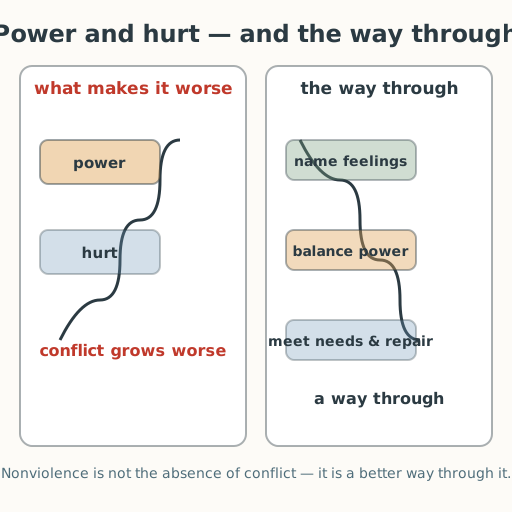
- Escalation-and-response chart · 1 per learner A two-column chart — "what makes conflict worse" and "what addresses it without violence" — with a worked scenario
- Capstone scenario · 1 per group A single invented conflict that touches power and hurt, for a full run through the unit's ideas
Low-tech / no-cost
- Voice and a shared board Build the chart aloud and role-play the scenario with a talking piece; no cards needed
- A found-object talking piece A stone or stick to pass in the circle so every voice is heard
Enriched / lab & device
- A short film on nonviolent conflict resolution · 1 An age-appropriate clip showing a conflict addressed without violence, handled with care
- A guest or visit · 1 A mediator or community peace-builder to talk with, in person or by call
Works in different contexts
- large-group Build the chart as a class, then small groups each run the capstone scenario and report one de-escalating move
- multi-age Younger learners name what makes the conflict worse; older learners name the nonviolent response and why it works
- self-directed A learner completes the chart and writes a one-paragraph plan for addressing the capstone scenario without violence
- level-grouped Learners ready to extend analyze how balancing power (a fair third party, a circle) changes the conflict's course
- outdoor-only Run the capstone in a circle outdoors with a talking piece, and discuss how space and calm change a conflict
Lesson 10 — Power, Hurt, and Conflict Without Violence
Summary
Learners analyze how power and hurt can make conflict worse, and how to address them without violence — naming feelings, balancing power, meeting needs, and repairing harm. The unit closes by running one capstone scenario through the whole arc: the moral framework, justice, influence, and restorative practice.
Objectives
- Explain how power and hurt can make conflict worse, and how to address them without violence. (D09.S4.07.02)
- Apply restorative steps — listening, taking responsibility, and repairing harm — to a role-played conflict. (D09.S4.07.01)
Connection
Most conflicts do not start violent; they become worse when two things are present: power and hurt. When one side has much more power — bigger, older, richer, more numerous, in authority — the conflict stops being fair. And when people are hurt — from the past, from fear, from being unheard — small sparks can grow. Naming these two things is the first step to answering conflict without violence. Today you learn how, and you bring the whole unit together.
Materials
- Escalation-and-response chart
- Capstone scenario
Preparation
- Copy the chart and capstone scenario.
- Retrieval: recall the three questions (helped, harmed, fair), the restorative steps (listen, take responsibility, repair), and the four methods of influence. Today all of them meet in one place: conflict.
Facilitator note
This lesson is written to the learner (“you”). The ideas to land: (1) two things make conflict worse: power — when one side holds much more, the conflict stops being fair — and hurt — past injury, fear, and feeling unheard, which fuel escalation; (2) conflict without violence means naming feelings, balancing power (bringing in a fair third party or a circle so everyone is heard), meeting needs, and repairing harm; (3) these are skills, not magic — they take practice. Model the chart once (worked example, S-011), then run the capstone. Emotional safety: the capstone scenario is invented; do not ask learners to disclose or re-enact real conflict, and never stage a fight — the “conflict” is described and discussed, not acted out physically. The ethics lens: nonviolence is not weakness; it is a demanding way of facing conflict that respects the dignity of everyone, including the one who caused harm. The egalitarian lens: balancing power is the heart of the matter — fairness in conflict requires that the less powerful be heard. The social-emotional lens: hurt is real and must be named before it can be addressed; the “I” statement (Rosenberg, S-148) is one tool. The multiple-traditions note (philosophy §11): nonviolence has deep roots in many world traditions — the principle of ahimsa (non-harming) in Jain, Buddhist, and Hindu thought, and Gandhi’s satyagraha in India’s freedom movement, alongside many others — and the “I” statement is one modern tool within that wider stream, with no single tradition as the default. The critical-thinking lens: ask whose power and whose hurt is in the room — and whether a proposed response makes it worse or better. End on hope and agency: nonviolence is something learners can practice today, not a distant ideal.
Procedure
- Recall (5 min). Name, from memory: the three questions; the three restorative steps; the four methods of influence. Today they meet in conflict.
- Meet power and hurt (10 min). Two things make conflict worse. Power: when one side holds much more, the conflict stops being fair. Hurt: past injury, fear, and feeling unheard, which turn small sparks into flames. When both are present, conflict escalates.
- Meet the nonviolent response (10 min). Look at the chart. To answer conflict without violence: name the feelings (“I feel ___ when ___”, an “I” statement); balance the power (bring in a fair third party, or sit in a circle where everyone is heard); meet the needs behind the anger; and repair the harm (the three restorative steps).
- Run the capstone (20 min). Read the invented scenario: A group project is due. One member, the oldest, takes over every task and speaks over the others, saying their ideas are best. A quieter member, who was left out before, stops speaking entirely and grows resentful. With your group: (a) name who has power and who is hurt; (b) say what would make it worse; (c) role-play a nonviolent path — name feelings, balance power, meet needs, repair. Use the talking piece.
- Close (5 min). One line each: what did this unit teach you that you will actually use? Nonviolence is not the absence of conflict — it is a better way through it.
Differentiation
- Support: Provide the two escalators (power, hurt) and the four responses pre-listed; learners match them to the scenario.
- Extension: Write a short plan that balances power in the scenario (a fair third party, a circle, a turn rule) and explain how it changes the outcome.
Assessment
- Formative (observation): Can the learner name power and hurt as escalators and give at least two nonviolent responses?
- Summative (performance): The capstone run-through, showing the unit’s skills — the framework, justice analysis, and restorative steps — in one performance.
- Self-assessment: Learners self-place on the mastery checklist for the unit’s objectives, marking “not yet / with help / on my own / can teach.”
Home connection
Ask at home: “When our family has a disagreement, does one person usually have more power? How do we make sure everyone is heard?” Try one nonviolent response this week.
Resources
- Nonviolent Communication and the “I” statement as tools for naming feelings and needs: Marshall B. Rosenberg, Nonviolent Communication: A Language of Life (2nd ed., 2003) (S-148).
- Nonviolence as a way of facing conflict has deep roots in many world traditions — among them ahimsa (non-harming) in Jain, Buddhist, and Hindu thought, and Gandhi’s satyagraha in India’s freedom movement. Nonviolent Communication is one modern tool within this wider stream, offered side by side rather than as the only tradition (philosophy §11).
- Restorative steps (listen, take responsibility, repair): International Institute for Restorative Practices, https://www.iirp.edu/ (S-022).
- On explicit instruction and worked examples: Kirschner, Sweller & Clark (2006), https://doi.org/10.1207/s15326985ep4102_1 (S-011).