Lesson 09 — Restoring After Harm: Listen, Take Responsibility, Repair
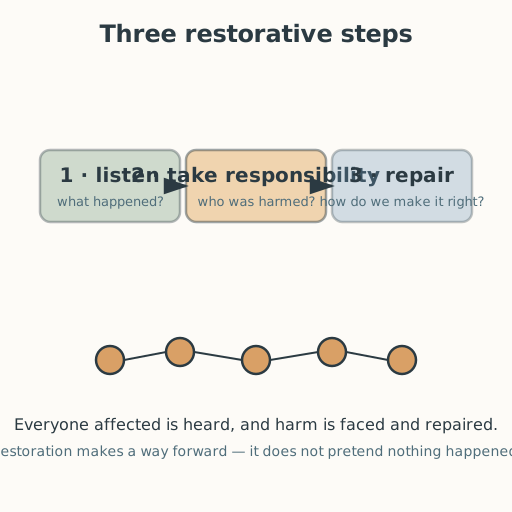
Learners learn three restorative steps — listen, take responsibility, repair — and apply them to an invented, role-played conflict. They practice with a talking piece in a circle and use three guiding questions: what happened, who was harmed, how do we make it right. No learner is asked to disclose real harm.
Objectives
Objectives
- D09.S4.07.01 Apply restorative steps (listening, taking responsibility, and repairing harm) to a real or role-played conflict.
Essential question
How do I apply restorative steps — listening, taking responsibility, repairing harm — to a conflict?
Key vocabulary
Materials
Standard materials
- Restorative steps card · 1 per learner A three-step card — listen, take responsibility, repair — with three guiding questions (what happened, who was harmed, how do we make it right)
- Role-play scenarios · 1 set per group Invented, low-stakes conflicts for practice (a shared item broken, a rumor spread, a group member left out)
Low-tech / no-cost
- Voice and a shared board Walk through the steps aloud with no cards; use invented conflicts only
- A talking piece A stone or stick passed around so each person speaks in turn — the listening circle made concrete
Enriched / lab & device
- A printed restorative-questions poster · 1 The three questions displayed where the group can return to them
- A recorded model conversation · 1 A short audio or video of a restorative conversation, to notice the steps in action
Works in different contexts
- large-group Model one scenario in a fishbowl, then small groups each role-play one scenario and reflect on the steps
- multi-age Younger learners practice the listening turn with a talking piece; older learners complete all three steps and reflect
- self-directed A learner writes the three steps applied to an invented scenario and self-checks that each step is present
- level-grouped Learners ready to extend identify where a step was skipped in a scenario and what that skipped step would have changed
- outdoor-only Sit in a circle with a talking piece and role-play the steps outdoors, using a found object as the shared item
Lesson 9 — Restoring After Harm: Listen, Take Responsibility, Repair
Summary
Learners learn three restorative steps — listen, take responsibility, repair — and apply them to an invented, role-played conflict. They practice with a talking piece in a circle and use three guiding questions: what happened, who was harmed, how do we make it right. No learner is asked to disclose real harm.
Objectives
- Apply restorative steps — listening, taking responsibility, and repairing harm — to a real or role-played conflict. (D09.S4.07.01)
Connection
When something is broken — a plate, a promise, a friendship — the question is what to do next. One answer is to blame and punish. Another is to restore: to hear everyone, to have the person who caused harm take responsibility, and to repair what was damaged. The second way does not ignore harm; it faces it and works to make things as right as they can be. Today you learn its steps — so that when harm happens around you, you have a path that is not just punishment.
Materials
- Restorative steps card
- Role-play scenarios
Preparation
- Copy the steps card and scenario cards.
- Retrieval: recall the three questions of the moral framework (helped, harmed, fair). Restorative practice is the three questions turned into action after harm.
Facilitator note
This lesson is written to the learner (“you”). The ideas to land: (1) restorative practice responds to harm by repairing it and restoring relationships, not only by punishing; (2) the three steps are: listen (everyone affected is heard), take responsibility (the person who caused harm owns it), repair (together, make things as right as possible); (3) three guiding questions: what happened? who was harmed, and how? how do we make it right? — these are the well-known restorative questions (International Institute for Restorative Practices, S-022). Model the steps once (worked example, S-011), then let groups role-play. Emotional safety is non-negotiable: use only invented, low-stakes conflicts; never ask a learner to disclose real harm or act out something that happened to them. If a learner shares real hurt, honor it calmly and gently redirect to the invented scenario, and follow your setting’s safeguarding practice. The ethics lens: restoration takes harm seriously without reducing a person to their worst act. The egalitarian lens: a circle gives everyone — the harmed, the one who harmed, and the community — a voice, rather than letting the loudest or most powerful decide. The social-emotional lens: listening and taking responsibility are emotional skills, and the circle holds them safely. The community lens: repair restores the group, not just the two people. The multiple-traditions note (philosophy §11): the circle and the talking piece draw on long-standing Indigenous and community traditions of restoring justice — among them Māori restorative practice in Aotearoa New Zealand, First Nations peacemaking and sentencing circles in North America, and Ubuntu-rooted reconciliation in southern Africa; the IIRP questions are one modern expression of these older ways, held side by side rather than ranked. Emphasize that repair is often imperfect — “as right as possible,” not “like it never happened.”
Procedure
- Recall (5 min). What were the three questions of the moral framework? Today we turn them into a way to respond after harm.
- Meet the three steps (10 min). Look at the steps card. Listen — everyone affected gets to speak and be heard. Take responsibility — the person who caused harm says what they did and owns it, without excuses. Repair — together, decide how to make things as right as possible.
- Meet the three questions (5 min). The steps are guided by three questions: What happened? Who was harmed, and how? How do we make it right?
- Model it (10 min). Watch a scenario be worked: One person breaks a shared item and hides it. Listen: both speak. Take responsibility: “I broke it, and I hid it — that was wrong.” Repair: together they agree how to fix or replace it and how to rebuild trust. Notice: no one is shamed, and the harm is not ignored.
- Role-play (15 min). In a small group, choose an invented scenario. Pass the talking piece so each person speaks in turn. Run all three questions. The goal is practice, not a perfect ending.
- Close (5 min). Share one thing the steps made possible. Restoration does not undo harm; it makes a way forward.
Differentiation
- Support: Practice only the listening turn with the talking piece before attempting all three steps; give a sentence starter for responsibility (“I did ___, and I am sorry for the harm it caused”).
- Extension: Identify a step that was skipped in a scenario and write what including that step would have changed.
Assessment
- Formative (observation): Can the learner name the three steps and the three questions, and use them in a role-play?
- Performance: The role-played restorative conversation, observed for the presence of listening, taking responsibility, and repairing.
Home connection
Ask at home how your family handles it when something gets broken or feelings get hurt — do people talk it through, and does someone make it right? Compare with the three steps.
Resources
- The three restorative questions (what happened? who was harmed and how? how do we make it right?) follow the restorative-practices framework of the International Institute for Restorative Practices: https://www.iirp.edu/ (S-022).
- The circle and the talking piece have deep roots in Indigenous and other long-standing traditions of restoring justice — among them Māori restorative practice (Aotearoa New Zealand), First Nations peacemaking and sentencing circles (North America), and Ubuntu-rooted reconciliation (southern Africa). The IIRP questions are one modern expression of these older ways, offered side by side rather than ranked (philosophy §11).
- On explicit instruction and worked examples: Kirschner, Sweller & Clark (2006), https://doi.org/10.1207/s15326985ep4102_1 (S-011).