Lesson 02 — How a Technology Spreads: Money by Phone
Learners trace how one technology — mobile money, born in Kenya in 2007 — spread across the world and changed the societies that adopted it. They follow a worked example, then trace a second technology (paper) the same way.
Objectives
Objectives
- D10.S1.07.01 Trace how one technology spread across the world and changed the societies that adopted it, using a non-Western example where possible.
Essential question
How does one technology spread across the world and change the societies that adopt it?
Key vocabulary
Materials
Standard materials
- Technology-journey sheet · 1 per learner A four-stage organizer — where it began, how it traveled, who adopted it, what changed
- Spread cards · 1 set per group Short cards about mobile money (M-Pesa) and, as a second case, paper
Low-tech / no-cost
- Voice and a shared board Tell the mobile-money journey aloud and build the four stages together on any surface
- A local technology Trace a technology learners can see around them (a phone, a pump, a stove) instead of printed cards
Enriched / lab & device
- A world map · 1 Mark the journey of mobile money from Kenya outward, and paper from China westward, on a real map
- A short documentary clip · 1 An age-appropriate clip about mobile money or the history of paper, handled with care
Works in different contexts
- large-group Trace the mobile-money journey together on the board, then groups trace a second technology and report one stage
- multi-age Younger learners name where it began and who adopted it; older learners add what changed and why the change spread
- self-directed A learner reads the journey, completes the four-stage sheet, and checks that each stage names real places and people
- level-grouped Learners ready to extend compare two technologies and say why one spread faster or wider than the other
- outdoor-only Use an outdoor technology (a water pump, a bicycle, a radio) and trace who adopted it and what changed in daily work
Lesson 2 — How a Technology Spreads: Money by Phone
Summary
Learners trace how one technology spread across the world and changed the societies that adopted it, using the non-Western example of mobile money (M-Pesa), launched in Kenya in 2007. They follow a worked example through four stages — where it began, how it traveled, who adopted it, what changed — then trace a second technology (paper) the same way.
Objectives
- Trace how one technology spread across the world and changed the societies that adopted it, using a non-Western example. (D10.S1.07.01)
Connection
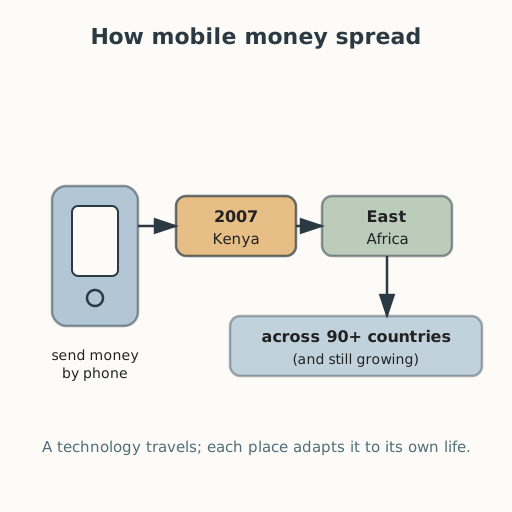
You have almost certainly seen someone pay for something with a phone — or done it yourself. That small action began in a specific place: in 2007, in Kenya, people who had no bank branch nearby began sending money to each other by text message. Within a few years the idea had traveled across East Africa and then to dozens of countries. Every technology has a story like this — a starting place, a journey, and a trail of changes. Today you learn to trace that story.
Materials
- Technology-journey sheet
- Spread cards
Preparation
- Copy the technology-journey sheet and spread cards.
- Retrieval: from Lesson 1, recall the four strands of the unit. Today we begin inside the first strand — Technology & Society.
Facilitator note
This lesson is written to the learner (“you”). The ideas to land: (1) a technology does not appear everywhere at once; it begins somewhere and spreads as people adopt and adapt it; (2) to trace a spread you ask four questions — where did it begin, how did it travel, who adopted it, and what changed for them; (3) adoption is not passive — each society adapts a technology to its own life. Model the mobile-money journey once, step by step (worked example — Kirschner, Sweller & Clark 2006, S-011), then let learners trace paper. The global lens: the example is deliberately non-Western (Kenya) — a reminder that innovation is human-wide, not one region’s property. The egalitarian lens: ask who got the technology and who was left out; mobile money reached people banks had skipped. The technology lens: the change is the point — a tool that spreads changes how people trade, save, and trust. The ethics lens: spread can bring good and harm; notice both. Facts to hold accurately: M-Pesa launched in Kenya in 2007 and grew where bank branches were scarce (S-210, S-211); paper was invented in China (traditionally credited to Cai Lun, c. 105 CE) and spread westward (S-317). Present these as documented history, not value claims.
Procedure
- Recall (5 min). What are the four strands of the unit? Today we trace how a technology spreads — the first strand.
- Meet the four questions (5 min). To trace a technology’s journey, ask: Where did it begin? How did it travel? Who adopted it? What changed?
- Watch it modeled — money by phone (15 min). In 2007, in Kenya, a service called M-Pesa let people send money to each other by text message. Many Kenyans had phones but no bank branch nearby, so the idea spread fast — first across Kenya, then East Africa, then to dozens of countries. What changed? People who had never had a bank account could save, pay, and receive money safely; small businesses and families could move money without traveling for days. Each new place adapted the idea to its own life. Trace these four stages on your sheet.
- Trace a second journey — paper (15 min). Now do the same for paper. It began in China (traditionally credited to Cai Lun around 105 CE). It traveled along trade routes through Central Asia to the Islamic world and then to Europe. Who adopted it? Scribes, then printers, then schools and governments. What changed? Writing and records became cheaper and more widespread; knowledge could travel farther and faster.
- Close (10 min). Share one change a technology brought. Notice the pattern: begin, travel, adopt, change — and that adoption is never just copying; it is adapting.
Differentiation
- Support: Provide the four stages pre-filled for mobile money and ask learners to match each detail to its stage.
- Extension: Compare the two journeys and propose one reason paper spread more slowly than mobile money (transport, not radio waves).
Assessment
- Formative (observation): Can the learner answer all four questions — begin, travel, adopt, change — for a technology, with real places and people named?
- Portfolio artifact: The completed technology-journey sheet for paper, kept in the portfolio.
Home connection
Ask someone at home how a technology reached their life — a phone, a stove, a tool — and whether it came from somewhere else. Trace its “begin, travel, adopt, change” story together.
Resources
- CGAP (mobile money / M-Pesa): https://www.cgap.org/ (S-210).
- World Bank — Financial Inclusion (mobile money): https://www.worldbank.org/en/topic/financialinclusion (S-211).
- Encyclopaedia Britannica — Paper / Papermaking: https://www.britannica.com/technology/papermaking (S-317).
- On explicit instruction and worked examples for novice skills: Kirschner, Sweller & Clark (2006), https://doi.org/10.1207/s15326985ep4102_1 (S-011).