Lesson 03 — Intended and Unintended: Two Kinds of Effect
Learners learn the difference between an **intended effect** (what a technology was designed to do) and an **unintended effect** (a consequence no one planned). They work the plastic bag as a worked example, then sort a second technology the same way.
Objectives
Objectives
- D10.S1.07.02 Explain the difference between an intended effect and an unintended effect of a technology, with an example of each.
Essential question
What is the difference between an intended effect and an unintended effect of a technology?
Key vocabulary
Materials
Standard materials
- Two-kinds-of-effect sheet · 1 per learner A two-column organizer — "intended" and "unintended" — with a technology at the top
- Technology cards · 1 set per pair Short cards — the plastic bag, the mobile phone, the car — each with a small description
Low-tech / no-cost
- Voice and a shared board Draw the two columns and sort effects aloud for one technology; no cards needed
- A familiar technology Use a technology learners handle every day (a bottle, a phone, a stove) instead of printed cards
Enriched / lab & device
- A projected two-column chart · 1 Display the intended/unintended columns large and editable for whole-group sorting
- A short news-style case · 1 One age-appropriate current example of an unintended effect, run through the two columns
Works in different contexts
- large-group Sort the plastic bag's effects as a class on the board, then pairs sort a second technology and share one finding
- multi-age Younger learners name what the technology was for (intended); older learners add the unintended effects and explain why they happened
- self-directed A learner reads the worked example, then sorts two technologies into the columns in writing and checks each column names real effects
- level-grouped Learners ready to extend ask "who is harmed by the unintended effect?" and connect it to fairness
- outdoor-only Use an outdoor example — a plastic wrapper by a path, a motorbike, a fishing net — and name its intended and unintended effects
Lesson 3 — Intended and Unintended: Two Kinds of Effect
Summary
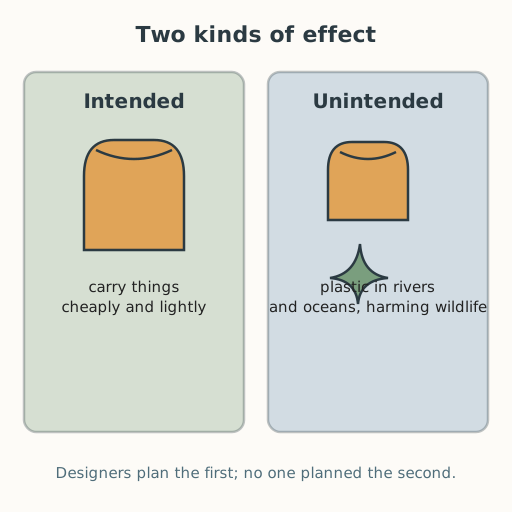
Learners distinguish an intended effect of a technology from an unintended effect. They work the plastic bag as a worked example — designed to carry things cheaply, it also ended up in rivers and oceans, harming wildlife — then sort a second technology the same way.
Objectives
- Explain the difference between an intended effect and an unintended effect of a technology, with an example of each. (D10.S1.07.02)
Connection
Think of a plastic bag. Somewhere, someone designed it to do one job: hold your shopping, cheaply and lightly. That part worked exactly as planned. But the same bag, dropped or blown away, can wash into a river and then the sea, where a turtle or a fish might swallow it. Nobody sat down and planned that second part — it happened anyway. Every technology has these two kinds of effect, and learning to see both is part of using tools wisely.
Materials
- Two-kinds-of-effect sheet
- Technology cards
Preparation
- Copy the two-kinds-of-effect sheet and technology cards.
- Retrieval: from Lesson 2, recall the four questions for tracing a technology (begin, travel, adopt, change). Today we zoom in on the last part — what changed — and split it into two kinds.
Facilitator note
This lesson is written to the learner (“you”). The ideas to land: (1) an intended effect is the result a designer planned for; an unintended effect is a consequence that happened anyway, planned or not; (2) “unintended” is not the same as “unimportant” — an unplanned harm is still a real harm; (3) seeing unintended effects is a skill, and it helps us design and choose better. Model the plastic bag once (worked example, S-011). The technology lens: design always aims at some effects and misses others — that gap is exactly where unintended effects live. The environment lens: many unintended effects land on the living Earth (plastic in the ocean, S-216; animals mistaking plastic for food, S-066). The egalitarian lens: unintended harm often falls hardest on people with the least power to avoid it — ask “who is harmed?” The ethics lens: noticing an unintended effect raises a question — now that we know, what do we owe? Keep the distinction descriptive first (what happened) and normative second (what we should do about it). Distinguish evidence (plastic enters rivers and oceans and can harm wildlife — S-216) from value (we should reduce it).
Procedure
- Recall (5 min). What four questions trace a technology’s journey? Today we split “what changed” into two kinds.
- Meet the two kinds (5 min). An intended effect is the result someone planned for. An unintended effect is a consequence that happened anyway, whether or not anyone planned it.
- Watch it modeled — the plastic bag (15 min). The bag was designed to carry things cheaply and lightly — that is its intended effect. But bags also blow into gutters, wash into rivers, and reach the ocean, where animals can swallow them or get tangled — that is an unintended effect. Sort these onto your two columns. Notice: the harm is real even though no one planned it.
- Sort a second technology (15 min). With a partner, take a technology card — the mobile phone or the car. List its intended effect, then list at least one unintended effect. Say which kind each is.
- Close (10 min). Share one unintended effect you found. Remember: unintended does not mean unimportant.
Differentiation
- Support: Provide the bag’s effects pre-listed and ask learners to sort them into the two columns, then add one effect of their own.
- Extension: For an unintended effect, ask “who is harmed most?” and propose one change to the design or its use that might reduce that harm.
Assessment
- Formative (observation): Can the learner give an intended and an unintended effect of a technology and say which is which?
- Portfolio artifact: The completed two-column sheet for one technology, kept in the portfolio.
Home connection
Choose one everyday object at home (a bottle, a phone, a food wrapper). With someone, name what it was made to do and one thing it does that probably was not planned.
Resources
- UNEP — Plastic Pollution: https://www.unep.org/plastic-pollution (S-216).
- National Geographic Kids — Plastic Pollution: https://kids.nationalgeographic.com/science/article/plastic-pollution (S-066).
- On explicit instruction and worked examples: Kirschner, Sweller & Clark (2006), https://doi.org/10.1207/s15326985ep4102_1 (S-011).