Lesson 09 — Alone and Together: Individual and Collective Action
Learners compare **individual actions** and **collective actions** for caring for the environment and explain why **both matter**. They sort actions into the two kinds and see that each strengthens the other.
Objectives
Objectives
- D10.S4.07.02 Compare individual actions and collective actions for caring for the environment, and explain why both matter.
Essential question
How do individual actions and collective actions for the environment compare, and why do both matter?
Key vocabulary
Materials
Standard materials
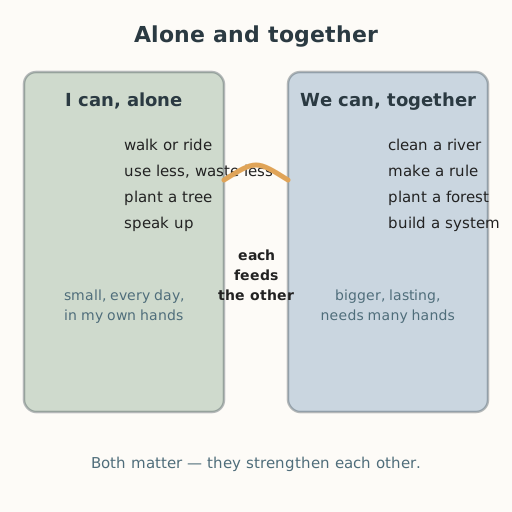
- Alone-and-together sheet · 1 per learner A two-column organizer — "I can, alone" and "we can, together" — with a bridge between them
- Action cards · 1 set per pair Cards naming actions — walk, waste less, plant a tree, clean a river, make a rule, plant a forest — to sort as individual or collective
Low-tech / no-cost
- Voice and a shared board Sort the actions aloud into the two columns on any surface; no cards needed
- A real choice Use a real environmental choice learners face (how to get to school, what to do with waste) instead of printed cards
Enriched / lab & device
- A projected sort board · 1 Display the two columns large and sort the actions as a class, then discuss the bridge
- A case study · 1 One real example — a community clean-up, a tree-planting movement, a school recycling program — to analyze
Works in different contexts
- large-group Sort the actions as a class on the board, then pairs each write one individual and one collective action for a shared goal
- multi-age Younger learners sort the actions; older learners explain why some goals need both an individual and a collective step
- self-directed A learner sorts the cards, then writes one individual and one collective action for a goal they choose, and checks each is real and doable
- level-grouped Learners ready to extend design a mini-campaign — an individual habit plus a collective ask (a rule, a group, a petition) — and explain how they support each other
- outdoor-only Choose a real local need (a littered path, a dry field) and name one thing you could do alone and one thing the community could do together
Lesson 9 — Alone and Together: Individual and Collective Action
Summary
Learners compare individual actions and collective actions for caring for the environment and explain why both matter. They sort actions into the two kinds and see that individual habits and collective changes strengthen each other.
Objectives
- Compare individual actions and collective actions for caring for the environment, and explain why both matter. (D10.S4.07.02)
Connection
Some changes are in your own hands: you can walk instead of ride, waste less, plant a tree, or speak up. Other changes need many hands at once: cleaning a whole river, making a rule that protects a forest, or changing how a whole town handles its waste. These are not rivals — a person who recycles at home is the same person who might help pass a recycling rule at school. Caring for the Earth takes both, and today you learn why.
Materials
- Alone-and-together sheet
- Action cards
Preparation
- Copy the alone-and-together sheet and action cards.
- Retrieval: from Lesson 8, recall the greenhouse effect and the human activities that add to it. Today we turn from what is happening to what we can do about it.
Facilitator note
This lesson is written to the learner (“you”). The ideas to land: (1) an individual action is one a person can do alone, now; a collective action needs many people — and often a rule, a group, or a system; (2) they do different jobs — individual actions model values and add up, while collective actions change the systems that shape everyone’s choices; (3) both matter, and they feed each other. Model the sort once (worked example, S-011). The environment & technology lens: systems (transport, energy, waste) are shaped by collective choices, so changing them is a collective act — this is the unit’s bridge from tools to stewardship. The egalitarian lens: collective action is how people with little individual power get a voice; a rule protects everyone, not just those who can afford to act. The ethics lens: caring for the Earth is a question of what we owe each other and the future. The global lens: people everywhere act both ways — a Kenyan tree-planting movement (the Green Belt Movement, S-059) and a household habit are the same two kinds — and stewardship is far older than any of these: Indigenous and traditional peoples have cared for land and sea for thousands of years through their own knowledge traditions, such as Aboriginal and Torres Strait Islander cultural burning (S-320, S-321) and Māori kaitiakitanga (guardianship of the environment), held here side by side with modern environmental action, never beneath it. Hold hope and agency high; end on what learners can do, not despair.
Procedure
- Recall (5 min). What makes the Earth warm? Today we ask: what can we do about it?
- Meet the two kinds (8 min). An individual action is one you can do alone, now — walk, waste less, plant a tree. A collective action needs many people — clean a river, make a rule, plant a forest, change a system.
- Sort the actions (12 min). With a partner, sort the action cards into the two columns. Some actions start alone and grow into a group — put those on the bridge.
- See the bridge (12 min). Look at your sheet’s bridge. A person who wastes less at home is the same person who can help start a school-wide waste rule. Individual habits model what matters and add up; collective action changes the systems that make good choices easy for everyone. Each makes the other more likely.
- Close (8 min). Share one pair — one thing you can do alone and one thing you could do together. Remember: both matter, because the Earth needs both our hands and our rules.
Differentiation
- Support: Provide the actions pre-sorted and ask learners to explain why each landed in its column.
- Extension: Design a mini-campaign for one goal — an individual habit plus a collective ask (a rule, a group, or a petition) — and explain how the two support each other.
Assessment
- Formative (observation): Can the learner name one individual and one collective action for a goal and explain why both are needed?
- Portfolio artifact: The completed alone-and-together sheet, kept in the portfolio.
Home connection
Choose one environmental goal for your home or street. Name one thing your household can do alone and one thing the neighborhood could do together — and why both matter.
Resources
- UN Environment Programme (UNEP): https://www.unep.org/ (S-282).
- Nobel Prize — Wangari Maathai (Green Belt Movement): https://www.nobelprize.org/prizes/peace/2004/maathai/facts/ (S-059).
- On explicit instruction and worked examples: Kirschner, Sweller & Clark (2006), https://doi.org/10.1207/s15326985ep4102_1 (S-011).