Lesson 08 — Why Is the Earth Warming?
Learners learn the **basic science of climate change** — greenhouse gases trapping heat — and the main **human activities** that add greenhouse gases. They label the greenhouse diagram and sort the activities that are heating the atmosphere.
Objectives
Objectives
- D10.S4.07.01 Explain the basic science of climate change (greenhouse gases trapping heat) and the main human activities that add to it.
Essential question
What is the basic science of climate change, and which human activities add to it?
Key vocabulary
Materials
Standard materials
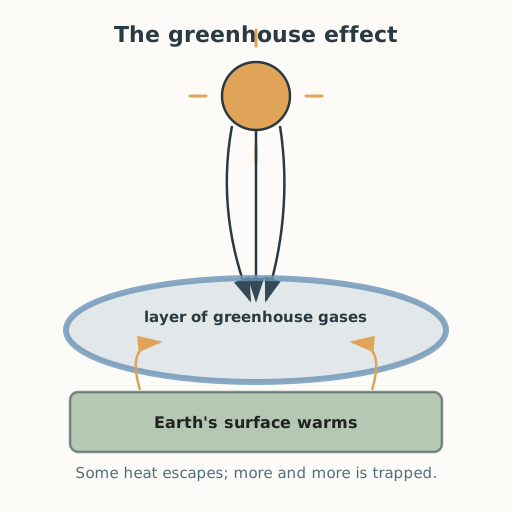
- Greenhouse-effect sheet · 1 per learner A diagram of the Sun, the Earth's surface, and a layer of greenhouse gases, with labels to add
- Activity cards · 1 set per group Cards naming human activities — burning coal and oil, cutting forests, farming, industry — to sort as sources of greenhouse gases
Low-tech / no-cost
- Voice and a shared board Draw the greenhouse effect together and act out "sunlight in, heat trapped" with hands; no cards needed
- A warm blanket Use a blanket on a warm body as a felt example of trapping heat — the blanket is not the heat, but it holds heat in
Enriched / lab & device
- A two-jar demonstration · 1 Two jars in sunlight, one covered, to see the covered one warm faster — a careful, adult-led demo
- A data graph · 1 A simple graph of rising carbon dioxide and rising temperature over time, read together
Works in different contexts
- large-group Build the greenhouse diagram as a class on the board, then groups sort the activity cards and report
- multi-age Younger learners name the gases and the Sun's heat; older learners connect each human activity to the gas it adds
- self-directed A learner labels the diagram, sorts the activity cards, and checks each activity names a real source of greenhouse gas
- level-grouped Learners ready to extend rank the main activities by how much they add, using a simple data table, and explain their ranking
- outdoor-only On a warm day, feel how a sheltered spot holds heat, and talk through how gases do the same for the whole planet
Lesson 8 — Why Is the Earth Warming?
Summary
Learners learn the basic science of climate change: the Sun’s energy reaches Earth, and a layer of greenhouse gases traps some of the heat, warming the planet. They then identify the main human activities that add greenhouse gases — burning fossil fuels, cutting forests, farming, and industry.
Objectives
- Explain the basic science of climate change (greenhouse gases trapping heat) and the main human activities that add to it. (D10.S4.07.01)
Connection
Have you ever sat in a closed car or a covered spot on a sunny day and felt it grow warm inside? The glass lets sunlight in but slows the heat from leaving. Earth’s atmosphere does something similar: certain gases — called greenhouse gases — let sunlight through but hold some of the heat near the surface. That holding is natural and keeps our planet warm enough to live on. The problem is that human activity has added so much more of those gases that the “blanket” has grown thicker, and the planet is warming.
Materials
- Greenhouse-effect sheet
- Activity cards
Preparation
- Copy the greenhouse-effect sheet and activity cards.
- Retrieval: from Lesson 6, recall that carbon cycles — and that burning buried carbon (fossil fuel) pushes extra carbon into the air. Today we see what that extra carbon does to the temperature.
Facilitator note
This lesson is written to the learner (“you”). The ideas to land: (1) the greenhouse effect is real and natural — the Sun’s energy comes in, and greenhouse gases trap some of the heat so Earth is warm enough for life; (2) human activities — burning fossil fuels (coal, oil, gas), cutting forests, some farming, and industry — add extra greenhouse gases, thickening the blanket; (3) that is why the Earth is warming, and the warming is a fact, not an opinion. Model the diagram once (worked example, S-011). The environment & technology lens: the warming is a direct bridge between human technology (burning fuel) and the living Earth — the unit’s central connection. The ethics lens: the science tells us what is happening; what we owe to others because of it is a value question, kept distinct. The egalitarian lens: the warming falls hardest on people who contributed least to it — an injustice we will return to in the next lesson. The global lens: this is a planet-wide change, measured the same way everywhere — and communities who live close to the land and sea, including many Indigenous peoples, have long noticed shifting seasons, weather, and wildlife through their own observation traditions, held side by side with the climate science here (philosophy §11). Hold the science precisely and cite it: the greenhouse effect and the role of human emissions are documented by the IPCC (S-005) and NOAA (S-309); warming also threatens health (S-124). End with agency, not despair — the next lesson is about action.
Procedure
- Recall (5 min). What happens to carbon when we burn buried fuel? Today we see what that extra carbon does to the temperature.
- Meet the greenhouse effect (12 min). Sunlight reaches Earth and warms the surface. Some heat rises back toward space, but a layer of greenhouse gases — including carbon dioxide — holds some of it near the surface. This is natural and keeps Earth warm enough for life.
- Label the diagram (10 min). On your sheet, label the Sun, the incoming energy, the surface, and the layer of greenhouse gases. Draw an arrow for the heat that is trapped.
- Sort the activities (15 min). With a group, sort the activity cards: burning coal, oil, and gas; cutting forests; some kinds of farming; and industry all add greenhouse gases. For each, say what gas or change it adds.
- Close (8 min). Share one activity you can now explain. Remember: the warming is real, it has a cause we can name, and — as we will see next — we can act on it.
Differentiation
- Support: Provide the diagram labels in a word bank and ask learners to place them, then match each activity to the gas it adds.
- Extension: Using a simple data table, rank the main activities by how much they add and explain your ranking.
Assessment
- Formative (observation): Can the learner explain how greenhouse gases trap heat and name at least two human activities that add them?
- Portfolio artifact: The labeled greenhouse diagram, kept in the portfolio.
Home connection
Explain the greenhouse effect to someone at home using the blanket or closed-car example, and name one thing your household does that adds greenhouse gases and one that does not.
Resources
- IPCC — Climate science: https://www.ipcc.ch/ (S-005).
- NOAA — Climate: https://www.climate.gov/ (S-309).
- WHO — Climate change and health: https://www.who.int/health-topics/climate-change (S-124).
- On explicit instruction and worked examples: Kirschner, Sweller & Clark (2006), https://doi.org/10.1207/s15326985ep4102_1 (S-011).