Lesson 05 — Capstone: All of Me, All of Us — Mutual Aid, Motives, and Celebration
The unit and year-end capstone. Learners retrieve mutual aid and the three motives from Unit 3, plan or join a small mutual-aid action to carry into Grade 8, reflect honestly on their motives, and close by celebrating each whole person, the caring community they have built, and the living Earth — looking ahead to Grade 8.
Objectives
Objectives
- D02.S4.07.01 Organize or join a mutual-aid action in their school or community.
- D02.S4.07.02 Reflect on the motives for helping, such as care, duty, or recognition.
Essential question
How do I carry mutual aid and honest motives forward — and how do we celebrate each whole person and the caring community we have built?
Key vocabulary
Materials
Standard materials
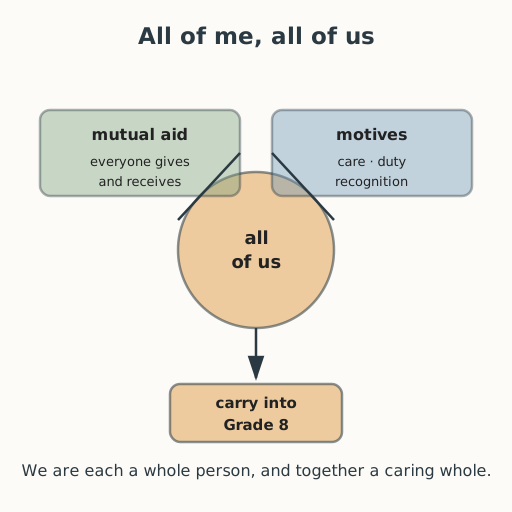
- All-of-me-all-of-us poster · 1 A central "we" circle surrounded by mutual aid (everyone gives and receives), the three motives (care, duty, recognition), and a "carry into Grade 8" arrow
- Carry-forward aid page · 1 per learner A page to name one mutual-aid action to join or start next year, a part to play, and an honest motives line for each of care, duty, and recognition
- Celebration items · as available Whatever marks a shared celebration — a circle, a song, a shared food or drink, the completed portfolio pages displayed together
Low-tech / no-cost
- Voice and a circle Name the action, the part, and the motives aloud in a closing circle; no page or poster needed
- The completed portfolio The pages learners made this week, laid out or held up, as the celebration itself
Enriched / lab & device
- A class "we did this" record · 1 A shared wall or slideshow of the year's actions and each learner's part, to celebrate the whole
- A short, respectful clip of a real mutual-aid effort · 1 A community cleanup, a shared harvest, a study circle — to see mutual aid in motion (verify the clip is appropriate)
Works in different contexts
- large-group Choose one action as a whole group and divide roles; every learner signs up for a small part, then reflect on motives in pairs before the shared celebration
- multi-age Older learners plan and assign roles; younger learners carry out a simple task and name one reason they want to help; celebrate together
- self-directed A learner plans a small action they can do alone or with one other person, writes an honest motives note for each of care, duty, and recognition, and holds a quiet personal celebration by reviewing their week's portfolio
- level-grouped Learners ready to extend distinguish mutual aid (help among equals, everyone gives and receives) from charity (one gives, one receives) and write the difference
- outdoor-only Plan and begin a real outdoor action — a shared cleanup or a path cleared together — then sit in a circle and reflect on motives and celebrate; no paper needed
Lesson 5 — Capstone: All of Me, All of Us — Mutual Aid, Motives, and Celebration
Summary
The unit and year-end capstone. Learners retrieve mutual aid and the three motives from Unit 3, plan or join a small mutual-aid action to carry into Grade 8, reflect honestly on their motives, and close by celebrating each whole person, the caring community they have built, and the living Earth — looking ahead to Grade 8.
Objectives
- Organize or join a mutual-aid action in their school or community. (D02.S4.07.01)
- Reflect on the motives for helping, such as care, duty, or recognition. (D02.S4.07.02)
Connection
In Kenya, people speak of harambee — “all pull together” — when a community joins to build a school or help a family. In Indonesia, gotong royong names neighbors sharing the burden of building and gathering. In the Andes, mink’a (or minga) is a long-standing practice of farming the terraces together so no one harvests alone. In rural North America, a barn raising gathered neighbors to lift a family’s barn in a day, the favor returning later. Different names, one thing: mutual aid — helping where everyone both gives and receives, no one above and no one below. And behind every act of help sits a motive — care, duty, recognition, often more than one at once. Today you carry that practice forward and celebrate all of it.
Materials
- All-of-me-all-of-us poster
- Carry-forward aid page
- Celebration items
- The completed week’s portfolio pages
Preparation
- Print or draw the all-of-me-all-of-us poster.
- Copy a carry-forward aid page for each learner.
- Gather the week’s portfolio pages (then/now/next, decisions, routine, belonging) to display.
- Retrieval: from Unit 3, recall mutual aid and the three motives — care, duty, recognition. This lesson carries them forward and celebrates.
Facilitator note
This lesson is written to the learner (“you”). The idea to land: mutual aid is helping among equals — everyone gives and receives — and carrying it forward with honest motives (care, duty, recognition) is how “all of me” meets “all of us”; the year ends in celebration of each whole person, the caring community, and the living Earth, not in ranking. This deepens Unit 3, Lesson 10 (which planned a mutual-aid action) by pointing it into Grade 8 and joining it to the unit’s identity work. Present mutual-aid traditions with respect as living practices, never as curiosities or a ranking (harambee, gotong royong, mink’a/minga, barn raising — S-164; the term’s canonical source is Kropotkin, S-163). Honor the egalitarian lens: mutual aid is solidarity among equals, not charity from above. Keep motives non-judged — all three are human and common, and naming them honestly is the skill (inquiry over creed). The ethics lens asks what is right toward others; the global lens holds many peoples’ ways of helping side by side; the technology lens asks how tools and messages can help or hinder mutual aid; the environment lens grounds the action in care for the land people share. The action must be small, safe, and genuinely doable, with every learner offered a real part. Model the planner once as a worked example (Kirschner, Sweller & Clark, 2006, S-011). This is a summative moment, but mastery is personal, never ranked — celebrate growth, never compare learners. Assess by what each learner can now explain, choose, and do, not by a score.
Procedure
- Gather and recall the unit (10 min). With a partner, retrieve the whole week: the three panels of your identity (then, now, next); the decision pattern you found; the routine you will carry; and the loss and gain in a community change. Name them without looking — this is the year’s harvest.
- Recall mutual aid and motives (8 min). Look at the poster. Mutual aid: everyone gives and receives, no one only the helper and no one only the helped. Three motives: care (I help because I feel for you), duty (I help because it is right and owed), recognition (I help to be seen as good). All three are human.
- Plan your carry-forward aid (20 min). Choose one small mutual-aid action you could join or start in Grade 8 — a study circle, a shared cleanup, a “help board,” a thank-you to someone who serves the community, a letter for a fair cause. On your page, fill the need, the people, the roles (what each person gives and receives), and the steps. Then write one honest line for each motive: My care says ___. My duty says ___. My want of recognition says ___. There is no wrong answer; name which motive is strongest in you today.
- Run it through the lenses (7 min). Check your action: Is it right (ethics)? Who benefits, and who is left out (egalitarianism)? How would another people or place do it (global)? What does it do to people and the Earth (technology & environment)? Adjust one line.
- Celebrate and look ahead (10 min). Display the week’s pages. In a circle, each person shares one thing they are proud of — one way they have grown. Remember: you are each a whole person, and together a caring whole. Carry all of it — the self, the routine, the community, the care — into Grade 8, and into the living world.
Differentiation
- Support: Provide a pre-chosen action and a roles word bank; ask the learner to fill only the “need” and their own role, plus one motives line.
- Extension: Distinguish mutual aid from charity in one or two sentences (mutual aid is among equals, everyone gives and receives; charity flows one way), and note why the difference matters.
Assessment
- Summative (performance + portfolio): The completed carry-forward aid page — a real part in a mutual-aid action plus an honest motives note — is the unit’s capstone artifact, kept in the year-end portfolio.
- Self-check: The learner confirms their motives note names care, duty, and recognition honestly, and marks one thing from the year they feel confident about and one they want to keep growing — “not yet” is information, never a verdict.
Home connection
Share your carry-forward aid plan with someone at home and invite them to add one action of their own — one way your household or street can pull together next year.
Resources
- On mutual aid as a widespread human practice: Kropotkin, Mutual Aid: A Factor of Evolution (1902; the term’s canonical source — held as a description of a practice, not a claim that helping is “good”) (S-163).
- On named communal-help traditions (harambee, gotong royong, mink’a/minga, barn raising): the “Communal work” entry in the open encyclopedia; verify local details with community members (S-164).
- On cooperative structures and why cooperation helps groups thrive: Johnson & Johnson, social interdependence theory (S-233); and Slavin, Cooperative Learning (S-147).
- On spaced, interleaved retrieval as a capstone: Dunlosky et al. (2013), https://doi.org/10.1177/1529100612453266 (S-039).
- On modeling a new skill before independent practice: Kirschner, Sweller & Clark (2006), https://doi.org/10.1207/s15326985ep4102_1 (S-011).