Lesson 04 — When Our Community Changes — Hard and Good, and What We Carry
Learners retrieve "when a community changes" from Unit 3 and deepen it by linking the community's change to their own: they name what a community lost and gained, reflect on how they belong to it now, and name what they hope the community carries forward. The result becomes the opening piece of the belonging-and-common-good reflection.
Objectives
Objectives
- D02.S3.07.02 Explain how communities change over time and why change can be both hard and good.
Essential question
How does our community change over time — and how do I belong to it, both through what we lose and what we carry forward?
Key vocabulary
Materials
Standard materials
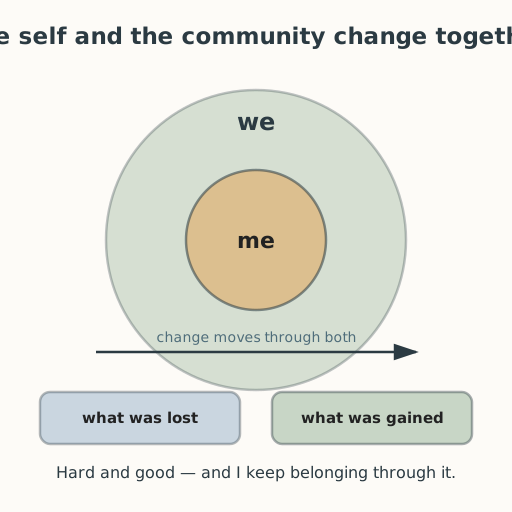
- Me-and-we change poster · 1 A "me" circle inside a "we" circle, with a change arrow through both — showing the self and the community change together, and a note "hard AND good"
- Belonging reflection page · 1 per learner A page with two columns, "what changed in our community" and "how I belong to it now," plus a line for what to carry forward
- Pencils · per learner
Low-tech / no-cost
- Voice and body Tell a community change aloud and act out the loss and the gain together; no poster or page needed
- Found objects Move stones or sticks to show a place changing — a path added, a field built over — while naming what is lost and gained
Enriched / lab & device
- A short, respectful clip of a real community change · 1 A road built, a market opened, families arriving — to see loss and gain together (verify the clip is appropriate)
- Class "change" wall · 1 Learners post one "hard AND good" change from their own community, building a shared record of both/and
Works in different contexts
- large-group Work the me-and-we poster together, then pairs fill the belonging page for one change and share one loss and one gain each
- multi-age Younger learners name one thing lost and one thing gained; older learners also name who felt the change most and how they themselves now belong
- self-directed A learner chooses one real or invented community change, fills both columns, and writes one line about what they hope the community carries forward
- level-grouped Learners ready to extend notice that the same change helps some and burdens others, and name how belonging can include and exclude at once
- outdoor-only Walk to a place that has changed and name what is new and what you imagine used to be there, then say how you belong to it now; no paper needed
Lesson 4 — When Our Community Changes — Hard and Good, and What We Carry
Summary
Learners retrieve “when a community changes” from Unit 3 and deepen it by linking the community’s change to their own: they name what a community lost and gained, reflect on how they belong to it now, and name what they hope the community carries forward. The result becomes the opening piece of the year-end belonging-and-common-good reflection.
Objectives
- Explain how communities change over time and why change can be both hard and good. (D02.S3.07.02)
Connection
No community stands still — a village gets a road and the market grows, but the quiet field where children played is gone; new families arrive with new languages and foods, and the neighborhood is richer, but the people who were there first may feel crowded or unseen. And you change with it: the self you wrote about on day one is not separate from the place you live in. A coast, a mountain town, a city block, a school — everywhere, the “me” and the “we” change together, hard and good, in the same breath.
Materials
- Me-and-we change poster
- Belonging reflection page
- Pencils
Preparation
- Print or draw the me-and-we change poster (a “me” circle inside a “we” circle, a change arrow through both).
- Copy a belonging reflection page for each learner.
- Retrieval: from Unit 3, recall the three-panel story of a community changing and the “both/and” idea — change brings loss and gain at once, and lands differently on different people.
Facilitator note
This lesson is written to the learner (“you”). The idea to land: communities change over time, and change is both hard and good; the self changes inside that community change, so belonging is not a fixed seat but something we keep re-finding. This deepens Unit 3, Lesson 9 (which named loss and gain in a community change) by connecting it to the “who I am becoming” work of this unit and adding the question “what do we carry forward?” Keep the examples global and ordinary (a road, a market, migration, a new building), never one region’s “default” and never a story that ranks one culture above another. Guard the egalitarian lens: the same change often helps some and burdens others, and naming who carries the cost is part of caring — without making anyone a villain; also notice how belonging can include some and exclude others at once. The environment lens: many community changes are changes to the land and water people share. The technology lens: new tools and roads and phones change a community’s shape and pace. Invite learners to name a change from their own community only if they wish; no one is required to share. Model one loss-and-gain pair as a worked example (Kirschner, Sweller & Clark, 2006, S-011). Note that grief for what is lost is real and legitimate — it is not “resisting progress.” The retrieval here is spaced recall (Dunlosky et al., 2013, S-039); the both/and stance follows RULER’s mixed-feelings framing (S-015).
Procedure
- Gather and recall (8 min). In Unit 3 you asked how a community changes. Quick retrieval: name one thing a community can lose when it changes, and one thing it can gain — and hold both. Today you add your own place inside that change.
- Meet the me-and-we poster (10 min). Look at the poster: a small “me” circle inside a large “we” circle, with a change arrow through both. Worked example: Our town got a new market road. Lost: the quiet field where we played. Gained: the clinic is reachable and new foods arrived. I changed too: I walk a different way to school and I know new neighbors — and I miss the field. The self and the community change together.
- Name the loss and the gain (12 min). On your page, choose one community change (real or invented) and fill two columns: what changed in our community and how I belong to it now. Name at least one loss and one gain in the change.
- Who feels it most — and what we carry (10 min). Share with a partner. Then ask: does this change help everyone equally? Often it helps some and burdens others. Finally, write one line: what I hope our community carries forward — one thing worth keeping through the change.
- Close (10 min). Change is not merely to accept or merely to resist; it is to understand — what is lost, what is gained, who carries each, and what we keep. Tomorrow you turn to how people care for one another through it, and you celebrate all of it together.
Differentiation
- Support: Provide a pre-chosen change with one loss and one gain already filled; ask the learner to add how they belong to it now.
- Extension: Write one paragraph arguing for the change and one arguing for what was lost, then one sentence holding both together — and one naming how you belong through it.
Assessment
- Formative (observation): Can the learner name a loss and a gain from the same community change, say how they belong to it now, and name one thing worth carrying forward?
- Portfolio (artifact): The belonging reflection page, kept as the opening piece of the unit’s belonging-and-common-good reflection.
Home connection
Ask someone at home what the neighborhood or village was like when they were young — listen for one thing they miss, one thing they are glad changed, and one thing they hope is never lost.
Resources
- On belonging and social awareness as core competencies: CASEL, https://casel.org/fundamentals-of-sel/ (S-001).
- On holding “both/and” — mixed, co-occurring feelings: the RULER approach to emotional intelligence, https://www.rulerapproach.org/ (S-015).
- On spaced retrieval of prior learning: Dunlosky et al. (2013), https://doi.org/10.1177/1529100612453266 (S-039).
- On modeling a new skill before independent practice: Kirschner, Sweller & Clark (2006), https://doi.org/10.1207/s15326985ep4102_1 (S-011).