Lesson 09 — Language That Includes and Excludes
Learners analyze how language can include or exclude people — through jargon, register, in-group slang, and the choice of one language over another in a mixed room. They sort real scenarios as welcoming or shutting out, then rewrite one excluding phrase to include more people.
Objectives
Objectives
- D04.S4.08.01 Analyze how language can include or exclude people, such as jargon or the use of one language over another.
Essential question
How can language include or exclude people?
Key vocabulary
Materials
Standard materials
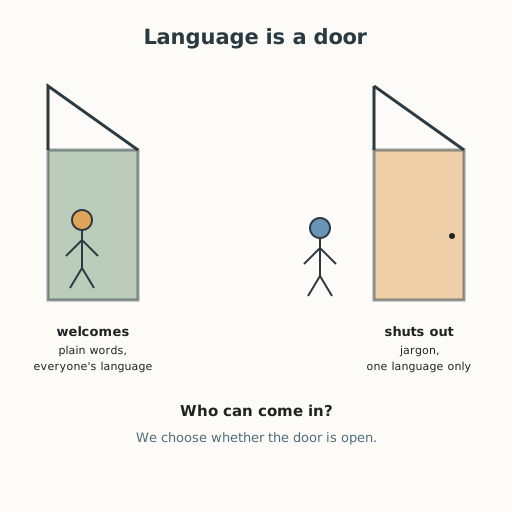
- Include-exclude card · 1 per learner A card with two doors — an open door (language that welcomes) and a closed door (language that shuts out) — each with example phrases and a question
- Scenario cards · 1 set per group Short real scenes — a doctor's jargon, a meeting held only in one language, a group's private slang — to sort as including or excluding and why
Low-tech / no-cost
- Voice and a shared surface Act out the scenarios aloud and sort them into "welcomes" and "shuts out" together; build the card on any board
- A remembered moment Learners recall a time they felt included or excluded by language and share (only if they wish) what the words did
Enriched / lab & device
- A real document or sign · 1 A real form, sign, or notice (a consent form, a bus notice) — ask who can read this, and who is shut out
- A plain-language rewrite · 1 per group Where devices allow, learners take one jargon-filled sentence and rewrite it in plain words so more people can understand it
Works in different contexts
- large-group Sort the scenario cards as a class into "welcomes" and "shuts out," then pairs rewrite one excluding phrase to include more people
- multi-age Younger learners point to who is left out of a phrase; older learners also name the mechanism (jargon, one language only) and a fix
- self-directed A learner reads the scenario cards, sorts each as including or excluding with a reason, and rewrites one excluding phrase
- level-grouped Learners ready to extend analyze a longer real-world case (a form, a policy) and propose a change that includes more people
- outdoor-only Look at a sign, notice, or spoken announcement around you and ask aloud who can understand it and who is shut out, and how to fix it
Lesson 9 — Language That Includes and Excludes
Summary
Learners analyze how language can include or exclude people — through jargon, register, in-group slang, and the choice of one language over another in a mixed room. They sort real scenarios as welcoming or shutting out, then rewrite one excluding phrase to include more people.
Objectives
- Analyze how language can include or exclude people, such as jargon or the use of one language over another. (D04.S4.08.01)
Connection
A door can be open or shut, and language is a door too. When a doctor says “your electrolytes are elevated” to someone who has never heard the word, the door shuts. When a meeting is held only in one language and half the room speaks another, the door shuts for half the room. When friends use a private slang you do not share, the door shuts a little. None of this is usually meant to hurt — but it does exclude, and noticing it is the first step to holding the door open. Today you learn to see which words open the door and which ones close it.
Materials
- Include-exclude card
- Scenario cards
Preparation
- Copy the include-exclude card and scenario cards.
- Retrieval: from Grade 6 and 7, recall communicating across a language difference (D04.S4.06.02) and recognizing dialect and accent as natural variation (D04.S4.07.02). Today we look at how language choices include or exclude.
Facilitator note
This lesson is written to the learner (“you”). The ideas to land: (1) language can welcome or shut out — through jargon (words only insiders know), register (how formal or casual), in-group slang, and using one language over another in a mixed room; (2) exclusion is usually not meant, but it is real, and we can notice it; (3) the fix is not “never use technical words” but “make sure everyone can come in” — explain, translate, invite, and honor every language. The ethics lens: whether we hold the door open is a question of right and wrong. The egalitarian lens is this lesson’s heart: language is a gate, and an equal world keeps the gate open — 40 per cent of people globally cannot learn in a language they understand (S-019), which is why home language first matters. The global lens: many-language rooms are the normal human condition, not an exception. The community lens: a group that includes everyone in its words is a stronger group. The social-emotional lens: being shut out by words hurts — name that feeling gently, and do not ask anyone to relive it if they do not wish. Use scenarios that are real but not pointed at any one learner. Hold “everyone deserves to come in” as a value, distinct from the descriptive claim that language can exclude.
Procedure
- Recall (5 min). How did you communicate across a language difference in Grade 6 and 7? Today we look at how the choice of words and languages opens or shuts a door.
- Meet the two doors (8 min). Language can welcome or shut out. It shuts out with jargon (words only insiders know), with a register too formal or too private, and with using one language over another when the room speaks many. It welcomes with plain words, with explanation, with translation, and with honoring every language.
- Sort the scenarios (15 min). With your group, take the scenario cards. For each, ask: who can understand this, and who is shut out? Sort each under “welcomes” or “shuts out,” and say why.
- Rewrite one door open (17 min). Choose one “shuts out” phrase. Rewrite it so more people can come in — use plain words, or add the other languages spoken in the room, or explain the jargon. Share your rewrite.
- Close (5 min). Remember: language is a door — we choose whether it is open.
Differentiation
- Support: Provide two labels (“everyone can understand” / “some people are shut out”) and ask learners to sort each scenario, then circle the one word that shuts people out.
- Extension: Analyze a longer real-world case — a form, a sign, a policy — and propose one concrete change that would include more people.
- Expression (UDL): Learners may sort and rewrite scenarios aloud, by signing, or by pointing to “welcomes” / “shuts out”; the rewrite can be spoken to a scribe. The two-doors image is described in its alt text, and the open-door/shut-door idea is carried in the lesson’s words.
Assessment
- Formative (observation): Can the learner identify how a phrase includes or excludes (jargon, register, or one-language-only) and rewrite one excluding phrase to include more people?
- Portfolio artifact: The completed scenario sort and one rewrite, kept in the portfolio.
Home connection
Notice one sign, form, or announcement this week — at a clinic, a shop, a station — and ask: who can understand this, and who is shut out? Tell someone what you noticed.
Resources
- On language access as a question of justice: UNESCO — International Mother Language Day, https://www.unesco.org/en/days/mother-language (S-019).
- On plurilingual communication as ordinary and valued: Council of Europe, CEFR Companion Volume (S-237).