Lesson 10 — Digital Translation: A Helpful Tool, Not a Substitute
Learners learn to use digital translation tools critically — knowing their strengths (speed, gist) and their limits (idioms, ambiguity, tone, uneven quality across languages) and when human translation or interpretation is needed. They work a literal-vs-meaning pair as a worked example, then analyze a second pair.
Objectives
Objectives
- D04.S4.08.02 Use digital translation tools critically, knowing their limits and when human translation is needed.
Essential question
How do I use digital translation tools critically, knowing their limits and when human translation is needed?
Key vocabulary
Materials
Standard materials
- Translation-limits card · 1 per learner A card naming four limits of machine translation — idioms, ambiguity, tone/nuance, uneven quality across languages — each with an example
- Literal-vs-meaning pairs · 1 set per pair Pairs showing a phrase translated literally (flat, wrong, or funny) against its real meaning, to compare
Low-tech / no-cost
- Voice and a shared surface Say an idiom in one language, translate it word-for-word, and compare to its real meaning together; build the card on any board
- A remembered idiom Learners recall an idiom from their own language, translate it word-for-word, and share how the real meaning gets lost
Enriched / lab & device
- A live translation tool · 1 per group Where devices allow, put one idiom through a translation tool and compare the tool's output to the real meaning, noticing what is lost
- A human-translation contrast · 1 Show the same line translated by a tool and by a human speaker, and compare which keeps the tone and meaning
Works in different contexts
- large-group Work one idiom together on the board, then pairs run a second idiom through the four limits and report what is lost
- multi-age Younger learners translate one word or phrase word-for-word and see what breaks; older learners name which limit (idiom, nuance, ambiguity) is at work
- self-directed A learner reads the literal-vs-meaning pairs, names which limit each shows, and writes when they would ask a human instead of a tool
- level-grouped Learners ready to extend research one low-resource language and note why translation tools are weaker for it, and when a human is needed
- outdoor-only Recall an idiom or a saying from your own language, translate it word-for-word aloud, and name what the real meaning keeps that the literal words lose
Lesson 10 — Digital Translation: A Helpful Tool, Not a Substitute
Summary
Learners learn to use digital translation tools critically — knowing their strengths (speed and gist) and their limits (idioms, ambiguity, tone and nuance, and uneven quality across languages) and when human translation or interpretation is needed. They work a literal-vs-meaning pair as a worked example, then analyze a second pair.
Objectives
- Use digital translation tools critically, knowing their limits and when human translation is needed. (D04.S4.08.02)
Connection
A translation tool can take a sentence in one language and hand you a sentence in another in a breath — a wonder no one had a generation ago. But it does not understand; it matches. When a tool turns an idiom word-for-word, you may get “the rain is falling ropes” instead of “it is raining very hard.” For a quick sense of a message, a tool is a gift; for a medical instruction, a legal document, or a poem, a human is still needed. Today you learn to tell which job is which.
Materials
- Translation-limits card
- Literal-vs-meaning pairs
Preparation
- Copy the translation-limits card and literal-vs-meaning pairs.
- Retrieval: from Grade 6 and 7, recall translation vs. interpretation (D04.S4.07.01) and that translation always gains and loses (D04.S4.06.01). Today we look at what machines keep and lose.
Facilitator note
This lesson is written to the learner (“you”). The ideas to land: (1) machine translation is fast and useful for gist, but it does not understand meaning — it is limited by idioms, ambiguity, tone and nuance, and uneven quality across languages (low-resource languages fare worse); (2) human translation and interpretation remain necessary for high-stakes, nuanced, or sensitive text; (3) the learner’s home language is the starting point — tools serve the person, not the other way around. Model the first pair once (worked example, S-011). The factual claims about machine-translation limits are standard (S-350); translation always gains and loses (S-167); plurilingual competence — drawing on more than one language — is the real skill tools only assist (S-237). The technology lens is this lesson’s heart: a tool is judged by what it serves. The ethics lens: using a tool carelessly can mislead or harm — in medicine, law, or safety, an error is not funny. The egalitarian lens: tools work better for big languages than for small ones — which means the tool itself can deepen the very inequality we are trying to undo; a human speaker of a small language is irreplaceable. The global lens: most of the world is multilingual, and tools are one more bridge among many. Invite learners to share idioms from their own languages as gifts, and let those who speak a language be its experts.
Procedure
- Recall (5 min). What did you learn in Grade 6 and 7 about translation and interpretation? Today we ask: what do machines keep, and what do they lose?
- Meet the limits (8 min). A translation tool matches words and patterns; it does not understand. So it stumbles on idioms (sayings whose meaning is not in the words), ambiguity (words with two meanings), tone and nuance (warmth, irony, respect), and uneven quality across languages (it is stronger for big languages, weaker for small ones).
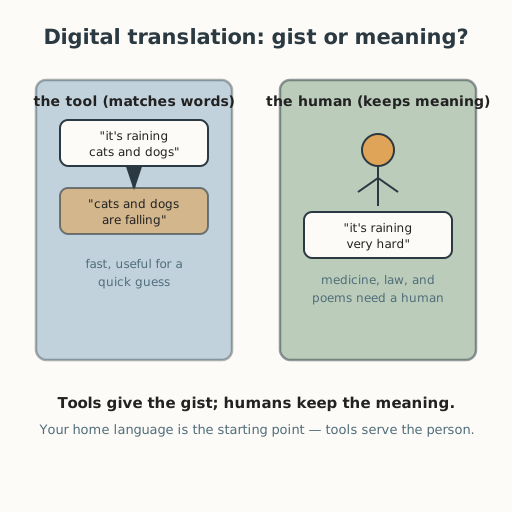
- Watch it modeled (12 min). Take the idiom “it’s raining cats and dogs.” A tool, matching word-for-word, might hand back something like “cats and dogs are falling from the sky.” The real meaning is “it is raining very hard.” The tool gave you words; a human gives you meaning. For a quick guess at a message, the tool is fine. For a medicine label or a poem, ask a human.
- Analyze a second pair (15 min). With a partner, take a literal-vs-meaning pair. Name which limit is at work (idiom, ambiguity, tone, or low-resource language), and say when you would trust the tool and when you would ask a human.
- Close (10 min). Share one limit you found. Remember: tools give the gist; humans keep the meaning.
Differentiation
- Support: Provide two labels (“the words / the meaning”) and ask learners to say which each column gives, and one time to ask a human.
- Extension: Research one low-resource language and write one sentence on why translation tools are weaker for it, and one situation where a human speaker is essential.
- Expression (UDL): Idioms and their lost meanings can be spoken and heard rather than read — a learner can share an idiom aloud and have the pair read to them. The machine-vs-human image is described in its alt text; the “gist vs. meaning” idea stands on words alone.
Assessment
- Formative (observation): Can the learner name at least two limits of machine translation and give one situation where human translation is needed, with a reason?
- Portfolio artifact: The completed literal-vs-meaning analysis, kept in the portfolio.
Home connection
Find one saying or idiom in a language you know and translate it word-for-word into another language. Share both versions with someone and laugh — then say what the real meaning is.
Resources
- Machine translation capabilities and limits: Encyclopaedia Britannica, “Machine translation”, https://www.britannica.com/technology/machine-translation (S-350).
- Translation always gains and loses: Everett, Language: The Cultural Tool (S-167).
- Plurilingual competence as the skill tools assist: Council of Europe, CEFR Companion Volume (S-237).