Lesson 07 — Two Equations at Once: Solving Systems by Graphing
Learners **analyze a pair of simultaneous linear equations by graphing**. They graph both lines, read the **point of intersection** as the solution that satisfies both equations at once, and see that parallel lines mean no solution.
Objectives
Objectives
- D05.S2.08.02 Solve linear equations in one variable and analyze a pair of simultaneous linear equations by graphing.
Essential question
How do I analyze a pair of simultaneous linear equations by graphing them?
Key vocabulary
Materials
Standard materials
- Coordinate grid sheet · 1 per learner A grid with axes for graphing two lines and marking their intersection
- System cards · 1 set per pair Cards with pairs of equations (y = 2x + 1 and y = −x + 7; y = x and y = x + 3) to graph and interpret
Low-tech / no-cost
- Voice and a shared board Graph both lines together and find the crossing point by hand; no cards needed
- String and a ground grid Lay two strings on a floor or ground grid and find where they cross
Enriched / lab & device
- A graphing tool · 1 per group To graph both lines at once and read the intersection precisely, where devices allow
- A systems-match game · 1 per group Cards pairing a pair of equations with its graph and its intersection point, for repeated play
Works in different contexts
- large-group Graph one system together and read the intersection, then have pairs graph systems and check each other's point
- multi-age Younger learners plot the points and draw one line; older learners graph both lines and interpret the intersection or parallel case
- self-directed A learner graphs each system alone, marks the intersection, and checks by substituting the point into both equations
- level-grouped Learners ready to extend explain why parallel lines have no solution and identical lines have infinitely many, and what that means in a story
- outdoor-only Graph two "routes" as lines on the ground and find where they cross — the meeting point of two travellers
Lesson 7 — Two Equations at Once: Solving Systems by Graphing
Summary
Learners analyze a pair of simultaneous linear equations by graphing. Two lines meet at a point — that point satisfies both equations at once, so it is the solution to the system. Parallel lines never meet, so they have no solution.
Objectives
- Analyze a pair of simultaneous linear equations by graphing, and interpret the point of intersection (or the parallel case) as the solution. (D05.S2.08.02)
Connection
Two travellers leave different towns and walk toward each other — where do they meet? One plan charges a flat fee plus a rate; another charges a different rate — at how many items do they cost the same? Each question is two rules at once, and the answer is where the two lines cross. Graphing both and reading the crossing point is how you find the one place both statements are true together.
Materials
- Coordinate grid sheet
- System cards
Preparation
- Copy the coordinate grid sheet and system cards.
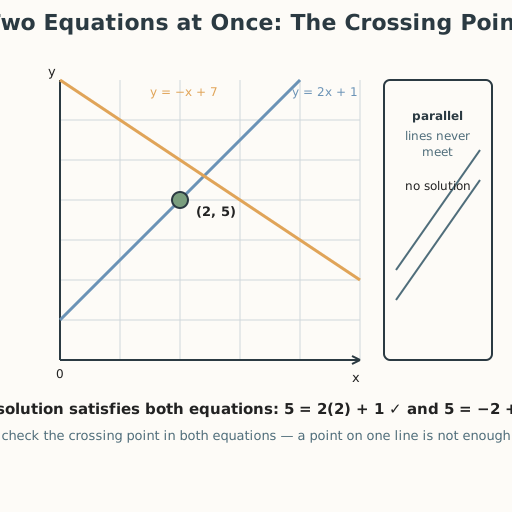
- Have worked examples ready: graph y = 2x + 1 and y = −x + 7; they cross at (2, 5); check: 5 = 2(2) + 1 ✓ and 5 = −2 + 7 ✓. Parallel case: y = x and y = x + 3 never cross.
- Recall from Lesson 5: a linear function graphs as a straight line; from Lesson 6: checking by substituting.
Facilitator note
This lesson is written to the learner (“you”). The ideas to land: (1) a system is two equations whose solution must satisfy both at once; (2) graphing both lines shows the solution as the point of intersection; (3) check the point by substituting into both equations, and recognize that parallel lines mean no solution. Because graphing and reading the intersection is a foundational skill, use explicit instruction, worked examples, and guided practice before independent work (Kirschner, Sweller & Clark, 2006). Watch for the slips of misreading the sign of the slope and of accepting a point that satisfies only one equation. The technology lens: a graphing tool makes the intersection visible instantly — but the learner must still interpret what the crossing means. The egalitarian lens: two honest rules and one grid are all anyone needs to find where two plans agree — the method is open to everyone, not reserved for experts (philosophy §4). The critical-thinking lens: always check the crossing point in both equations — a point on one line is not enough. The global lens: the coordinate grid traces to Descartes (1637) while locating a place by two distances is far older, from latitude/longitude to grid squares (S-240). Retrieval: y = kx (Grade 7) is the line through the origin; today’s lines are its grown-up relatives.
Procedure
- Gather (5 min). You can solve one equation. Today you solve two at once — where two rules agree.
- Meet the system (10 min). A system of equations is two equations at once. A solution must make both true. Graphed, the solution is the point of intersection.
- Worked example — two lines (15 min). Graph y = 2x + 1 (through (0,1), slope 2) and y = −x + 7 (through (0,7), slope −1). They cross at (2, 5). Check: 5 = 2(2) + 1 ✓ and 5 = −2 + 7 ✓. So (2, 5) is the solution.
- Worked example — parallel (5 min). Graph y = x and y = x + 3. Same slope, different start: they never meet. No solution — the two rules can never agree.
- Practice with a partner (10 min). Graph each system card, mark the intersection, and check it in both equations. Trade and check each other’s points.
- Close (5 min). Share one system and its meeting point. Remember: the solution is where both lines agree — check it in both equations, and parallel means no meeting at all.
Differentiation
- Support: Provide one line pre-graphed and guide plotting the second; describe each step aloud for learners with low vision; use whole-number intersections only.
- Accessibility: Offer a tactile grid (raised lines, or a string grid on the ground) so learners who are blind or have low vision can feel where two lines cross; for learners with dyscalculia, pre-plot one line and offload point-finding arithmetic to a partner.
- Extension: Explain in a story why parallel lines (equal cost per item but different fixed fee) never give the same total, and why identical lines give infinitely many solutions.
Assessment
- Formative (observation/performance): Can the learner graph a pair of linear equations, read the point of intersection, and verify it satisfies both equations (and recognize the parallel case)?
- Self-check: The learner asks, “Did I graph both lines correctly? Is my intersection on both lines? Did I substitute the point into both equations, and did I check whether the lines are parallel?”
Home connection
At home, find two “plans” or rates (two prices, two speeds, two schedules), write them as equations, and graph or sketch where they agree — then explain the crossing point to someone.
Resources
- Systems of linear equations solved by graphing are standard in middle-grades mathematics; see John A. Van de Walle, Elementary and Middle School Mathematics (10th ed., 2019) (S-026). The note that coordinate grids trace to Descartes (1637) while locating by two distances is older is documented history (MacTutor, S-240). On explicit instruction for novice skills: Kirschner, Sweller & Clark (2006), S-011.