Lesson 06 — Solving Linear Equations in One Variable
Learners solve **linear equations in one variable** by doing the same operation to both sides — using inverse operations to isolate the variable. They solve multi-step equations and equations with the variable on both sides, and check every solution by substituting it back.
Objectives
Objectives
- D05.S2.08.02 Solve linear equations in one variable and analyze a pair of simultaneous linear equations by graphing.
Essential question
How do I solve a linear equation in one variable by doing the same thing to both sides?
Key vocabulary
Materials
Standard materials
- Balance-pan sheet · 1 per learner A drawing of a balance with a variable and constants on each side, to record "do the same to both sides" at each step
- Equation cards · 1 set per pair Cards with one-variable equations (2x + 3 = 11; 3x = x + 8; 4(x − 2) = 12) to solve and check
Low-tech / no-cost
- Voice and a shared board Act out the balance with arms (keep both sides equal) and write each step on the board; no cards needed
- Counters and a line Build the equation with counters and remove or split equally on both sides
Enriched / lab & device
- A calculator · 1 per group To check solutions by substituting back into the original equation
- A step-by-step equation tool · 1 per group A tool that shows the balance at each step, where devices allow, to feel each move keeps equality
Works in different contexts
- large-group Solve one equation together step by step, then have pairs solve and check each other's work
- multi-age Younger learners solve one-step equations with counters; older learners solve multi-step and variable-on-both-sides equations
- self-directed A learner solves the equation cards alone, writing each step and substituting to check, against the worked examples
- level-grouped Learners ready to extend solve an equation with no solution (2x + 3 = 2x + 5) and one with infinitely many (2x + 3 = 2x + 3), and explain what each means
- outdoor-only Solve a real balance problem with stones on a beam or a line in the dust, doing the same to both sides each step
Lesson 6 — Solving Linear Equations in One Variable
Summary
Learners solve linear equations in one variable by keeping a balance: do the same thing to both sides, use inverse operations to isolate the variable, and check by substituting the solution back. They move from two-step equations to equations with the variable on both sides.
Objectives
- Solve linear equations in one variable, including multi-step equations and equations with the variable on both sides, and check the solution. (D05.S2.08.02)
Connection
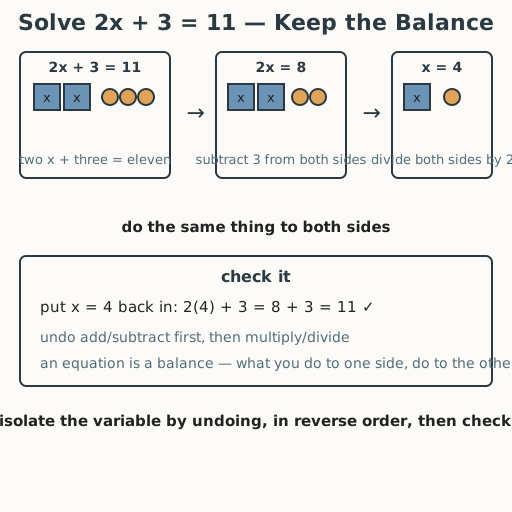
A market stall sells baskets at a price you cannot see, plus a fixed delivery fee of 3 coins. You paid 11 coins for two baskets. What does one basket cost? The equation 2x + 3 = 11 says it: undo the +3 (subtract 3 from both sides), then undo the ×2 (divide both sides by 2) — x = 4. Solving an equation is untying a knot one careful move at a time, and it is how a buyer, a cook, or a builder finds a fair unknown.
Materials
- Balance-pan sheet
- Equation cards
Preparation
- Copy the balance-pan sheet and equation cards.
- Have worked examples ready: 2x + 3 = 11 → subtract 3 → 2x = 8 → divide 2 → x = 4; and 3x = x + 8 → subtract x → 2x = 8 → x = 4.
- Recall from Grade 7: two-step equations (D05.S2.07.01); from Lesson 5: the variable is the input.
Facilitator note
This lesson is written to the learner (“you”). The ideas to land: (1) an equation is a balance — whatever you do to one side you must do to the other; (2) to isolate the variable, undo operations with their inverses in reverse order (add/subtract first, then multiply/divide); (3) a solution is checked by substituting it back. Because solving equations is a foundational skill, use explicit instruction, worked examples, and guided practice before independent work (Kirschner, Sweller & Clark, 2006). Watch for the slips of doing an operation to only one side and of forgetting to distribute (4(x − 2) = 4x − 8). The critical-thinking lens: “check your answer” is not a ritual — it is the honest test of whether the solution is right. The egalitarian lens: the same two moves solve the equation no matter who holds it — mathematics is a leveler, not a gate (philosophy §4). The global lens: the word “algebra” comes from al-jabr (“completion”) in al-Khwarizmi’s 9th-century treatise, where moving a term to the other side was described as completing or balancing — the same balance we use today (S-293). Retrieval: y = kx (Grade 7) and f(x) (Lesson 5) are related — solving an equation finds the input that makes two expressions equal.
Procedure
- Gather (5 min). You can describe how one thing depends on another. Today you find the unknown inside an equation.
- Meet the balance (10 min). An equation is a balance: both sides are equal, and they stay equal only if you do the same thing to both sides.
- Worked example — two steps (10 min). Solve 2x + 3 = 11. Subtract 3 from both sides: 2x = 8. Divide both sides by 2: x = 4. Check: 2(4) + 3 = 11. ✓
- Worked example — variable on both sides (10 min). Solve 3x = x + 8. Subtract x from both sides: 2x = 8. Divide by 2: x = 4. Check: 3(4) = 12 and 4 + 8 = 12. ✓
- Practice with a partner (10 min). Solve the equation cards, writing each step and substituting to check. Trade and check each other’s work.
- Close (5 min). Share one equation and how you untied it. Remember: do the same to both sides, undo in reverse order, and always check.
Differentiation
- Support: Start with one-step equations (x + 3 = 11) and a drawn balance; describe each move aloud for learners with low vision; model each inverse explicitly.
- Accessibility: Model the balance tactilely with counters or stones on a real beam and narrate each move; for learners with dyscalculia, keep a worked-step card visible and offload the arithmetic to a partner so the focus stays on doing the same to both sides.
- Extension: Solve 2x + 3 = 2x + 5 (no solution) and 2x + 3 = 2x + 3 (every number works), and explain what each ending means.
Assessment
- Formative (observation/performance): Can the learner solve a linear equation in one variable, showing the same operation on both sides, and verify the solution by substitution?
- Self-check: The learner asks, “Did I do the same thing to both sides every step? Did I undo add/subtract before multiply/divide? Did I substitute my answer back to check?”
Home connection
At home, set up a small unknown (a price, a number of items) as an equation, solve it, and check by plugging the answer back in — then explain the balance to someone.
Resources
- Solving linear equations is standard in middle-grades mathematics; see John A. Van de Walle, Elementary and Middle School Mathematics (10th ed., 2019) (S-026). The word “algebra” derives from al-jabr in al-Khwarizmi’s 9th-century treatise (MacTutor, S-293). On explicit instruction and worked examples for novice skills: Kirschner, Sweller & Clark (2006), S-011.