Lesson 09 — The Pythagorean Theorem: Right Triangles and Distance
Learners use the **Pythagorean theorem** (a² + b² = c²) to solve problems about right triangles and distances. They see why the squares on the two legs equal the square on the hypotenuse, solve for a missing side, and find straight-line distances — meeting the theorem's many-lands history.
Objectives
Objectives
- D05.S3.08.02 Use the Pythagorean theorem to solve problems about right triangles and distances.
Essential question
How does the Pythagorean theorem let me solve problems about right triangles and distances?
Key vocabulary
Materials
Standard materials
- Right-triangle sheet · 1 per learner A sheet with right triangles and squares on each side, to see that the two leg-squares together equal the hypotenuse square
- Theorem cards · 1 set per pair Cards with right-triangle problems (find the hypotenuse, find a leg, find a distance) to solve with a² + b² = c²
Low-tech / no-cost
- Voice and a shared board Draw the squares on each side and count; no cards needed
- A knotted rope or string Make a 3-4-5 triangle with knots, as rope-builders have done, to feel the theorem
Enriched / lab & device
- A calculator · 1 per group To find square roots in real distance problems (c = √(a² + b²))
- A dynamic geometry tool · 1 per group To drag a right triangle and watch the squares on its sides keep their relationship, where devices allow
Works in different contexts
- large-group Demonstrate the 3-4-5 squares together, then have pairs solve cards and check each other's work
- multi-age Younger learners count squares on the 3-4-5 triangle; older learners solve for unknown sides and distances
- self-directed A learner works the sheet and cards alone, applying a² + b² = c² and checking each answer
- level-grouped Learners ready to extend find the distance between two points on a grid and explain why the theorem gives the straight-line length
- outdoor-only Lay a rope 3-4-5 triangle on the ground to make a true right angle, then measure a real diagonal (across a field or room)
Lesson 9 — The Pythagorean Theorem: Right Triangles and Distance
Summary
Learners use the Pythagorean theorem — a² + b² = c² — to solve problems about right triangles and distances. They see that the squares on the two legs together equal the square on the hypotenuse, find a missing side, and use the theorem to find the straight-line distance between two places.
Objectives
- Use the Pythagorean theorem to solve problems about right triangles and distances. (D05.S3.08.02)
Connection
A ladder leans against a wall, a kite string runs to the sky, a path cuts diagonally across a field instead of along its two edges. In each, a right triangle hides the answer: the two short sides tell you the long side. The rule — the squares on the two short sides add up to the square on the long side — was known to rope-builders in India, to surveyors in China, and on a Babylonian clay tablet long before it carried the name “Pythagoras.” It is one of the most useful and most shared ideas humans have found.
Materials
- Right-triangle sheet
- Theorem cards
Preparation
- Copy the right-triangle sheet and theorem cards.
- Have worked examples ready: a 3-4-5 triangle (3² + 4² = 9 + 16 = 25 = 5²); find a hypotenuse (legs 6 and 8 → c = √(36 + 64) = √100 = 10); find a leg (hypotenuse 13, one leg 5 → the other leg is √(169 − 25) = √144 = 12).
- Recall from Grade 7: the gou-gu / right-triangle rule appears in China’s Nine Chapters (S-289).
Facilitator note
This lesson is written to the learner (“you”). The ideas to land: (1) in a right triangle, the hypotenuse c is opposite the right angle; (2) a² + b² = c² — the squares on the two legs together equal the square on the hypotenuse; (3) use it to find a missing side or a straight-line distance, taking a square root to finish. Because applying the theorem is a foundational skill, use explicit instruction, worked examples, and guided practice before independent work (Kirschner, Sweller & Clark, 2006). Watch for the slips of putting c on a leg (the hypotenuse is always the longest side, opposite the right angle) and of adding before squaring. The global lens is essential here: the relationship was known before Pythagoras — in Babylonian records (Plimpton 322, c. 1800 BCE, S-354), in India’s Sulbasutras (rope rules for altars, c. 800 BCE, S-292), and in China as the gou-gu rule (S-289); “Pythagoras’s theorem” is a widely used name, not a claim about who first knew it (philosophy §11). The technology lens: the theorem is the mathematics behind the distance a GPS or a map computes between two points. The egalitarian lens: a rope with 3-4-5 knots makes a true right angle for anyone, anywhere — the tool is open to all. The critical-thinking lens: check that the longest side is the hypotenuse before squaring.
Procedure
- Gather (5 min). You can move shapes and prove when two are the same. Today you unlock the rule inside every right triangle.
- Meet the theorem (10 min). In a right triangle, the side opposite the right angle is the hypotenuse (c); the other two sides are the legs (a and b). The rule: a² + b² = c².
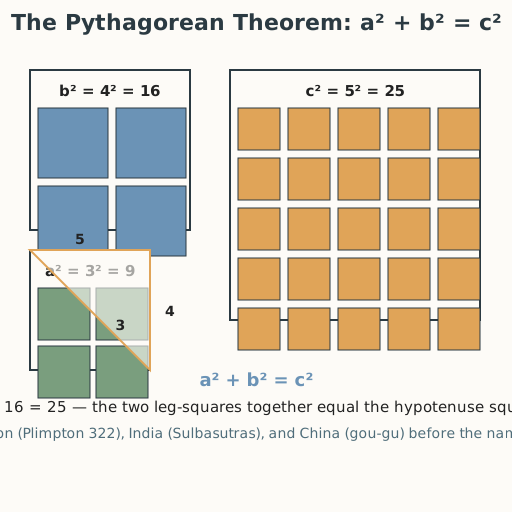
- See it with squares (10 min). Draw squares on each side of a 3-4-5 triangle: 3² = 9, 4² = 16, 5² = 25 — and 9 + 16 = 25. The two leg-squares together exactly equal the hypotenuse square.
- Worked examples (15 min). Find a hypotenuse: legs 6 and 8 → c = √(36 + 64) = √100 = 10. Find a leg: hypotenuse 13, one leg 5 → the other leg is √(169 − 25) = √144 = 12.
- Practice with a partner (5 min). Solve the theorem cards, then trade and check each other’s sides and square roots.
- Close (5 min). Share one problem you solved. Remember: square the legs, add, and take the square root — a² + b² = c² finds any right-triangle distance.
Differentiation
- Support: Use only whole-number Pythagorean triples (3-4-5, 6-8-10, 5-12-13) and a drawn square on each side; describe each step aloud for learners with low vision.
- Accessibility: Build the 3-4-5 squares tactilely (cut or folded squares of 9, 16, and 25 units, or a knotted rope) so learners who are blind or have low vision can feel the relationship; for learners with dyscalculia, keep a worked example visible and offload the squaring and square-root arithmetic to a partner.
- Extension: Find the distance between two points on a coordinate grid by treating the rise and run as legs, and explain why the theorem gives the straight-line length.
Assessment
- Formative (observation/performance): Can the learner identify the hypotenuse and apply a² + b² = c² to find a missing side or a distance, taking the square root correctly?
- Self-check: The learner asks, “Did I put c on the longest side (opposite the right angle)? Did I square before adding? Did I take the square root at the end, and is my answer reasonable?”
Home connection
At home, find a right triangle (a corner, a leaning ladder, a diagonal shortcut), measure two sides, and use the theorem to predict the third — then measure to check.
Resources
- The Pythagorean theorem is standard in middle-grades geometry; see John A. Van de Walle, Elementary
and Middle School Mathematics (10th ed., 2019) (S-026). That the relationship predates Pythagoras
is documented history: Babylonian Plimpton 322 (c. 1800 BCE, MacTutor, S-354), the Indian
Sulbasutras (c. 800 BCE, S-292), and the Chinese gou-gu rule (S-289); holding “Pythagoras’s theorem”
as a name, not a claim about priority, is the curriculum’s stance (
docs/philosophy.md§4, §11). On explicit instruction for novice skills: Kirschner, Sweller & Clark (2006), S-011.