Lesson 02 — Designing a Controlled Experiment
Learners design a **controlled experiment** by working a full example — does warm water dissolve sugar faster than cold? — and then designing their own. They name the hypothesis, independent, dependent, and control variables, the control group, and a plan for repeated trials.
Objectives
Objectives
- D06.S1.08.01 Design a controlled experiment with a clear hypothesis, variables, and a plan for repeated trials and controls.
Essential question
How do I design a controlled experiment with a clear hypothesis, variables, and a plan for repeated trials and controls?
Key vocabulary
Materials
Standard materials
- Experiment design sheet · 1 per learner A blank template with spaces for question, hypothesis, independent, dependent, and control variables, control group, and repeated trials
- Worked-example card · 1 per learner The warm-water-and-sugar example, fully labeled, to study before designing their own
Low-tech / no-cost
- A shared board or large paper Model the worked example on the board; learners copy the template by hand
- Voice and a partner Talk through each part of the design aloud before writing
Enriched / lab & device
- Simple lab kit (cups, thermometer, sugar, water, timer) · 1 set per group If available, actually run the warm-water-and-sugar experiment and record three trials
- A spreadsheet or data table app · 1 per group Record repeated trials and average them digitally
Works in different contexts
- large-group Model the worked example once to the whole group, then pairs each design their own experiment and share one variable at a time
- multi-age Younger learners fill in the hypothesis and one variable; older learners complete all parts including repeated trials and the control group
- self-directed A learner studies the worked example, then fills the template for a new question and self-checks each box is complete
- level-grouped Learners ready to extend identify a lurking variable in a flawed design and rewrite the design to fix it
- outdoor-only Design an experiment that could run outdoors (e.g., does soil in sun or shade stay wetter?) without needing a lab
Lesson 2 — Designing a Controlled Experiment
Summary
Learners design a controlled experiment by first working through a full worked example — does warm water dissolve sugar faster than cold? — and then designing their own. They name the hypothesis, the independent, dependent, and control variables, the control group, and a plan for repeated trials.
Objectives
- Design a controlled experiment with a clear hypothesis, variables, and a plan for repeated trials and controls. (D06.S1.08.01)
Connection
You have probably already run a fair test without calling it that. If you have tried watering one plant and not another to see which grows, or listened to a friend sing in a big room versus a small one, you were changing one thing and watching what happened while keeping the rest the same. That is the heart of a controlled experiment — and it is the most powerful tool humans have for learning what actually causes what. Today you learn to build one on purpose, so your “I wonder if…” becomes evidence.
Materials
- Experiment design sheet
- Worked-example card
Preparation
- Copy the design sheet and worked-example card.
- Retrieval: from Grade 3 and 5, recall the fair test (change one thing, keep the rest the same) and the difference between evidence, inference, and opinion.
Facilitator note
This lesson is written to the learner (“you”). The skill to land: a controlled experiment has (1) a testable question and a hypothesis — a prediction you can check; (2) an independent variable — the one thing you change; (3) a dependent variable — what you measure to see the effect; (4) control variables — everything else you keep the same; (5) a control group or condition — the unchanged comparison; and (6) repeated trials — running it more than once so one odd result cannot mislead you. This is a skill, so use a worked example first, then guided practice (explicit instruction carries skills for novices — S-011). Model the sugar-and-water example fully on the board, then have learners design their own on a new question before any independent work. The critical-thinking lens: the fair test is exactly the tool that turns “pattern” into “cause” (S-306). The ethics lens: a clear design protects against fooling ourselves — honesty about variables is honesty about evidence. The egalitarian lens: the same design works with a lab kit or with two cups and a watch, so no learner is locked out by equipment. The global lens: “working scientifically” is practiced worldwide, and its basics — change one thing, keep the rest the same — are the same in every language (S-242). Emphasize that a hypothesis is a testable prediction, not a guess to defend; a result that surprises you is still useful evidence.
Procedure
- Recall (5 min). From Grade 3 and 5: what is a fair test, and what is the difference between evidence and a guess? Today we build the full, grown-up version.
- Meet the parts (8 min). A controlled experiment has six parts. Read them on the worked example: question, hypothesis (a prediction you can check), independent variable (what you change), dependent variable (what you measure), control variables (what you keep the same), and repeated trials (running it more than once).
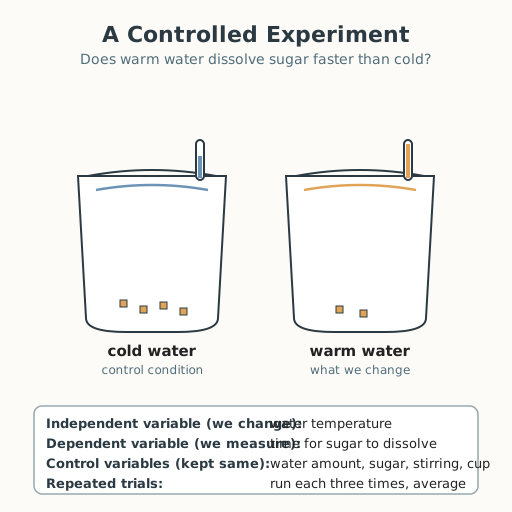
- Study the worked example (12 min). Question: does warm water dissolve sugar faster than cold water? Hypothesis: warm water will dissolve the sugar faster. Independent variable: water temperature. Dependent variable: time for the sugar to disappear. Control variables: same amount of water, same amount of sugar, same stirring, same cup. Control condition: the cold-water cup (the unchanged comparison). Repeated trials: run each three times and average. Trace each part and say why it matters.
- Design your own (20 min). Choose a new question from the list (or your own): Does light make a plant grow taller? Does salt make water freeze slower? Does a heavier ball roll farther on a ramp? Fill in every box of the design sheet. State your hypothesis, your variables, your control, and how many trials you would run.
- Peer-check (5 min). Swap sheets with a partner. Check: is one thing changed? Is the rest the same? Is there a comparison? Are there repeated trials? Fix what is missing.
- Close (5 min). Share one part of your design you are proud of. A good experiment is a fair test — and a fair test is how we learn what is really true.
Differentiation
- Support: Provide the variables pre-listed and ask learners to label each one; give the hypothesis as a fill-in (“I think ___ will ___ because ___”).
- Extension: Trade designs with a partner and find a lurking variable — something that could change without you noticing — then rewrite the design to control it.
Assessment
- Formative (observation): Can the learner name all six parts and place them in a new design?
- Portfolio artifact: The completed experiment design sheet, kept in the portfolio.
Home connection
Find a small everyday question at home (does a wet cloth dry faster in sun or shade?) and sketch a one-variable fair test for it. Bring your sketch to the next lesson.
Resources
- On working scientifically — variables, fair tests, and bias: BBC Bitesize (KS3), “Working scientifically,” https://www.bbc.co.uk/bitesize/topics/zsg6m39 (S-242).
- On turning pattern into cause: Bradford Hill (1965), https://en.wikipedia.org/wiki/Bradford_Hill_criteria (S-306).
- On explicit instruction and worked examples: Kirschner, Sweller & Clark (2006), https://doi.org/10.1207/s15326985ep4102_1 (S-011).