Lesson 03 — Revising Models When New Evidence Appears
Learners see how a scientific **model is revised — not thrown away — when new evidence appears**, using the shift from the "bad air" (miasma) model to the germ model of disease. They trace the evidence: Semmelweis's handwashing data and Snow's cholera map.
Objectives
Objectives
- D06.S1.08.02 Explain how scientific models are revised when new evidence appears, using a historical example.
Essential question
How are scientific models revised — not thrown away — when new evidence appears?
Key vocabulary
Materials
Standard materials
- Model-revision sheet · 1 per learner A two-column sheet — old model on the left, new model on the right, with a "what evidence changed it" row
- Story cards · 1 set per group Cards telling the Semmelweis and Snow stories in short, ordered steps to arrange
Low-tech / no-cost
- A shared board or large paper Draw the two models side by side and fill the "what changed it" row together
- Voice and retelling Tell the two stories aloud and have learners retell the evidence in their own words
Enriched / lab & device
- A short video or animation on germ theory · 1 An age-appropriate account of the miasma-to-germs shift, to watch and then retell
- A printed cholera map (Broad Street, 1854) · 1 per group John Snow's spot map to examine and ask what pattern it reveals
Works in different contexts
- large-group Tell the stories once to the whole group, then small groups arrange the story cards and fill the revision sheet
- multi-age Younger learners match each model to a picture; older learners state what evidence changed the model and why it was kept-and-revised
- self-directed A learner reads the two stories, fills the revision sheet, and writes one sentence on why the old model was revised, not simply discarded
- level-grouped Learners ready to extend name a second historical model revision and state the evidence that drove it
- outdoor-only Use a real example outdoors — a stream that has changed course — and ask what model explained it before, and what new evidence changed it
Lesson 3 — Revising Models When New Evidence Appears
Summary
Learners see how a scientific model is revised — not thrown away — when new evidence appears, using the shift from the “bad air” (miasma) model to the germ model of disease. They trace the evidence: Semmelweis’s handwashing data (1847) and Snow’s cholera map (1854).
Objectives
- Explain how scientific models are revised when new evidence appears, using a historical example. (D06.S1.08.02)
Connection
Have you ever been sure of something, then changed your mind when you learned more? Science works the same way, but on purpose. When new evidence shows up that a model cannot explain, scientists do not start from nothing — they revise the model, keeping the parts that still work and replacing the parts that do not. That is how humans went from “sickness floats in bad air” to “tiny living things can make us sick.” Today you follow that very revision, step by step.
Materials
- Model-revision sheet
- Story cards
Preparation
- Copy the revision sheet and story cards.
- Retrieval: from Grade 7, recall that a claim needs evidence, and that a pattern alone does not prove a cause (S-306).
Facilitator note
This lesson is written to the learner (“you”). The idea to land: a scientific model is a simplified picture of how something works; when new evidence appears that the model cannot explain, the model is revised — kept where it still fits, changed where it does not — rather than thrown away entirely. The worked historical example: (1) the old “miasma” model said disease came from bad air; (2) Semmelweis (Vienna, 1847) showed that washing hands with a chlorine solution sharply cut deaths from childbed fever — evidence the “air” model could not explain (S-357); (3) Snow (London, 1854) mapped cholera cases and traced them to one water pump, showing the cause moved through water, not air (S-358); (4) the model was revised to the germ model — tiny living things cause disease — which kept the useful idea that disease spreads while replacing the wrong idea about how. The ethics lens: Semmelweis’s evidence was dismissed for years — an honest reminder that who speaks can delay what is true, and that science is a human, sometimes unjust, practice. The egalitarian lens: Snow’s map showed cholera struck the people who shared a pump — clean water is a matter of justice, not only of health. The global lens: cholera pandemics crossed borders, and the germ model was built by evidence gathered in many places — long before 1800s Europe, other traditions had reached toward the same idea: Ibn Sina (Avicenna), in Persia around 1025 CE, wrote that sickness could spread through water and soil by unseen agents, and smallpox variolation — a deliberate, evidence-based inoculation — was practiced in China, India, and parts of Africa centuries before it reached Europe. The germ model is a shared human achievement, not one region’s alone. The critical-thinking lens: notice the model was revised because of evidence, not authority — that is what makes it trustworthy. Keep it honest: the story is documented history, told as a model-revision example, and it is held as evidence, not creed (philosophy §11).
Procedure
- Recall (5 min). From Grade 7: why does a pattern alone not prove a cause? Today we watch a cause get found — and a model get revised.
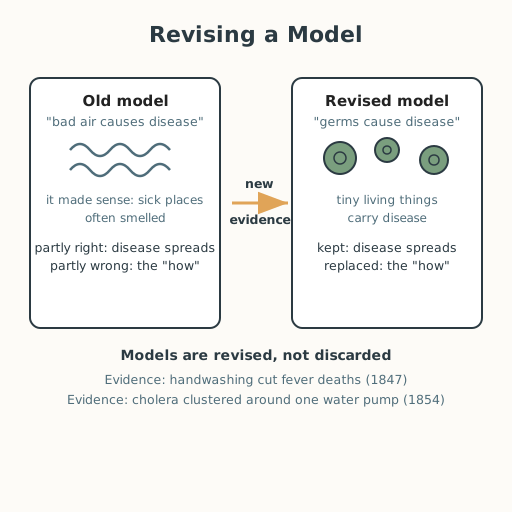
- Meet the old model (8 min). Long ago, many people believed disease came from miasma — “bad air.” It made sense: sick places often smelled. But the miasma idea was only one old model: in Persia a thousand years ago, the scholar Ibn Sina wrote that sickness can spread through water and soil, and people in China, India, and parts of Africa were already inoculating against smallpox. Different places held different models; evidence would sort them out. A model is a simplified picture; this one was partly right (disease spreads) and partly wrong (the how).
- Meet the new evidence (15 min). Semmelweis (1847): doctors went from dissecting bodies straight to delivering babies; when he had them wash hands with a chlorine solution, deaths from childbed fever fell sharply. Snow (1854): a cholera outbreak in London — he mapped the cases and found they clustered around one water pump on Broad Street. Remove the pump’s handle, and the cases dropped. The “bad air” model could not explain either fact.
- Revise the model (10 min). The model was revised, not discarded: the useful part — disease spreads from person to person or place to place — stayed; the wrong part — that it floats in bad air — was replaced. The new model: tiny living things (germs) cause disease. Fill in the two-column sheet: old model, new evidence, revised model.
- Arrange the story (7 min). In a group, put the story cards in order: miasma → handwashing data → the map → the pump → germ theory.
- Close (5 min). Share one way the old model was kept and one way it was changed. A model that can be revised is a model that can grow closer to the truth.
Differentiation
- Support: Provide the two models pre-written and ask learners to match each piece of evidence to the model it changed.
- Extension: Name a second historical model revision (for example, the idea that continents move — you will meet it later this unit) and state the evidence that drove it.
Assessment
- Formative (observation): Can the learner explain what evidence changed the model and why the model was revised rather than discarded?
- Portfolio artifact: The completed model-revision sheet, kept in the portfolio.
Home connection
Ask at home: is there anything your family once believed about health that changed when they learned something new? Compare with the miasma-to-germs story.
Resources
- On Semmelweis and handwashing: Encyclopaedia Britannica, “Ignaz Semmelweis,” https://www.britannica.com/biography/Ignaz-Semmelweis (S-357).
- On Snow and the Broad Street pump: CDC, “150th Anniversary of John Snow and the Pump Handle,” https://www.cdc.gov/mmwr/preview/mmwrhtml/mm5334a1.htm (S-358).
- On hand hygiene as current practice: WHO hand-hygiene guidance (S-016).
- On explicit instruction and worked examples: Kirschner, Sweller & Clark (2006), https://doi.org/10.1207/s15326985ep4102_1 (S-011).