Lesson 07 — Electric and Magnetic Fields
Learners explain **electric and magnetic fields** and how they interact to produce **forces and currents**. They trace the chain — moving charge → field → force → current — and see how it makes motors and generators work.
Objectives
Objectives
- D06.S3.08.02 Explain electric and magnetic fields and how they interact to produce forces and currents.
Essential question
How do electric and magnetic fields interact to produce forces and currents?
Key vocabulary
Materials
Standard materials
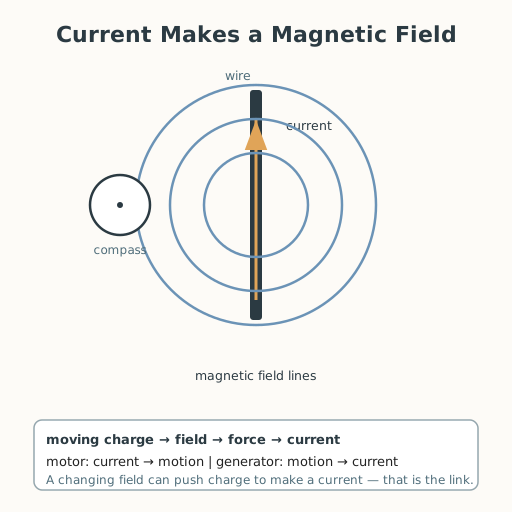
- Fields sheet · 1 per learner A diagram of a current-carrying wire with concentric magnetic field lines and a compass, to label
- Field cards · 1 set per group Cards for the chain — moving charge → field → force → current → motor/generator — to arrange in order
Low-tech / no-cost
- A shared board or large paper Draw the field lines and the chain together
- A magnet and a compass (if any) Show a real field acting at a distance; if none, describe it aloud
Enriched / lab & device
- A battery, wire, and compass · 1 set per group A safe, simple circuit to see the compass needle move when current flows — the field made visible
- A small hand-crank generator or toy motor · 1 Turn it to see motion become current (and current become motion)
Works in different contexts
- large-group Demonstrate the compass-and-wire once to the whole group, then small groups arrange the field cards and label the sheet
- multi-age Younger learners match a magnet to what it attracts; older learners trace the moving-charge-to-current chain and explain a motor or generator
- self-directed A learner labels the sheet, arranges the chain, and writes one sentence on how a generator works
- level-grouped Learners ready to extend explain why an electromagnet can be turned on and off, and where that is useful
- outdoor-only Use a compass to find north, and discuss Earth's magnetic field and how it guides travelers
Lesson 7 — Electric and Magnetic Fields
Summary
Learners explain electric and magnetic fields and how they interact to produce forces and currents. They trace the chain — moving charge → field → force → current — and see how it makes motors and generators work.
Objectives
- Explain electric and magnetic fields and how they interact to produce forces and currents. (D06.S3.08.02)
Connection
Hold two magnets near each other and feel the invisible push or pull between them — a force that works across empty space. That invisible region is a field, and it is not just a curiosity: the light in your room, the hum of a fan, and the charging of a phone all depend on the dance between electric and magnetic fields. Today you learn to name that dance and see where it powers your life.
Materials
- Fields sheet
- Field cards
Preparation
- Copy the fields sheet and field cards.
- Retrieval: from Grade 5, recall magnets attract and repel and act at a distance; from Grade 6, recall that a circuit carries a current.
Facilitator note
This lesson is written to the learner (“you”). The ideas to land: (1) a field is a region where a force acts without touching — an electric field surrounds electric charge, a magnetic field surrounds a magnet; (2) an electric current is moving charge; (3) a current in a wire produces a magnetic field around it, and a changing or moving magnetic field can push charge to make a current — that is the interaction; (4) this link is the basis of motors (current → force → motion) and generators (motion → changing field → current). Model the chain once (worked example, S-011), using the compass-and-wire demo if available (S-360). The technology lens: generators and motors run the modern world — but note that the principle is universal and was discovered and applied worldwide, not in one place. The egalitarian lens: electricity is not yet available to everyone — hundreds of millions still live without reliable power, and access is a matter of justice, not luck (S-052). The critical-thinking lens: “current makes a field, and a changing field makes a current” is a precise, checkable claim, not a story. The global lens: Earth itself has a magnetic field that guides compasses and has helped travelers and sailors find their way for centuries — the magnetic compass was first developed in China and then spread along the world’s trade and sea routes (S-187). Keep the physics precise and cite the electromagnetism source (S-360); hold the field as a model with strong evidence, not a visible thing you can point to (philosophy §11).
Procedure
- Recall (5 min). From Grade 5: what do magnets do, and how can they act without touching? From Grade 6: what flows in a circuit? Today we connect the two.
- Meet the field (10 min). A field is a region where a force acts at a distance. An electric field surrounds electric charge; a magnetic field surrounds a magnet. A current is moving charge.
- Watch them interact (12 min). A current in a wire produces a magnetic field around it — a compass needle near the wire swings. And a moving or changing magnetic field can push charge to make a current. Electric and magnetic fields are two faces of one interaction.
- Trace the chain (10 min). Arrange the field cards: moving charge → field → force → current. Then two machines: a motor turns current into motion; a generator turns motion into current.
- Label the sheet (8 min). On the fields sheet, label the wire, the current, the field lines, and the compass. Write one sentence for each machine.
- Close (5 min). Share one way electric and magnetic fields touch your day. An invisible field powers much of the world — and not everyone yet shares in it.
Differentiation
- Support: Provide the chain pre-ordered and ask learners to match each card to its meaning.
- Extension: Explain why an electromagnet can be switched on and off, and name one place that is useful (a crane, a door lock, a speaker).
Assessment
- Formative (observation): Can the learner explain a field, and how current makes a magnetic field and a changing field makes a current?
- Portfolio artifact: The labeled fields sheet, kept in the portfolio.
Home connection
Look around home for anything with a motor or that plugs in. Ask: where is a current flowing, and where is a field doing work?
Resources
- On electromagnetism, currents, and fields: BBC Bitesize (KS3), “Electromagnetism,” https://www.bbc.co.uk/bitesize/topics/zrvbkqt/articles/z7922v4 (S-360).
- On magnets acting at a distance and compasses: BBC Bitesize (KS2, NI), “What is a magnet?,” https://www.bbc.co.uk/bitesize/articles/zpvcrdm (S-187).
- On light and energy access: Our World in Data, “Light at Night,” https://ourworldindata.org/light-at-night (S-052).
- On explicit instruction and worked examples: Kirschner, Sweller & Clark (2006), https://doi.org/10.1207/s15326985ep4102_1 (S-011).