Lesson 06 — Atoms, Elements, Compounds, and Reactions
Learners explain **atoms, elements, and compounds**, and how a **chemical reaction rearranges atoms** — never creating or destroying them — to form new substances. They build water from hydrogen and oxygen and count atoms before and after.
Objectives
Objectives
- D06.S3.08.01 Explain atoms, elements, and compounds, and how chemical reactions rearrange atoms to form new substances.
Essential question
How do atoms, elements, and compounds rearrange in a chemical reaction to form new substances?
Key vocabulary
Materials
Standard materials
- Atom-building sheet · 1 per learner A diagram of an atom (nucleus with protons and neutrons, electrons around it) and a space to draw a simple reaction
- Element tiles · 1 set per group Tiles for a few elements (H, O, C, N) with symbols and colors, to combine into compounds
Low-tech / no-cost
- A shared board or large paper Draw atoms and reactions together; use circles or stones to stand for atoms
- Found objects as atoms Seeds, pebbles, or buttons stand in for atoms of different elements to combine and rearrange
Enriched / lab & device
- A molecular model kit (or clay and sticks) · 1 per group Build water (H₂O) and rearrange atoms to make a new substance
- A short animation of a chemical reaction · 1 An age-appropriate clip showing atoms rearranging, not appearing or vanishing
Works in different contexts
- large-group Model the water reaction once to the whole group, then small groups combine element tiles into compounds and count atoms before and after
- multi-age Younger learners match element symbols to pictures; older learners build the reaction and show atoms are conserved
- self-directed A learner builds water from element tiles, writes the reaction, and self-checks that the same atoms are present on both sides
- level-grouped Learners ready to extend balance a second reaction (e.g., carbon + oxygen → carbon dioxide) and count each kind of atom
- outdoor-only Look at rust or a burning ember (safely, at a distance) and ask what is rearranging here
Lesson 6 — Atoms, Elements, Compounds, and Reactions
Summary
Learners explain atoms, elements, and compounds, and how a chemical reaction rearranges atoms — never creating or destroying them — to form new substances. They build water from hydrogen and oxygen and count atoms before and after.
Objectives
- Explain atoms, elements, and compounds, and how chemical reactions rearrange atoms to form new substances. (D06.S3.08.01)
Connection
Everything you can touch — water, air, your own hand — is made of tiny pieces called atoms, too small to see. A handful of atoms joined one way makes the water you drink; the very same atoms joined another way make something else entirely. When iron rusts, when a candle burns, when bread bakes, atoms are not being created or destroyed — they are being rearranged. Today you learn to see those invisible rearrangements.
Materials
- Atom-building sheet
- Element tiles
Preparation
- Copy the atom-building sheet and element tiles.
- Retrieval: from Grade 3 and 6, recall the states of matter and that matter is made of particles too small to see; from Grade 7, recall that matter is reused, not created new.
Facilitator note
This lesson is written to the learner (“you”). The ideas to land: (1) an atom is the smallest piece of an element — with a nucleus of protons and neutrons, and electrons around it; (2) an element is a substance made of one kind of atom, and elements are organized on the periodic table; (3) a compound is a substance made of two or more different elements chemically joined (a molecule is a group of atoms bonded together); (4) in a chemical reaction, atoms are rearranged to form new substances, and no atoms are created or destroyed — that is why the total count is the same before and after. Worked example: hydrogen + oxygen → water (2 H₂ + O₂ → 2 H₂O) — model it with tiles, counting atoms on each side (S-359). The critical-thinking lens: “atoms are conserved” is a checkable fact, not a guess — the same idea as Grade 7’s “matter is reused, not created new.” The technology lens: every material we make — metals, plastics, medicines — is atoms rearranged; the same atoms can become a medicine or a poison depending on how they are joined. The environment lens: reactions like rusting, burning, and photosynthesis are atoms rearranging, and the atoms stay on Earth (S-253). The global lens: the same elements make up every place on Earth — the oxygen in the air of one country is the same element as the oxygen in another. Keep claims precise and cite the atoms/elements/reactions source (S-359); hold the invisible atom as a model with overwhelming evidence, not creed (philosophy §11).
Procedure
- Recall (5 min). From Grade 3 and 6: what is matter made of? From Grade 7: what did we mean when we said matter is reused, not created new? Today we meet the atoms that do the reusing.
- Meet the atom (10 min). An atom is the smallest piece of an element — a nucleus of protons and neutrons, with electrons around it. An element is a substance made of one kind of atom (like hydrogen, oxygen, carbon). The periodic table lists them all.
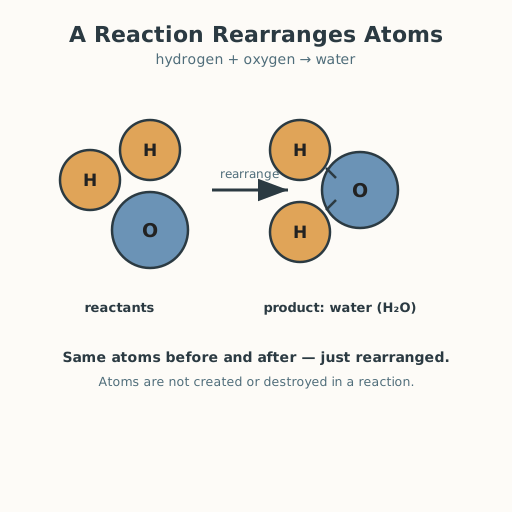
- Meet compounds (8 min). A compound is made of two or more different elements chemically joined. A molecule is a group of atoms bonded together. Water, H₂O, is a compound: two hydrogens joined to one oxygen.
- Watch a reaction (15 min). A chemical reaction rearranges atoms to make new substances. Worked example: hydrogen + oxygen → water. Count the atoms before and after — the same number of each kind, just rearranged. Build it with element tiles.
- Build your own (7 min). With a group, build another reaction — carbon + oxygen → carbon dioxide (CO₂) — and count atoms on each side. Same atoms, new substance.
- Close (5 min). Share one thing you now know about what happens when something rusts, burns, or bakes. Atoms are rearranged, never made or lost.
Differentiation
- Support: Provide the reaction pre-built and ask learners to count each kind of atom on both sides.
- Extension: Balance a reaction with more parts (e.g., two water molecules forming) and explain conservation of atoms in your own words.
Assessment
- Formative (observation): Can the learner explain atom, element, and compound, and show that a reaction rearranges the same atoms?
- Portfolio artifact: The completed atom-building sheet, kept in the portfolio.
Home connection
Find something at home that changed — a brown apple, a rusted nail, baked bread — and ask: what atoms were rearranged here?
Resources
- On atoms, elements, compounds, and reactions: BBC Bitesize (KS3), “Atoms, elements and compounds,” https://www.bbc.co.uk/bitesize/topics/zstp34j, and “Conservation of mass,” https://www.bbc.co.uk/bitesize/topics/zypsgk7/articles/zxh7jsg (S-359).
- On matter being reused, not created new: National Geographic Education, “The Carbon Cycle,” https://education.nationalgeographic.org/resource/carbon-cycle/ (S-253).
- On explicit instruction and worked examples: Kirschner, Sweller & Clark (2006), https://doi.org/10.1207/s15326985ep4102_1 (S-011).