Lesson 10 — Capstone: Systems, Evidence & Models — Putting It Together
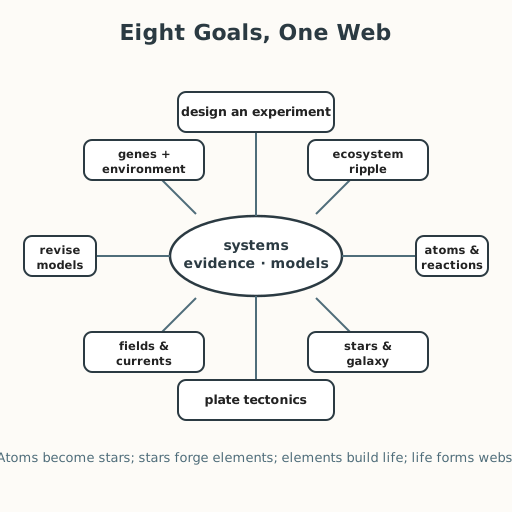
Learners synthesize the unit's **eight goals** into one web around **systems, evidence, and models**, recalling each goal, writing one sentence and drawing one picture for each, and choosing one goal to explain fully. This spaced-retrieval pass closes the unit.
Objectives
Objectives
- D06.S1.08.01 Design a controlled experiment with a clear hypothesis, variables, and a plan for repeated trials and controls.
- D06.S1.08.02 Explain how scientific models are revised when new evidence appears, using a historical example.
- D06.S2.08.01 Explain how organisms inherit and express traits through genes (DNA) and how the environment interacts with genes.
- D06.S2.08.02 Analyze how changes in one population ripple through an ecosystem and can reduce or restore balance.
- D06.S3.08.01 Explain atoms, elements, and compounds, and how chemical reactions rearrange atoms to form new substances.
- D06.S3.08.02 Explain electric and magnetic fields and how they interact to produce forces and currents.
- D06.S4.08.01 Describe the life cycle of stars, the formation of elements, and our place in the galaxy.
- D06.S4.08.02 Explain how plate tectonics shapes continents, mountains, and ocean basins over millions of years.
Essential question
How do all eight goals of this unit fit together as one way of seeing the world — systems, evidence, and models?
Key vocabulary
Materials
Standard materials
- Capstone map sheet · 1 per learner A one-page map of the eight goals, with a space to write one sentence and draw one picture for each
- Eight goal cards · 1 set per group One card per goal, to sort and connect into a single web
Low-tech / no-cost
- A shared board or large paper Build the eight-goal web together on one big sheet
- Voice and memory Recall each goal aloud from memory before writing, with no cards needed
Enriched / lab & device
- A digital slide or poster tool · 1 per group Build the web digitally and present it
- The full portfolio assembled · 1 per learner Gather all eight portfolio artifacts from the unit into one place for a final reflection
Works in different contexts
- large-group Build the web once as a whole class on the board, then each learner completes their own map and shares one goal
- multi-age Younger learners match each goal to a picture; older learners write the connecting sentence for each and explain the whole web
- self-directed A learner completes the map from memory, self-checks each goal is covered, and writes a one-paragraph summary of the whole unit
- level-grouped Learners ready to extend choose one goal and explain how it connects to at least two others in the web
- outdoor-only Build the web outdoors, and for each goal find or point to something real nearby that it explains
Lesson 10 — Capstone: Systems, Evidence & Models — Putting It Together
Summary
Learners synthesize the unit’s eight goals into one web around systems, evidence, and models, recalling each goal, writing one sentence and drawing one picture for each, and choosing one goal to explain fully. This spaced-retrieval pass closes the unit.
Objectives
- Recall and connect all eight goals: designing a controlled experiment, revising models, genes and environment, ecosystem ripples, atoms and reactions, fields, stars, and plate tectonics. (D06.S1.08.01, D06.S1.08.02, D06.S2.08.01, D06.S2.08.02, D06.S3.08.01, D06.S3.08.02, D06.S4.08.01, D06.S4.08.02)
Connection
You began this unit by remembering what you already knew, and you have added eight new ways of seeing — from the atoms in a drop of water to the stars that made the atoms in your body. Now you weave them together. A scientist is not someone who knows eight facts; a scientist is someone who can see how the pieces connect into one living picture of the world. Today you build that picture.
Materials
- Capstone map sheet
- Eight goal cards
Preparation
- Copy the capstone map sheet and goal cards.
- Retrieval: this whole lesson is a retrieval and synthesis pass — the “science of learning” payoff of the unit (S-039). Have the learner’s earlier portfolio artifacts on hand.
Facilitator note
This lesson is written to the learner (“you”). It is the closing capstone and synthesis. The goal: each learner recalls all eight goals and connects them into one web around systems, evidence, and models. The eight goals are: (1) design a controlled experiment — hypothesis, variables, controls, repeated trials; (2) revise models when evidence appears — miasma → germ theory, and continental drift → plate tectonics; (3) genes + environment shape inheritance and expression; (4) one population ripples through an ecosystem, reducing or restoring balance; (5) atoms, elements, compounds, and reactions rearrange matter; (6) electric and magnetic fields produce forces and currents; (7) stars forge the elements and we live in the Milky Way; (8) plate tectonics shapes continents, mountains, and ocean basins. This is a retrieval and spacing moment — having learners recall rather than re-read is what makes the learning durable (S-039). Keep assessment mastery, not ranking: a learner who cannot yet recall a goal simply revisits that lesson’s artifact and tries again — “not yet” is information, never a verdict. The four lenses, together: the critical-thinking lens asks what evidence supports each claim; the ethics lens asks what is right and who is affected; the egalitarian lens asks who benefits and who is left out; the global lens asks how this looks in other places and times; the environment lens asks what this means for the living Earth. Origins remain held as models with evidence, never creed (philosophy §11). Celebrate the collective: each learner’s map is a thread in one class web.
Procedure
- Recall, don’t peek (8 min). Without looking at notes, list the unit’s eight goals from memory. What can you remember? (That is the point — recalling is the learning.)
- Check and fill (5 min). Compare with the eight goal cards. For any goal you missed, open that lesson’s artifact and add it. “Not yet” is not a failure; it is a map of what to revisit.
- Build your web (15 min). On the capstone map, write one sentence and draw one picture for each of the eight goals. Connect them to the center: systems, evidence, models.
- Choose a deep dive (15 min). Pick the one goal that most interested you and explain it fully to a partner — what it means, what evidence supports it, and one way it touches real life. Then listen to your partner’s.
- Weave the class web (7 min). As a group, add everyone’s maps to one shared web. Notice how the goals touch: atoms become stars, stars forge elements, elements build life, life forms webs.
- Close (5 min). Look at your map. You did not memorize eight facts — you built a way of seeing. Carry it with you.
Differentiation
- Support: Work from the goal cards with pictures; choose one goal to explain instead of eight.
- Extension: Choose one goal and explain how it connects to at least two others (for example: stars forge the atoms that reactions rearrange, and plate tectonics is a model that was revised).
Assessment
- Summative (portfolio): The completed capstone map — all eight goals, each with a sentence and a picture — kept in the portfolio.
- Self/peer: Learners self-check each goal is present and give one specific “I understood this when you said…” to a partner.
- Mastery, not ranking: A learner missing a goal revisits its artifact and completes it; the map is finished when it is finished, not before.
Home connection
Show someone at home your capstone map and explain one goal end to end. Teaching it is the surest sign you have learned it.
Resources
- On retrieval practice and spacing: Dunlosky et al. (2013), https://doi.org/10.1177/1529100612453266 (S-039).
- On explicit instruction and worked examples: Kirschner, Sweller & Clark (2006), https://doi.org/10.1207/s15326985ep4102_1 (S-011).