Lesson 09 — Critiquing a Design: Function, Materials, Fairness, Footprint
Learners critique a design with **evidence**, using four lenses — **function, materials, fairness, and environmental footprint** — and separating observation from judgment. They examine everyday objects, asking who can use them, who is left out, and what they cost the Earth.
Objectives
Objectives
- D07.S4.08.02 Critique a design using evidence about its function, materials, fairness, and environmental footprint.
Essential question
How do I critique a design using evidence about its function, materials, fairness, and environmental footprint?
Key vocabulary
Materials
Standard materials
- Design critique sheet · 1 per learner A frame with four lenses — function, materials, fairness, footprint — each with space for evidence
- Two designed objects to critique · 2 per pair Everyday objects (or photos of them) chosen to differ in function, materials, fairness, and footprint
Low-tech / no-cost
- The learners' own prototypes from Lesson 8 Critique a peer's prototype as the subject, with no special objects needed
- A shared board or large paper Write the four lenses on the board; learners fill the frame by hand
Enriched / lab & device
- A product catalog or images of designs · 1 per group Examine contrasting designs from around the world — a gourd water vessel and a plastic bottle, a hand-woven basket and a cardboard box, a wooden stool and a molded plastic chair
- A shared document or slide · 1 per group Write the critique collaboratively and compare evidence
Works in different contexts
- large-group Critique one object together and model the four lenses, then pairs critique a second and share one evidence-based sentence each
- multi-age Younger learners answer "does it work?" and "what is it made of?"; older learners complete all four lenses with evidence
- self-directed A learner critiques one object alone, self-checking that every judgment cites something observed
- level-grouped Learners ready to extend evaluate an object's full life cycle — materials, making, use, disposal — and propose one improvement
- outdoor-only Critique a found or built object outdoors — a tool, a shelter, a water carrier — using the four lenses
Lesson 9 — Critiquing a Design: Function, Materials, Fairness, Footprint
Summary
Learners critique a design with evidence, using four lenses — function, materials, fairness, and environmental footprint — and separating observation from judgment. They examine everyday objects, asking who can use them, who is left out, and what they cost the Earth.
Objectives
- Critique a design using evidence about its function, materials, fairness, and environmental footprint. (D07.S4.08.02)
- Separate observation from judgment. (D07.S4.08.02)
Connection
Every object you touch today was designed — the cup, the chair, the shoe, the phone — by someone who made a long chain of choices. A critique asks four honest questions about those choices: does it work? what is it made of? who can use it — and who is left out? what does it cost the Earth? A beautiful object that breaks, or that only some hands can hold, or that poisons the water when thrown away, is not a good design no matter how it looks. Learning to ask these four questions makes you a sharper user of the made world — and a fairer maker of it.
Materials
- Design critique sheet
- Two designed objects to critique
Preparation
- Copy the design critique sheet; choose and gather two everyday objects (or photos) that differ in function, materials, fairness, and footprint.
- Retrieval: from Grade 7, recall explaining how a design choice trades off cost, materials, function, and environmental impact — today we turn that into a full, evidence-based critique.
Facilitator note
This lesson is written to the learner (“you”). The skill to land: a design critique answers four questions with evidence — (1) function (does it work?), (2) materials (what is it made of, and what happens to it later?), (3) fairness (who can use it, and who is left out?), and (4) footprint (what does it cost the Earth across its whole life — materials, making, use, disposal?) — and separates observation from judgment, with judgment citing evidence. This is a skill, so model the critique once on one object, then let learners practice in pairs (explicit instruction carries novice skills — S-011). The critical-thinking lens: “good design is judged on all four, not one” is the evidence habit applied to made things. The egalitarian lens is central: fairness asks who is left out — a design that only some people can use is a fairness problem, and universal design is the frame for building access in from the start (S-369). The environment lens: footprint asks about the whole life cycle — materials, making, use, and disposal — not just one moment (S-371). The technology lens: a machine or tool is a design made real, and every design choice has consequences for people and the planet. The ethics lens: a critique describes the object and its consequences, never the designer, and it weighs trade-offs honestly rather than pretending any design is perfect. Keep the tone generative: critique helps us choose and make better, fairer, kinder things.
Procedure
- Recall (5 min). From Grade 7: how does a design choice trade off cost, materials, function, and environmental impact? Today we turn that into critique.
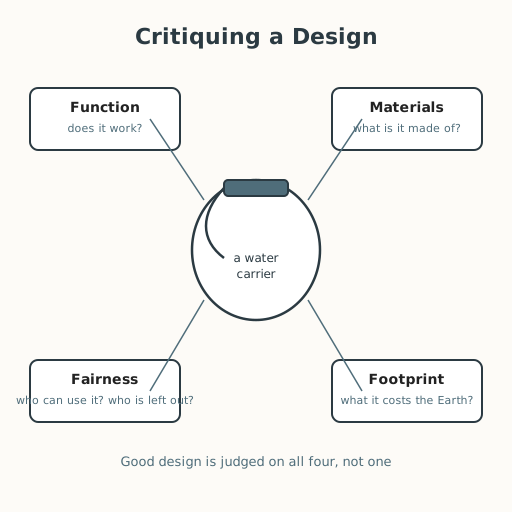
- Meet the four lenses (10 min). Look at the design critique sheet. Four questions: function (does it work?), materials (what is it made of?), fairness (who can use it — who is left out?), footprint (what does it cost the Earth, from making to disposal?). These four make a critique complete.
- Modeled critique (10 min). Together, critique one object (for example, a paper cup or a wooden stool). Answer all four questions with evidence: what it does, what it is made of, whose hands can hold it, and what happens to it when it is thrown away.
- Practice in pairs (20 min). Critique a second object. Fill in the four lenses. Rule: every judgment sentence must name something you observed about the object.
- Peer-check (5 min). Swap sheets. Check: is each judgment backed by evidence? Are all four lenses addressed? Fix what is missing.
- Close (5 min). Share one evidence-based sentence: “This works because ___, but it leaves out ___.” That is a critique that can change how things are made.
Differentiation
- Support: Answer two lenses (function and materials) with a sentence starter (“It works because ___, and it is made of ___”).
- Extension: Evaluate the object’s full life cycle — materials, making, use, disposal — and propose one improvement that raises fairness or lowers footprint.
Assessment
- Formative (observation): Can the learner name evidence for function and fairness and connect a judgment to it?
- Peer/portfolio artifact: The completed design critique sheet, kept in the portfolio.
Home connection
At home, pick one everyday object and answer two questions with evidence: does it work, and who might be left out of using it? Bring your answers to the next lesson.
Resources
- On designing for everyone (the principles of universal design): The Center for Universal Design, NC State University, https://design.ncsu.edu/research/center-for-universal-design/ (S-369).
- On a design’s environmental footprint across its life cycle: U.S. Environmental Protection Agency, “Sustainable Materials Management,” https://www.epa.gov/smm (S-371).
- On explicit instruction and worked examples: Kirschner, Sweller & Clark (2006), https://doi.org/10.1207/s15326985ep4102_1 (S-011).