Lesson 02 — Keeping Food Safe: Clean, Separate, Cook, Chill
Learners explain **how to handle food safely** using the four keys — **clean, separate, cook, chill** — and sort food-handling scenes into safe and unsafe. They learn that unsafe food can cause illness, and that most foodborne illness is preventable with simple habits.
Objectives
Objectives
- D03.S3.08.01 Plan and prepare a simple balanced meal using safe food-handling practices.
Essential question
How do I handle food safely so that what I prepare keeps me well instead of making me sick?
Key vocabulary
Materials
Standard materials
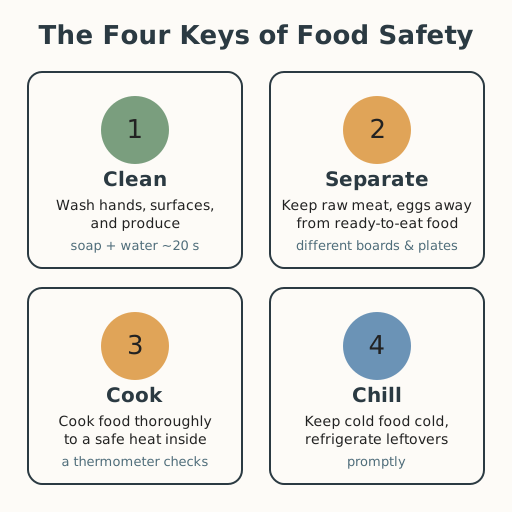
- Four-keys food-safety sheet · 1 per learner A one-page diagram of clean, separate, cook, and chill, with space to write one action for each
- Scenario cards · 1 set per group Small food-handling scenes (washing produce, cutting raw meat on a board, cooling leftovers, cooking eggs) to sort as safe or unsafe
Low-tech / no-cost
- A shared board or large paper Draw the four keys together and act out each scenario with voice and motion
- Soap and water, if available Practice a real 20-second handwash with song or counting
Enriched / lab & device
- A food thermometer · 1 per group Show how a thermometer checks that food reaches a safe temperature inside
- A refrigerator or cooler and labels · 1 set Practice placing foods in the right place and labeling leftovers with a date
Works in different contexts
- large-group Model each of the four keys once to the whole group, then small groups sort the scenario cards and report one finding
- multi-age Younger learners match each scenario to a picture; older learners explain *why* it is safe or unsafe in one sentence
- self-directed A learner completes the four-keys sheet, sorts the scenarios, and writes one rule for each key in their own words
- level-grouped Learners ready to extend explain *why* temperature matters — how heat and cold slow or stop the germs that cause illness
- outdoor-only Discuss keeping food covered, cool, and away from insects and animals when eating outdoors, and clean water for washing
Lesson 2 — Keeping Food Safe: Clean, Separate, Cook, Chill
Summary
Learners explain how to handle food safely using the four keys — clean, separate, cook, chill — and sort food-handling scenes into safe and unsafe. They learn that unsafe food can cause illness, and that most foodborne illness is preventable with simple habits.
Objectives
- Explain the four keys of safe food handling — clean, separate, cook, chill. (D03.S3.08.01)
- Sort food-handling practices into safe and unsafe and say why. (D03.S3.08.01)
Connection
Have you ever heard of someone getting sick after eating food that sat out too long, or that touched a raw ingredient? That kind of illness comes from tiny germs that can grow on food when it is handled the wrong way. The good news: a few simple habits stop most of them before they ever reach you. Today you learn four keys that turn an ordinary kitchen into a safe one — clean, separate, cook, and chill.
Materials
- Four-keys food-safety sheet
- Scenario cards
Preparation
- Copy the four-keys sheet and scenario cards; have soap and water ready for a real handwash.
- Retrieval: from earlier grades, recall handwashing and why it prevents sickness; from Grade 7, recall first aid and when to seek help.
Facilitator note
This lesson is written to the learner (“you”). The facts to land: (1) unsafe food can carry germs (bacteria, viruses, parasites) that cause foodborne illness — and unsafe food is a global problem that affects everyone, rich and poor, in every country (S-372); (2) the four keys are clean (wash hands, surfaces, and produce), separate (keep raw meat/poultry/seafood/eggs away from ready-to-eat food to stop cross-contamination), cook (cook food thoroughly to a safe internal temperature), and chill (keep perishable food cold and refrigerate leftovers promptly) — a common simplification of the WHO’s five keys to safer food, which add “use safe water and raw materials” (S-373); (3) most foodborne illness is preventable through these habits (S-372). This is a skill, so model each key once (a worked example — wash hands for ~20 seconds, use a separate board for raw meat, check that food is cooked through, put leftovers away) before the sort (explicit instruction carries novice skills — S-011). The egalitarian lens: safe food is a right, and not everyone has clean water, refrigeration, or a safe kitchen — a fair world works to change that, and the low-tech variants below honor it. The global lens: every cuisine on Earth has its own food-safety wisdom (drying, fermenting, salting, quick cooking), and no single tradition owns safety. The ethics lens: keeping food safe is a way of caring for the people we cook for. The environment lens: chilling and cooking use energy; using what is fresh and local can mean safer food with a smaller footprint. Keep it factual and calm — this is about germs, not fear; every body can learn to handle food safely.
Procedure
- Recall (5 min). From earlier grades: why do we wash our hands before eating? Today we learn how to keep the food itself safe.
- Meet the four keys (12 min). Look at the four-keys sheet. Clean — wash hands, surfaces, and produce. Separate — keep raw meat, poultry, seafood, and eggs away from food you eat uncooked, so germs don’t cross over. Cook — heat food thoroughly so the inside reaches a safe temperature. Chill — keep cold food cold and refrigerate leftovers quickly (S-373).
- Model one key (8 min). Together, model one: wash hands with soap for about 20 seconds (sing a short song or count). Watch how a real handwash works.
- Sort the scenarios (15 min). In your group, sort the scenario cards into safe and unsafe. For each unsafe one, say which key would fix it.
- Write one rule each (5 min). On your sheet, write one action for each key in your own words.
- Close (5 min). You now hold four keys that protect every meal you will ever make. Next: we use them to plan a balanced meal.
Differentiation
- Support: Sort a smaller set of scenarios with a partner; match each unsafe card to the key that fixes it.
- Extension: Explain why heat and cold help — how cooking kills harmful germs and chilling slows their growth.
Assessment
- Formative (observation): Can the learner name the four keys and correctly sort at least three scenarios, naming the fix?
- Portfolio artifact: The completed four-keys sheet, kept in the portfolio.
Home connection
At home, watch a meal being made and find one place the four keys are followed. Name one place they could be followed even better — and, if it is safe to do so, offer to help.
Resources
- On foodborne illness and safe food handling: World Health Organization, “Food safety,” https://www.who.int/news-room/fact-sheets/detail/food-safety (S-372).
- On the five keys to safer food: World Health Organization, “Five keys to safer food,” https://www.who.int/publications/i/item/9789241594639 (S-373).
- On explicit instruction and worked examples: Kirschner, Sweller & Clark (2006), https://doi.org/10.1207/s15326985ep4102_1 (S-011).