Lesson 03 — Planning a Balanced Meal
Learners **plan a simple, balanced meal** by choosing foods from several groups — vegetables and fruit, grains, protein, and water — using the foods their own family actually eats. They learn that a balanced meal is a *mix*, not any one "right" food, and that many cultures have their own balanced plates.
Objectives
Objectives
- D03.S3.08.01 Plan and prepare a simple balanced meal using safe food-handling practices.
Essential question
How do I plan a simple, balanced meal from the foods my own family eats?
Key vocabulary
Materials
Standard materials
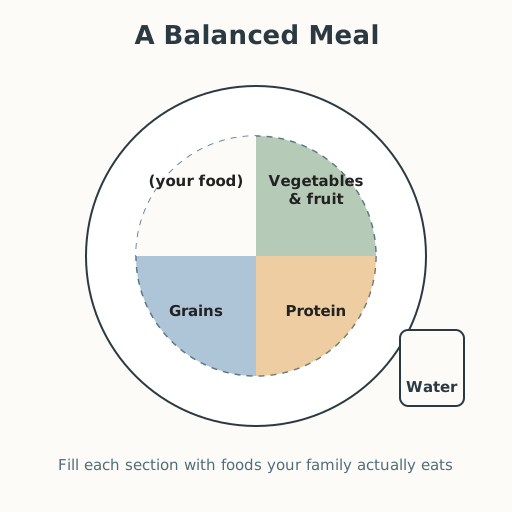
- Balanced-meal plate sheet · 1 per learner A simple plate diagram with spaces for several food groups and a drink, to fill in with real foods the learner's family eats
- Food cards · 1 set per group Cards of common foods (rice, beans, eggs, greens, fruit, fish, bread, lentils, yam, milk, water) to sort into groups and arrange on a plate
Low-tech / no-cost
- A shared board or large paper Draw a big plate and sort the foods by voice and drawing; no printed cards needed
- Real or pictured local foods Use whatever foods are common at home or in the market as the "cards"
Enriched / lab & device
- A slideshow of meals from many cultures · 1 Photos of balanced meals from several regions (rice and lentils, maize and beans, fish and greens, bread and chickpeas) to discuss
- A food-labels collection · 1 set Real or photographed labels to check what a packaged food contributes to a meal
Works in different contexts
- large-group Build one big class plate together on the board, then each learner draws their own with their family's foods
- multi-age Younger learners sort foods into simple groups; older learners explain *why* a mix of groups makes a meal balanced
- self-directed A learner fills the plate sheet with foods their own family eats and writes one sentence explaining the balance
- level-grouped Learners ready to extend plan a full day's meals, not just one, and explain what each meal contributes
- outdoor-only Use a real leaf, a seed, and a stone as stand-ins for "grow food, seed food, water," and plan a meal from what is near
Lesson 3 — Planning a Balanced Meal
Summary
Learners plan a simple, balanced meal by choosing foods from several groups — vegetables and fruit, grains, protein, and water — using the foods their own family actually eats. They learn that a balanced meal is a mix, not any one “right” food, and that many cultures have their own balanced plates.
Objectives
- Plan a simple, balanced meal by choosing foods from several food groups. (D03.S3.08.01)
- Explain what makes the meal balanced, using foods the learner’s own family eats. (D03.S3.08.01)
Connection
Every day, people all over the world sit down to a meal — and the meals could not look more different: rice and lentils in one home, maize and beans in another, bread and greens in a third, fish and fruit in a fourth. Yet the idea behind a balanced meal is shared nearly everywhere: put several different kinds of food together so the body gets what it needs. Today you learn that idea and build a plate from the foods you already know and love.
Materials
- Balanced-meal plate sheet
- Food cards
Preparation
- Copy the plate sheet and food cards; gather real or pictured local foods if possible.
- Retrieval: from earlier grades, recall food groups and that food gives the body energy to grow, play, and learn.
Facilitator note
This lesson is written to the learner (“you”). The idea to land: a balanced meal brings together several food groups so the body gets a mix of nutrients — vegetables and fruit, grains (starchy foods), protein foods (beans, lentils, eggs, fish, meat, nuts), and water to drink (S-038, S-120). It is a mix, not a formula: no single food is “the” healthy food, and no family’s meal is wrong. The standard does not ask for a specific diet, so honor every way of eating — vegetarian, vegan, halal, kosher, gluten-free, and the many food-based dietary guidelines that differ by country and culture (S-118). Use the plate as a worked example: build one plate together (rice + beans + greens + a fruit + water), then let learners build their own from their own family’s foods (explicit instruction carries novice skills — S-011). The egalitarian lens: access to a full, varied plate is not equal everywhere, and food security is a matter of justice (S-120); the lesson never shames a learner for what is or is not on their table. The global lens: many cultures express “balanced” differently — combining a grain with a legume (rice + beans, maize + beans, bread + chickpeas) is a worldwide pattern that makes protein complete. The ethics lens: planning a meal for a family is an act of care. The environment lens: plant foods and foods grown nearby often cost the Earth less — a thread we pick up more in Grade 9. Keep the tone warm and practical; this is about nourishment, never weight or judgment.
Procedure
- Recall (5 min). From earlier grades: what food groups can you name, and why does food matter to a body?
- Meet the balanced plate (10 min). Look at the plate sheet. A balanced meal brings together several groups: vegetables and fruit, grains (rice, bread, maize, noodles, yam), protein (beans, lentils, eggs, fish, meat, nuts), and water to drink (S-038).
- Model one plate (10 min). Together, build a plate on the board: for example, rice + beans + greens + a piece of fruit + water. Name the group each food belongs to.
- Build your own plate (15 min). On your sheet, fill the plate with foods your own family eats — one or more from each group. Draw or write them.
- Explain the balance (5 min). Write one sentence: “My meal is balanced because it has ___ (give the groups).”
- Close (5 min). There is no single “right” meal — only a mix that feeds a body. Next: we prepare a simple meal safely.
Differentiation
- Support: Use a pre-sorted set of foods and match each to its group; build the plate with a partner.
- Extension: Plan a whole day’s meals and name what each meal contributes that the others do not.
Assessment
- Formative (observation): Can the learner build a plate with foods from at least three groups and name them?
- Portfolio artifact: The filled balanced-meal plate sheet, kept in the portfolio.
Home connection
At home, notice one meal your family already makes that is balanced — and name the groups on the plate. If you can, help plan the next meal.
Resources
- On a balanced meal as a mix of food groups: World Health Organization, “Healthy diet,” https://www.who.int/news-room/fact-sheets/detail/healthy-diet (S-038); WHO, “Nutrition,” https://www.who.int/health-topics/nutrition (S-120).
- On how dietary guidance differs by country and culture: Food and Agriculture Organization, “Food-based dietary guidelines,” https://www.fao.org/nutrition/education/food-dietary-guidelines/en/ (S-118).
- On explicit instruction and worked examples: Kirschner, Sweller & Clark (2006), https://doi.org/10.1207/s15326985ep4102_1 (S-011).