Lesson 09 — Building a Self-Care Routine: Sleep, Hygiene, Movement, Connection
Learners **build a personal self-care routine** covering the four pillars — **sleep, hygiene, movement, and connection** — choosing one realistic action for each that fits their own life. They learn that a routine that is small and kept beats one that is grand and abandoned.
Objectives
Objectives
- D03.S4.08.02 Build a personal self-care routine covering sleep, hygiene, movement, and connection, and track how it affects wellbeing.
Essential question
How do I build a personal self-care routine covering sleep, hygiene, movement, and connection?
Key vocabulary
Materials
Standard materials
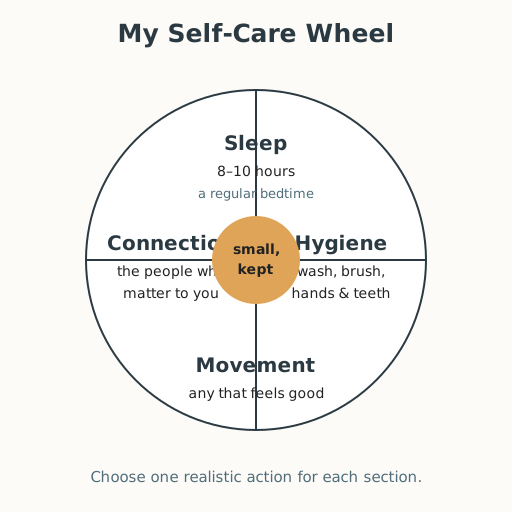
- Self-care wheel sheet · 1 per learner A wheel with four sections — sleep, hygiene, movement, connection — with space to write one realistic action for each
- Routine builder cards · 1 set per group Cards of small self-care actions (a regular bedtime, brushing teeth twice a day, a daily walk, a check-in with a friend) to sort into the four sections
Low-tech / no-cost
- A shared board or large paper Draw the four-part wheel together and fill it in by voice and drawing
- Voice and body Act out each kind of self-care — stretching, washing, resting, greeting a friend — with no cards needed
Enriched / lab & device
- A sleep-and-energy diary · 1 per learner A one-week page to note bedtime, wake time, and how rested the learner felt, to reflect on
- A movement or mindfulness app or video · 1 A short guided routine to try, chosen carefully for age and tone
Works in different contexts
- large-group Build one class wheel on the board, then each learner completes their own with actions that fit their life
- multi-age Younger learners match each action to one of the four sections; older learners write a realistic action for each and explain why it helps
- self-directed A learner completes the wheel, choosing one realistic action per section that fits their actual day
- level-grouped Learners ready to extend set a small, specific goal for one section and plan how they will keep it for a week
- outdoor-only Build the wheel outdoors and choose movement and connection actions that can happen outside — a walk, a game, a shared meal in the open air
Lesson 9 — Building a Self-Care Routine: Sleep, Hygiene, Movement, Connection
Summary
Learners build a personal self-care routine covering the four pillars — sleep, hygiene, movement, and connection — choosing one realistic action for each that fits their own life. They learn that a routine that is small and kept beats one that is grand and abandoned.
Objectives
- Build a personal self-care routine covering sleep, hygiene, movement, and connection. (D03.S4.08.02)
- Choose actions that are realistic for the learner’s own life and explain why each helps wellbeing. (D03.S4.08.02)
Connection
Have you ever made a big plan — exercise every day, sleep early every night — and watched it fall apart in three days? That is normal. A routine that works is not the one that is grand; it is the one that is small, realistic, and kept. Self-care is not a treat for a bad day; it is the ordinary, repeatable care of a body and a mind — sleep, washing, moving, and staying connected to people. Today you build one that actually fits your life.
Materials
- Self-care wheel sheet
- Routine builder cards
Preparation
- Copy the wheel sheet and builder cards.
- Retrieval: from Grade 8 Unit 2, recall how stress affects the body and the healthy ways back to calm; from Grade 7, recall noticing body signals and setting social-media boundaries.
Facilitator note
This lesson is written to the learner (“you”). It opens the self-care strand. The idea to land: a self-care routine rests on four everyday pillars — sleep, hygiene, movement, and connection — and the best routine is the one the learner can actually keep. The evidence-aligned guidance: sleep — most adolescents need about 8–10 hours a night (S-050); hygiene — daily washing, handwashing, tooth and body care prevent illness (S-016, S-017); movement — regular physical activity benefits body and mind, and any amount helps (S-069); connection — belonging and supportive relationships are central to adolescent wellbeing (S-261, S-311). Emphasize realistic over grand: one small, specific action per pillar is the whole lesson. This is a skill-building moment — model building one routine on the board (worked example: “sleep — lights out by 10; hygiene — brush teeth morning and night; movement — a 20-minute walk after school; connection — call one friend this week”), then let learners build theirs (explicit instruction carries novice skills — S-011). The social-emotional lens: self-care is not selfish; a person who is well can be there for others. The egalitarian lens: a routine must fit the learner’s real life — their home, their chores, their water and privacy, their family’s schedule — and no routine is “better” because it costs more; dignity, not display. The global lens: people everywhere practice care in different forms — a daily walk, a prayer, a bath, a family meal, a nap — and every culture has its own wisdom; honor them all. Even tooth care takes many forms: a brush and paste in one home, a chewing stick (miswak, neem, or another local twig) in another — both are real ways people keep teeth clean, and neither is “better.” The ethics lens: caring for one’s own body and mind is a responsibility we hold toward ourselves, and it makes us better able to care for others. The technology & environment lens: screens and light quietly shape sleep and mood, and a safe place to move plus clean water to wash with are environmental foundations of any routine — so a realistic routine works with the tools a learner has and the place they live in, never against them. Watch for learners whose circumstances make some pillars hard (no quiet place to sleep, no clean water, no safe space to move) — meet them with adaptation, never shame, and help them find what is possible. This routine will be tracked in the next lesson, so keep it safe to track: habits and feelings, never weight, appearance, or anything that could shame.
Procedure
- Recall (5 min). From Grade 8 Unit 2: what does stress do to a body, and what helps it return to calm? Today we build the daily version of that.
- Meet the four pillars (10 min). Look at the self-care wheel. Four sections: sleep (about 8–10 hours for most teens), hygiene (washing, teeth, hands), movement (any movement that feels good), connection (the people who matter to you) (S-050, S-016, S-069, S-261).
- Model one routine (10 min). Watch one built on the board: one small, specific action per pillar. Notice how small each action is — that is what makes it keepable.
- Build yours (15 min). On your wheel, write one realistic action for each pillar — something that fits your day, your home, and your life. Make it small enough to keep.
- Pair check (5 min). Read your four actions to a partner. Together, ask: is each one small enough? Does it fit your real life? Adjust if needed.
- Close (5 min). You have built the bones of a routine. Next: we track it for a week and see what it does for you.
Differentiation
- Support: Choose one action for each pillar from the builder cards rather than writing your own.
- Extension: Set a small, specific goal for one pillar (for example, “lights out by 10 for five nights”) and plan one thing that would help you keep it.
Assessment
- Formative (observation): Can the learner name all four pillars and give one realistic action for each?
- Portfolio artifact: The completed self-care wheel, kept in the portfolio (and tracked next lesson).
Home connection
Share one pillar of your routine with someone at home and invite them to do it with you — a walk, a shared meal, an earlier bedtime. Self-care grows when it is shared.
Resources
- On adolescent sleep needs: American Academy of Sleep Medicine, “Recommended Amount of Sleep for Pediatric Populations,” https://aasm.org/resources/pdf/pediatricsleepdurationconsensus.pdf (S-050).
- On hand hygiene and oral health: World Health Organization, “Hand hygiene,” https://www.who.int/teams/integrated-health-services/infection-prevention-control/hand-hygiene (S-016); WHO, “Oral health,” https://www.who.int/news-room/fact-sheets/detail/oral-health (S-017).
- On physical activity: World Health Organization, “Physical activity,” https://www.who.int/news-room/fact-sheets/detail/physical-activity (S-069).
- On adolescence, belonging, and wellbeing: World Health Organization, “Adolescent health,” https://www.who.int/health-topics/adolescent-health (S-261); WHO, “Mental health of adolescents,” https://www.who.int/news-room/fact-sheets/detail/adolescent-mental-health (S-311).
- On explicit instruction and worked examples: Kirschner, Sweller & Clark (2006), https://doi.org/10.1207/s15326985ep4102_1 (S-011).