Lesson 07 — Digital Tools and Civic Participation: Risks and Benefits
Learners explain how digital tools change civic participation — reach, speed, and coordination on one side; misinformation, surveillance, and harassment on the other — and weigh the risks and benefits of organizing online, ending with a reasoned judgment rather than a simple verdict for or against.
Objectives
Objectives
- D09.S3.08.02 Explain how digital tools change civic participation, and weigh the risks and benefits of organizing online.
Essential question
How do digital tools change civic participation — and how do I weigh the risks and benefits of organizing online?
Key vocabulary
Materials
Standard materials
- Digital-participation case sheet · 1 per learner One real case of people organizing online — for example, coordinating protest or relief through mobile networks — to weigh risks and benefits
- Risk-benefit chart · 1 per learner A two-column chart (benefits, risks) with room for a closing judgment
Low-tech / no-cost
- Paper and pencil Draw the two columns by hand; discuss the case aloud
- A role-play Act out organizing a small action with and without digital tools, and feel the difference
Enriched / lab & device
- A real news report on a digitally organized action · 1 To ground the risk-benefit weighing in a documented case
- A device to examine privacy settings · 1 per pair To see concretely how information can be public, private, or shared without consent
Works in different contexts
- large-group Weigh one case whole-group on the board, then pairs weigh a second and share one benefit and one risk
- multi-age Younger learners sort benefit and risk cards; older learners write the closing judgment with reasons
- self-directed A learner reads the case, fills the chart alone, and writes a two-sentence judgment on when online organizing is worth it
- level-grouped Learners ready to extend design one safeguard against a named risk (privacy, checking sources, protecting participants)
- outdoor-only Discuss how people without phones organized for centuries — town criers, drums, word of mouth — and what digital tools add and take away
Lesson 7 — Digital Tools and Civic Participation: Risks and Benefits
Summary
Learners explain how digital tools change civic participation — reach, speed, and coordination on one side; misinformation, surveillance, and harassment on the other — and weigh the risks and benefits of organizing online, ending with a reasoned judgment rather than a simple verdict for or against.
Objectives
- Explain how digital tools change civic participation, and weigh the risks and benefits of organizing online. (D09.S3.08.02)
Connection
A phone in your pocket can reach a thousand people in a minute. Before phones, people organized with drums, bells, posters, and word of mouth — slower, but harder to spy on and harder to falsify. The phone changed what is possible: a march can be called in an hour, aid can be coordinated across a city, a voice that was never heard can suddenly be heard everywhere. But the same speed carries false stories, and the same reach can be watched. Today you weigh both sides — not to decide that digital tools are good or bad, but to decide how to use them well when you act with others.
Materials
- Digital-participation case sheet
- Risk-benefit chart
Preparation
- Copy the case sheet and risk-benefit charts.
- Choose one real, documented case of people organizing online — for example, the use of social media to coordinate protest or spread information during the 2010–11 Arab Spring uprisings (S-391), or a digitally coordinated relief effort. Prepare the facts plainly, including both a benefit and a harm, so the weighing is honest.
Facilitator note
This lesson is written to the learner. It delivers the second strand-3 goal, and it carries the technology lens explicitly (philosophy §4). Teach the change as a trade-off to weigh, not a hero/villain story: digital tools give reach (many people, cheaply), speed (instantly), and coordination (many hands organized at once) — and they also enable misinformation (false stories spread as fast as true ones), surveillance (the tools that connect can also be watched), and harassment (a loud crowd can drown or threaten a single voice). The egalitarianism lens: ask who can use the tools and who cannot — a digital divide means the same tools widen some voices and silence others. The critical-thinking lens: the skill here is the same source-checking habit from media literacy (S-063) — check before you share. The ethics lens: organizing online is a moral act; the organizer’s duty includes protecting the people they organize with. The global lens: the Arab Spring is one well-documented case among many — do not present it as the only story, and note that digital organizing happens (and is blocked) on every continent (S-391). Keep the tone measured: these are real risks, but the lesson ends with safeguards so learners leave with agency, not fear (facilitation.md). The standard is a reasoned judgment, not a verdict that online organizing is always worth it or never worth it.
Procedure
- Feel the change (8 min). In pairs, list three ways people organized before phones (drums, posters, word of mouth, letters) and three ways they organize now. What changed?
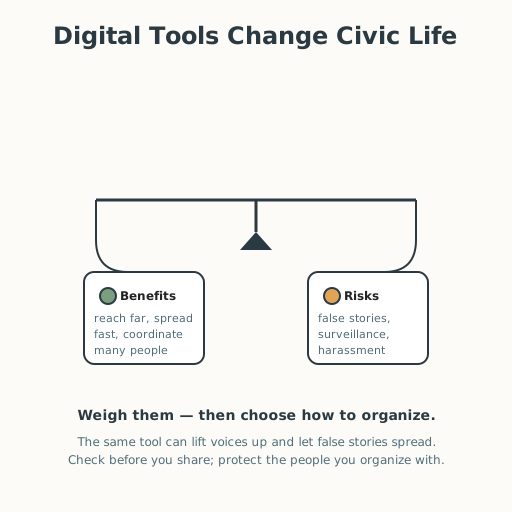
- Meet the two columns (8 min). Read the risk-benefit chart. Benefits: reach, speed, coordination. Risks: misinformation, surveillance, harassment. Give one everyday example of each.
- Read the case (8 min). Read the digital-participation case: people organizing online to demand change or coordinate help. Notice what the tools made possible and what went wrong or could go wrong.
- Weigh it (15 min). Fill your chart: list the benefits and the risks you see in the case. Then write one sentence saying which side you think weighs heavier in this case, and why.
- Build a safeguard (10 min). Choose one risk from your chart and write one safeguard — checking a source before sharing, protecting participants’ names, agreeing on rules for speaking. How would it help?
- Feedback and close (6 min). Share your safeguard with a partner. Ask: does it address a real risk, or only a made-up one? Digital tools change civic life — your job is to use them with your eyes open. Next: evaluating a real conflict.
Differentiation
- Support: Sort pre-made “benefit” and “risk” cards before writing your own.
- Extension: Design a second safeguard and connect it to a specific risk you named in the case.
Assessment
- Formative (self): Does the learner’s chart name at least one benefit and one risk, and does their judgment give a reason rather than only a verdict?
- Artifact: The completed risk-benefit chart and the safeguard, kept in the portfolio.
Home connection
Ask someone at home how people shared news and organized when they were young, and what they think phones changed — for better and for worse. Compare their two sides with yours.
Resources
- On digital organizing during the 2010–11 Arab Spring: Encyclopaedia Britannica, “Arab Spring,” https://www.britannica.com/event/Arab-Spring (S-391).
- On checking sources before sharing: Common Sense Education, “News & Media Literacy,” https://www.commonsense.org/education/digital-citizenship/topic/news-and-media-literacy (S-063).
- On cooperative/collective action as a researched structure: Slavin, Cooperative Learning (1995) (S-147).