Lesson 06 — How a Social Movement Works: Goals, Strategies, Effects
Learners analyze how social movements work — goals, strategies, and effects — using real examples (the Green Belt Movement, the Chipko movement, the Salt March, and others), and evaluate what made each succeed or struggle. They see that movements are ordinary people acting together, judged by what they do and what they change.
Objectives
Objectives
- D09.S3.08.01 Analyze a social movement (its goals, strategies, and effects) and evaluate what made it succeed or struggle.
Essential question
How do social movements work — their goals, strategies, and effects — and what makes one succeed or struggle?
Key vocabulary
Materials
Standard materials
- Movement case cards · 1 set per group Short, accurate profiles of two or three movements — for example, the Green Belt Movement, the Chipko movement, and the Salt March
- Movement analysis chart · 1 per learner A chart for recording a movement's goals, strategies, effects, and an evaluation
Low-tech / no-cost
- Paper and pencil Draw the analysis chart by hand; tell the movement stories aloud
- A timeline drawn on the ground or board Plot a movement's strategies and effects over time
Enriched / lab & device
- A short documentary clip of a movement · 1 To see goals, strategies, and effects in action rather than only read about them
- A world map · 1 Locate each movement and note that movements happen on every continent
Works in different contexts
- large-group Analyze one movement whole-group on the board, then small groups analyze a second and share evaluations
- multi-age Younger learners sequence a movement's events on a timeline; older learners write the goals-strategies-effects evaluation
- self-directed A learner reads two movement profiles, fills the chart alone, and writes which one succeeded or struggled and why
- level-grouped Learners ready to extend compare two movements and identify what one did that the other could not
- outdoor-only Use a movement about land, water, or trees — Chipko or the Green Belt Movement — and discuss it while sitting near living things it sought to protect
Lesson 6 — How a Social Movement Works: Goals, Strategies, Effects
Summary
Learners analyze how social movements work — goals, strategies, and effects — using real examples (the Green Belt Movement, the Chipko movement, the Salt March, and others), and evaluate what made each succeed or struggle. They see that movements are ordinary people acting together, judged by what they do and what they change.
Objectives
- Analyze a social movement (its goals, strategies, and effects) and evaluate what made it succeed or struggle. (D09.S3.08.01)
Connection
When the trees near a village were about to be cut down, the villagers — many of them women — walked into the forest and wrapped their arms around the trunks. They did not fight; they hugged the trees until the cutters stopped. That is the Chipko movement in India in the 1970s, and it is a social movement in miniature: ordinary people, a clear goal, a clever strategy, and a lasting effect. Today you learn to take a movement apart — its goals, strategies, and effects — so you can judge for yourself what makes one work.
Materials
- Movement case cards
- Movement analysis chart
Preparation
- Copy the movement case cards and analysis charts.
- Prepare two or three short, accurate profiles (see Resources for sources). Use movements from different regions and different aims, so the lesson is genuinely global — for example, the Green Belt Movement (Kenya, tree-planting and land; S-059), the Chipko movement (India, forest protection; S-328), the Salt March (India, nonviolent resistance to an unjust tax; S-390), and, as further options, the 1952 Defiance Campaign in South Africa (S-146) and the peaceful resistance of Parihaka (S-144).
Facilitator note
This lesson is written to the learner. It opens strand 3. Teach the three-part frame — goals (what is unfair and what would be fair), strategies (how people act: organize, petition, protest, build allies), effects (what changed, who benefited, who was left out) — with a worked example first, then let learners apply it (S-011). The egalitarianism lens is central: a movement is ordinary people acting together, often those with the least power, and the evaluation always asks who benefited and who was left out. The global lens: use movements from several continents and treat none as the “default” story; resistance to injustice is a human pattern, not one nation’s export (philosophy §4). The community lens: connect to a change learners have seen or could make in their own school or neighborhood. The ethics lens: strategies are chosen, and learners weigh them — nonviolence, disruption, and their costs — as questions, not as a script (philosophy §11). Keep the history faithful and dated; do not romanticize any movement or flatten its struggles (a movement can partly succeed and partly fail). The standard is a reasoned evaluation, not agreement with the movement’s aims. Be ready for the fact that some movements used force or were met with force; name it honestly and hold it as one more thing to weigh, without glorifying violence (facilitation.md).
Procedure
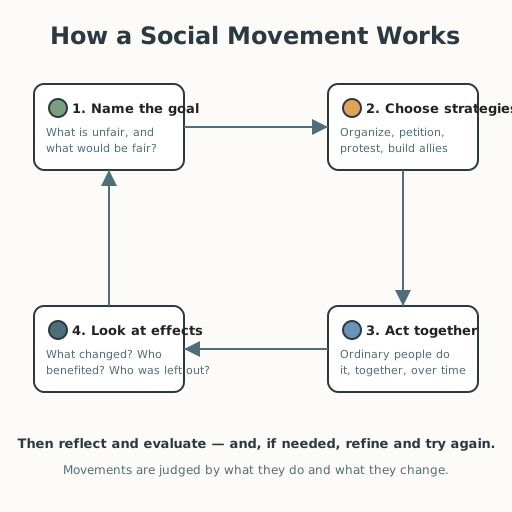
- Meet the frame (8 min). Three questions to ask of any movement: What is its goal? (what is unfair, and what would be fair) What are its strategies? (how people act together) What were its effects? (what changed, who benefited, who was left out).
- Worked example (12 min). Listen as we analyze the Chipko movement together. Goal: protect the forests villages depend on. Strategies: villagers — especially women — embraced the trees, nonviolently, to stop the cutting. Effects: tree-cutting was halted in places; the idea spread and helped inspire later forest protection. Then evaluate: it succeeded because its strategy was peaceful, visible, and rooted in the people most affected.
- Analyze a second movement (15 min). Read a movement profile — the Green Belt Movement or the Salt March. On your chart, record its goals, strategies, and effects in your own words.
- Evaluate (10 min). Write three sentences: did it succeed or struggle, and why? Name at least one thing that helped it and one thing that made it hard.
- Peer feedback (7 min). Trade charts. Ask: did they name a goal, a strategy, and an effect — and give a reason for their evaluation? Offer one kind suggestion.
- Close (3 min). Movements are ordinary people acting together over time. Next: how digital tools change civic participation.
Differentiation
- Support: Sequence a movement’s events on a drawn timeline before filling the chart.
- Extension: Compare two movements and name one thing one did that the other could not, and why.
Assessment
- Formative (peer): Does the learner’s chart name a goal, a strategy, and an effect, and does their evaluation give a reason rather than only a verdict?
- Artifact: The completed movement analysis chart and evaluation, kept in the portfolio.
Home connection
Ask someone at home about a change they have seen people work for together — in their neighborhood, workplace, or country. What was the goal, how did people act, and what changed?
Resources
- On the Green Belt Movement: Nobel Prize, “Wangari Maathai — Facts,” https://www.nobelprize.org/prizes/peace/2004/maathai/facts/ (S-059).
- On the Chipko movement: Encyclopaedia Britannica, “Chipko movement,” https://www.britannica.com/topic/Chipko-movement (S-328).
- On the Salt March: Encyclopaedia Britannica, “Salt March,” https://www.britannica.com/event/Salt-March (S-390).
- Further examples: South African History Online, “Defiance Campaign 1952,” https://www.sahistory.org.za/article/defiance-campaign-1952 (S-146); NZHistory, “Parihaka,” https://nzhistory.govt.nz/politics/parihaka (S-144).
- On explicit instruction and worked examples for new skills: Kirschner, Sweller & Clark (2006), https://doi.org/10.1207/s15326985ep4102_1 (S-011).