Lesson 09 — Peace and Reconciliation After Conflict
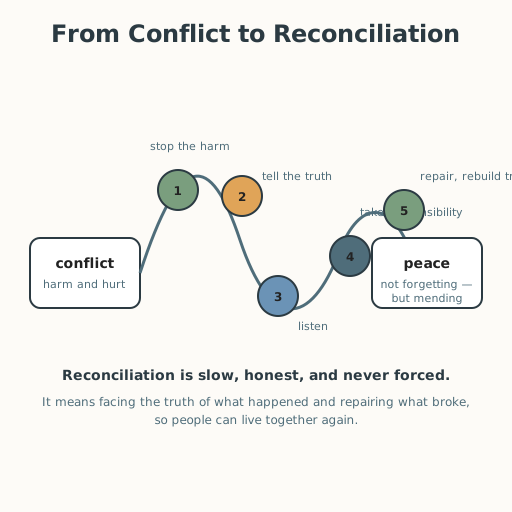
Learners analyze how groups and societies have pursued peace and reconciliation after conflict, using South Africa's Truth and Reconciliation Commission and other examples. They trace the slow path — stop the harm, tell the truth, listen, take responsibility, repair — and see that reconciliation is honest, patient, and never forced.
Objectives
Objectives
- D09.S4.08.02 Analyze how groups and societies have pursued peace and reconciliation after conflict, using a historical example.
Essential question
How have groups and societies pursued peace and reconciliation after conflict?
Key vocabulary
Materials
Standard materials
- Reconciliation case sheet · 1 per learner One historical example of a society pursuing peace and reconciliation after conflict — for example, South Africa's Truth and Reconciliation Commission
- Reconciliation path chart · 1 per learner A chart with the steps of reconciliation (stop harm, tell truth, listen, take responsibility, repair) to map onto the case
Low-tech / no-cost
- Paper and pencil Draw the path by hand; tell the case aloud
- A walking role-play Walk the reconciliation path in steps, one learner narrating each step
Enriched / lab & device
- A short documentary clip on a reconciliation process · 1 To see truth-telling, listening, and repair in real voices
- A world map · 1 Locate the example and note that reconciliation has been attempted on every continent
Works in different contexts
- large-group Map one example whole-group on the board, then small groups map a second and share one insight
- multi-age Younger learners sequence the reconciliation steps on cards; older learners write what each step required and what could have failed
- self-directed A learner reads the case, fills the path chart alone, and writes why reconciliation is slow and never forced
- level-grouped Learners ready to extend compare two reconciliation efforts and weigh what one did that the other did not
- outdoor-only Discuss reconciliation as a path walked slowly, and walk it together while naming each step
Lesson 9 — Peace and Reconciliation After Conflict
Summary
Learners analyze how groups and societies have pursued peace and reconciliation after conflict, using South Africa’s Truth and Reconciliation Commission and other examples. They trace the slow path — stop the harm, tell the truth, listen, take responsibility, repair — and see that reconciliation is honest, patient, and never forced.
Objectives
- Analyze how groups and societies have pursued peace and reconciliation after conflict, using a historical example. (D09.S4.08.02)
Connection
After a deep fight, saying “sorry” and moving on is not the same as making peace. Real peace comes after the harm stops, after the truth is told, after each side is truly heard, after the one who caused harm takes responsibility, and after what broke is repaired. That is true between two friends — and it is true between whole peoples. Today you study how a society tried to do this on a large scale, and you learn the path that peace actually takes.
Materials
- Reconciliation case sheet
- Reconciliation path chart
Preparation
- Copy the case sheet and path charts.
- Prepare one historical example in accurate, age-appropriate detail: South Africa’s Truth and Reconciliation Commission (1996–1998) is the anchor (S-392); other examples a learner could choose include Indigenous peacemaking and talking circles (S-161) or a local example of repair after harm. Present the conflict honestly but without graphic detail; the focus is the process of reconciliation, not the horror of the conflict.
Facilitator note
This lesson is written to the learner. It delivers the second strand-4 goal and closes the strand’s arc from conflict (L08) to reconciliation (L09). Teach the path explicitly with a worked example (S-011): stop the harm → tell the truth → listen → take responsibility → repair and rebuild trust. Use South Africa’s Truth and Reconciliation Commission (S-392) as the anchor: after apartheid ended, the TRC invited people to testify publicly about what happened — truth-telling — and, in defined cases, offered amnesty in exchange for full disclosure, alongside reparations — a real, documented, and contested attempt to trade some punishment for truth and repair. Present it as one attempt, with real strengths and real limits (philosophy §11): truth-telling helped some families learn what happened to loved ones, but many felt justice was incomplete and the harm of poverty and inequality remained — that honesty is the point, not a failure of the lesson. The egalitarianism lens: reconciliation only works when the less powerful are genuinely heard and their harm taken seriously. The global lens: reconciliation has been attempted on every continent; also name Indigenous peacemaking circles (S-161) so the story is not one region’s export. The ethics lens: the aim is repair, not revenge — and the lesson is careful not to say reconciliation is easy, automatic, or always the right path in every case; it is one hard, honorable way. The community lens: connect to the small reconciliations learners already practice in families and friendships. Hold the topic with care (facilitation.md “holding difficult topics safely”): keep it honest but not sensational, and end with agency and hope — the path is real, and people have walked it.
Procedure
- Meet the path (8 min). Read the reconciliation path chart. Five steps: stop the harm, tell the truth, listen, take responsibility, repair and rebuild trust. Say each in your own words.
- Read the example (12 min). Read the reconciliation case: South Africa’s Truth and Reconciliation Commission, which invited people to testify about what happened, offered amnesty for full disclosure in defined cases, and supported reparations. Notice: it traded some punishment for truth and repair.
- Map the steps (15 min). On your chart, match each step of the path to something the example actually did. Where did truth-telling happen? Who was heard? How was responsibility taken? Where did repair fall short?
- Weigh it (10 min). Write three sentences: what did this attempt at reconciliation achieve, and where did it fall short? Name one strength and one limit.
- Connect it (7 min). Think of a smaller reconciliation you have seen or could do — in a friendship or family. Which step of the path matters most there, and why?
- Close (3 min). Reconciliation is slow, honest, and never forced. Next: gathering the whole unit together.
Differentiation
- Support: Sequence the five path steps on cards before mapping them onto the example.
- Extension: Compare the TRC with another reconciliation effort and weigh what one did that the other did not.
Assessment
- Formative (observation): Can the learner map at least three path steps onto the historical example, and name one strength and one limit of the process?
- Artifact: The completed path chart and the three-sentence weighing, kept in the portfolio.
Home connection
Ask someone at home about a time a relationship was repaired — what step mattered most, and how long it took. Bring one idea about what makes reconciliation real.
Resources
- On South Africa’s Truth and Reconciliation Commission: Encyclopaedia Britannica, “Truth and Reconciliation Commission, South Africa,” https://www.britannica.com/topic/Truth-and-Reconciliation-Commission-South-Africa (S-392).
- On restorative justice and Indigenous peacemaking circles: Zehr, Changing Lenses (1990) (S-161); International Institute for Restorative Practices, https://www.iirp.edu/ (S-022).
- On explicit instruction and worked examples for new skills: Kirschner, Sweller & Clark (2006), https://doi.org/10.1207/s15326985ep4102_1 (S-011).