Lesson 10 — Capstone: Ethics, Justice & Civic Power — Putting It Together
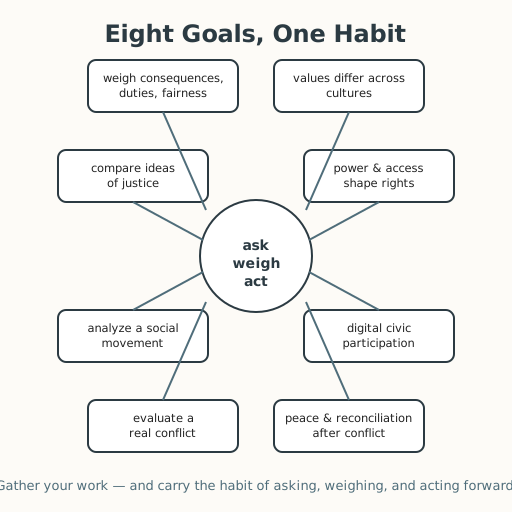
Learners gather the unit's eight goals into one web around the habit ask, weigh, act, revisit their own portfolio artifacts, and write a short reflection on the habit they will carry forward. The capstone is a spaced-retrieval pass and a celebration, not a test.
Objectives
Objectives
- D09.S1.08.01 Evaluate a real-world moral dilemma by weighing consequences, duties, and fairness, and defend a reasoned position.
- D09.S1.08.02 Explain how values and moral codes differ across cultures and argue for respectful engagement with those differences.
- D09.S2.08.01 Compare different ideas of justice (such as equal treatment, need, and restitution) and apply them to a real case.
- D09.S2.08.02 Analyze how power and access shape who gets their rights protected and who does not.
- D09.S3.08.01 Analyze a social movement (its goals, strategies, and effects) and evaluate what made it succeed or struggle.
- D09.S3.08.02 Explain how digital tools change civic participation, and weigh the risks and benefits of organizing online.
- D09.S4.08.01 Evaluate a real conflict and weigh peaceful, restorative, and other responses, defending a reasoned choice.
- D09.S4.08.02 Analyze how groups and societies have pursued peace and reconciliation after conflict, using a historical example.
Essential question
How do the eight goals of this unit fit together — and what habit do I carry forward?
Key vocabulary
Materials
Standard materials
- Capstone web sheet · 1 per learner A one-page web connecting the unit's eight goals around the habit ask, weigh, act
- Portfolio artifacts from the unit · 1 set per learner The learner's own charts and positions from Lessons 2–9, gathered for reflection
Low-tech / no-cost
- A shared board or large paper Draw the web together and post each learner's one-line takeaway
- Voice and memory Recall the eight goals aloud in a circle, one per learner, building the web by ear
Enriched / lab & device
- A digital portfolio or shared document · 1 Assemble the unit's artifacts into one place to reflect on and celebrate
Works in different contexts
- large-group Build the web whole-group on the board, then each learner writes and reads a one-line takeaway
- multi-age Younger learners match each artifact to a goal; older learners write the synthesis and the forward-looking sentence
- self-directed A learner gathers their own artifacts, fills the web, and writes a half-page reflection on the habit they will carry forward
- level-grouped Learners ready to extend write a real dilemma of their own and weigh it with all three lenses as a final demonstration
- outdoor-only Sit in a circle outdoors and pass a found object as a talking piece, each learner naming one goal they now hold more clearly
Lesson 10 — Capstone: Ethics, Justice & Civic Power — Putting It Together
Summary
Learners gather the unit’s eight goals into one web around the habit ask, weigh, act, revisit their own portfolio artifacts, and write a short reflection on the habit they will carry forward. The capstone is a spaced-retrieval pass and a celebration, not a test.
Objectives
- Revisit and connect all eight grade-8 goals of the unit, and reflect on the habit of asking, weighing, and acting. (D09.S1.08.01–D09.S4.08.02)
Connection
A tool you use once is soon forgotten; a tool you use many times becomes part of your hand. This unit gave you tools — three lenses for a dilemma, three ideas of justice, a way to see power and access, a frame for movements, a scale for digital risks, a path through conflict to reconciliation. Today you gather them all, look at the work your own hands made, and decide which of these tools you will actually carry — because a habit is a tool you keep using long after the lesson ends.
Materials
- Capstone web sheet
- Portfolio artifacts from the unit
Preparation
- Copy the capstone web sheets.
- Have learners gather their artifacts from Lessons 2–9: the dilemma position, the values comparison, the justice chart, the power-and-access chart, the movement evaluation, the digital risk-benefit chart, the conflict position, and the reconciliation path chart.
Facilitator note
This lesson is written to the learner. It is the unit’s closing retrieval-and-synthesis pass, so its goals are modest and its tone is celebratory (S-039; Dunlosky et al. on spaced retrieval). (1) Recall the eight goals — one per strand: weigh consequences/duties/fairness and values differ across cultures (S1); compare ideas of justice and power/access shape rights (S2); analyze a movement and digital participation (S3); evaluate a conflict and pursue reconciliation (S4). (2) Connect them through the one habit: ask, weigh, act. (3) Reflect on the learner’s own work and write a forward-looking sentence. Do not introduce new content or grade a “final answer” — this is mastery-through-recall and a portfolio celebration, not a ranking (philosophy §8, §11). The four lenses reappear as a summary: ethics (the habit of weighing), egalitarianism (always asking who is left out), global (the same questions, asked differently everywhere), critical-thinking (evidence vs. values, questions held open). If a learner has an incomplete artifact, invite them to finish it now rather than mark it “done” (mastery, not ranking). End with the unit’s through-line, spoken plainly: we hold questions as questions — and we act anyway, with care.
Procedure
- Rebuild the web (12 min). Look at the capstone web sheet. Around the center ask, weigh, act, the eight goals are written. For each goal, say aloud one thing you did in this unit that practiced it.
- Connect the goals (8 min). Choose two goals that feel connected and write one sentence saying how — for example, power and access (who reaches a right) connects to social movements (how the left-out organize to widen access).
- Revisit your work (15 min). Open your portfolio artifacts. Pick the one you are proudest of and the one you would now do differently. Write one sentence for each: why this one, and what changed in my thinking.
- Name the habit (10 min). Write three sentences: which of these tools will you actually carry — and where in your real life will you use it? Be specific (a place, a relationship, a decision).
- Share and celebrate (8 min). In a circle, each learner shares their one-sentence takeaway — a goal they now hold more clearly, or a tool they will carry. Listen without judging; every takeaway is a real one.
- Close (2 min). We ask, we weigh, we act — and we keep the questions open. Carry the habit forward.
Differentiation
- Support: Match each artifact to its goal on the web before writing the reflection.
- Extension: Write a real dilemma of your own and weigh it with all three lenses as a final demonstration of the unit’s first goal.
Assessment
- Portfolio (summative): The assembled artifacts from Lessons 2–9, plus the capstone reflection, show the learner’s growth across the unit’s eight goals.
- Self: The learner names one tool they will carry and where they will use it.
Home connection
Share your capstone takeaway with someone at home, and ask them: what is one habit of fairness or care they try to live by? Compare your answers.
Resources
- On the payoff of spaced retrieval and the unit’s closing recall pass: Dunlosky et al. (2013), https://doi.org/10.1177/1529100612453266 (S-039).
- On the unit’s through-line of inquiry over creed: see
docs/philosophy.md§11.