Lesson 09 — Caring for Land and Water: Stewardship Practices Across Cultures
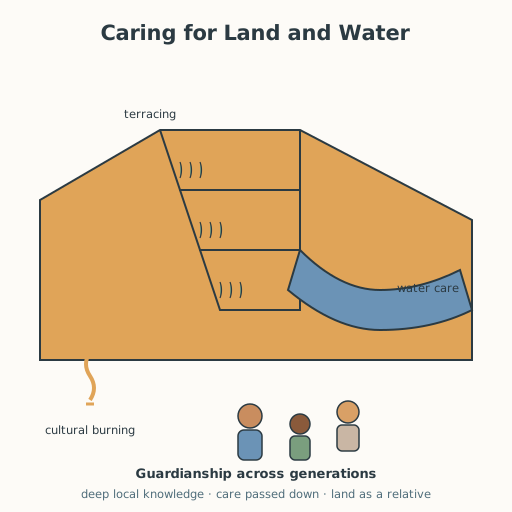
Learners **analyze a community's practice for caring for land or water, from any culture, and what makes it work**. They study real examples — Indigenous cultural burning in Australia, Andean terracing, and Māori kaitiakitanga (guardianship) — and name the common threads: deep local knowledge, care across generations, and treating land and water as beings owed care, not only resources to use.
Objectives
Objectives
- D10.S4.08.02 Analyze a community's practice for caring for land or water, from any culture, and what makes it work.
Essential question
How does a community care for land or water, and what makes that practice work?
Key vocabulary
Materials
Standard materials
- Stewardship analysis sheet · 1 per learner A one-practice organizer — what the practice does, what knowledge it uses, who passes it on, and what makes it work
- Practice cards · 1 set per group Cards for several real practices — Indigenous cultural burning in Australia, terracing in the Andes, Māori kaitiakitanga (guardianship), and a local or regional water practice — each with facts
Low-tech / no-cost
- A shared board or large paper Draw the one-practice organizer together; no printed sheet needed
- Voice and a partner Describe a practice aloud — "the people burn small patches in cool weather so…"
Enriched / lab & device
- A short documentary clip on one stewardship practice · 1 Shows a real community practicing cultural burning or terracing or water care
- A map or atlas · 1 per group Locate each practice's place and discuss how the land shaped the practice
Works in different contexts
- large-group Model one practice as a whole class, then small groups analyze one more each and report
- multi-age Younger learners match each practice to its place; older learners explain what makes it work
- self-directed A learner analyzes one practice alone and writes a paragraph on what makes it work
- level-grouped Learners ready to extend compare two practices and say what they share and where they differ
- outdoor-only Name a real local practice for caring for land or water near you, and say what makes it work
Lesson 9 — Caring for Land and Water: Stewardship Practices Across Cultures
Summary
Learners analyze a community’s practice for caring for land or water, from any culture, and what makes it work. They study real examples — Indigenous cultural burning in Australia, Andean terracing, and Māori kaitiakitanga (guardianship) — and name the common threads: deep local knowledge, care across generations, and treating land and water as beings owed care, not only resources to use.
Objectives
- Analyze a community’s practice for caring for land or water, from any culture, and what makes it work. (D10.S4.08.02)
Connection
Every place on Earth has people who have learned, over many generations, how to live with it. Aboriginal and Torres Strait Islander peoples in Australia light small, cool fires in the right season so big, destructive fires cannot take hold. Andean farmers cut terraces into steep mountains so rain soaks the soil instead of washing it away. Māori communities name themselves kaitiaki — guardians — of rivers and forests. These are not relics; they are living answers to the question this unit has been asking. Today you study how people care for the Earth, and what makes that care work.
Materials
- Stewardship analysis sheet
- Practice cards
Preparation
- Copy the sheet and practice cards.
- Retrieval: from Lesson 6, recall that some ecosystems depend on fire and that Indigenous peoples have used fire to care for land for thousands of years. Today we study such practices in their own right.
Facilitator note
This lesson is written to the learner (“you”). The idea to land: across cultures, communities hold living practices for caring for land and water, and what makes them work is deep local knowledge, care passed across generations, and a view of land and water as beings owed care — not only resources to extract. The worked examples (all real, all cited): Indigenous cultural burning in Australia — small, cool, seasonally-timed fires that reduce fuel and encourage new growth, rooted in Aboriginal and Torres Strait Islander knowledge (S-320, S-321). Andean terracing — stone terraces that slow water, hold soil, and create farmable land on steep slopes, maintained by communities over centuries. Māori kaitiakitanga — the practice of guardianship of rivers, forests, and coasts, holding people as relatives of the natural world, not its owners (S-202). The environment lens is this lesson’s core: these practices are tested, effective care — they work because they match the place. The global & anthropological lens is central too: this is not one culture’s story but a worldwide pattern — every region holds its own stewardship traditions, and we honor each as a living practice, never as a museum specimen (philosophy §4). The egalitarian lens: Indigenous and local peoples have often been pushed off their land, and recognizing their stewardship is a matter of justice, not charity. The ethics lens: treating land and water as beings owed care is one answer to “what is right here” — and it differs from treating them only as resources, a difference learners should weigh, not be told to adopt (philosophy §11). The technology lens: these practices are technologies too — tools and knowledge for living — that often cost the Earth less than the industrial ones this unit has weighed. Hold the examples with respect and accuracy; where a practice is a living tradition of a specific people, name that people and cite the source, and invite learners to bring their own communities’ practices forward.
Procedure
- Recall (5 min). From Lesson 6: how can fire help an ecosystem? Today we study people who use fire — and other tools — to care for land on purpose.
- Meet stewardship (5 min). Stewardship is caring for land or water so it keeps thriving — for people now and later. Many cultures call it something stronger: guardianship.
- Study three practices (15 min). Read the cards: cultural burning (Australia), terracing (the Andes), kaitiakitanga (Aotearoa New Zealand). For each, note what it does and what knowledge it uses.
- Name what makes it work (10 min). Fill the organizer for one practice: what it does, the knowledge it rests on, who passes it down, and what makes it work. Common threads: deep local knowledge, care across generations, and seeing land and water as beings owed care.
- Weigh it (10 min). Compare with the industrial resource use you weighed in Lessons 2 and 8. What does each approach assume the Earth is — a relative to care for, or a resource to use? What does each gain and give up?
- Close (5 min). Caring for the Earth is not new, and it is not one people’s idea — it is everywhere.
Differentiation
- Support: Provide one practice organizer pre-filled and ask the learner to explain one thing that makes it work.
- Extension: Compare two practices and write what they share and where they differ, using evidence from both cards.
Assessment
- Formative (observation): Can the learner analyze one practice and name at least one thing that makes it work?
- Portfolio artifact: The completed stewardship analysis sheet, kept in the portfolio.
Home connection
Ask an elder or neighbor: how did people care for this land or water when they were young? Bring one practice (or one question) to share.
Resources
- On Indigenous cultural burning: CSIRO, “Indigenous cultural burning education resources” (S-320); Firesticks Alliance / Living Knowledge Network (S-321).
- On Māori concepts of guardianship and the natural world: Te Ara — The Encyclopedia of New Zealand (S-202).
- On traditional and place-based stewardship as part of sustainable living: UNESCO, “Intangible Cultural Heritage,” https://ich.unesco.org/ (S-056).
- On explicit instruction and worked examples: Kirschner, Sweller & Clark (2006), https://doi.org/10.1207/s15326985ep4102_1 (S-011).