Lesson 01 — How Should a Society Remember a Painful Past?
Learners examine how different societies have tried to remember harm — through memorials, truth commissions, apologies, and reparations — and reason about it using three ethical frameworks, holding more than one defensible answer at once.
Objectives
Objectives
- D09.S1.09.01 Analyze a moral question using more than one ethical framework (such as consequences, duties, and virtues) and compare what each shows.
- D08.S1.09.02 Explain historical perspective, how people in the past saw their world differently, using one specific example.
Essential question
How should a society remember harm it has done or suffered?
Key vocabulary
Materials
Standard materials
- Short descriptions of three real cases of historical memory · 1 set Chosen from different world regions, each one or two paragraphs and non-graphic
- Paper and pen · per learner
Low-tech / no-cost
- Spoken case summaries The facilitator tells each case briefly; no printout needed
- A talking circle Discussion with no materials at all
Enriched / lab & device
- Documentary clips or museum virtual tours · 1 per group Short, age-appropriate clips about a memorial or a truth commission
Works in different contexts
- large-group Discuss the three frameworks as a whole group, then let small groups apply them to one case
- self-directed A learner reads the cases, applies the frameworks in writing, then discusses with one other person
- outdoor-only Hold the talking circle outside; a calm, natural space can help hold hard subjects
Lesson 1 — How Should a Society Remember a Painful Past?
Summary
Every society has a past that includes harm — harm it suffered and harm it caused. This lesson does not tell learners what to conclude about that; it gives them tools to think about it honestly: three ethical frameworks, and the habit of historical perspective. The goal is not a “correct” answer but the ability to hold a hard question without collapsing it.
Objectives
- Analyze a moral question using more than one ethical framework (consequences, duties, virtues) and compare what each shows. (D09.S1.09.01)
- Explain historical perspective — how people in the past saw their world differently — using one specific example. (D08.S1.09.02)
Connection
What a society chooses to remember — and how it chooses to remember — shapes who that society becomes. Whether a town keeps a statue, whether a nation apologizes, whether a museum names what happened: these are decisions made by real people, often in disagreement. You will inherit these decisions, and you will have to make some yourself. This lesson is practice for that.
Materials
- Short, non-graphic descriptions of three real cases of historical memory (from different world regions)
- Paper and pen
Preparation
- Choose three cases of a society reckoning with its past — for example, a truth and reconciliation commission, a public memorial, a national apology, or a program of reparations — from different regions. Keep each description short and non-graphic.
Facilitator note
This is a hard topic; hold it with care (docs/facilitation.md). Name feelings before
facts, and let learners step away if they need to. The lesson’s stance is not
relativism — some ways of remembering are more honest or more just than others — but
it is also not a single answer. Do not impose a conclusion. The discipline is to
give every serious view its strongest version before arguing against it, and to
separate what is known (evidence) from what is chosen (values). Where a learner has
a personal connection to a case, let them share only if they choose.
Procedure
- Meet the three cases (10 min). Read or hear each case. For each, note two things: what is being remembered, and how the society has chosen to remember it.
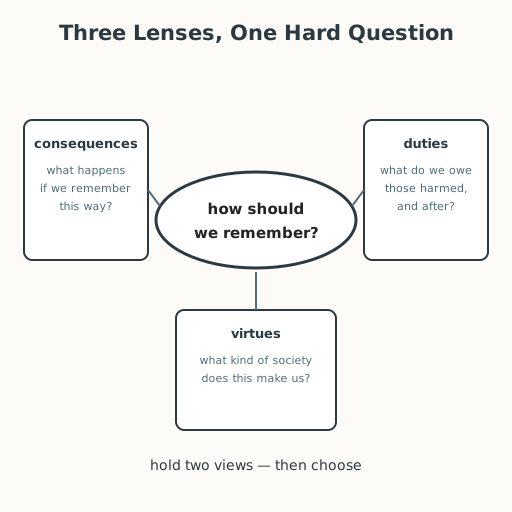
- Three lenses (15 min). For one case, ask it in three ways — write one sentence
for each:
- Consequences: what happens if we remember this way? if we forget?
- Duties: what do we owe the people harmed, and the people who came after?
- Virtues: what kind of person or society does this choice make us — honest, just, compassionate?
- Historical perspective (10 min). Before judging, try to understand: how did people at the time see their world? What did they believe, fear, and value? Understanding is not excusing — name the difference in your own words.
- Hold two views (15 min). Write the strongest argument you can for remembering one way, and the strongest argument for a different way. Which tension can’t be resolved easily, and why?
- Close (5 min). A mature mind can hold more than one true thing at once, and can still choose. What is one question you are leaving with, rather than one answer?
Differentiation
- Support: Offer sentence frames for each lens; work with one case only.
- Extension: Compare two cases and argue which society’s approach was more just, using evidence and naming the values your judgment rests on.
Assessment
- Formative: Can the learner apply at least two frameworks to a case and name a genuine tension?
- Performance/self: The written reflection — strongest view for each side — plus a one-line note on what they are still uncertain about.
Resources
- South Africa’s Truth and Reconciliation Commission (historical overview): https://www.britannica.com/event/Truth-and-Reconciliation-Commission-South-Africa
- UNESCO — Teaching about the Holocaust and genocide (pedagogical guidance for facilitators): https://www.unesco.org/en/holocaust-genocide-education
Home connection
Ask an elder in your family: what is one thing from our community’s past that people remember, and how do they remember it? Listen without arguing, then reflect in writing.