Lesson 10 — Capstone: Launching Our Cooperative Project
Learners **launch** the cooperative project they designed, finalizing a plan with a goal, roles, timeline, check-ins, and a committed first step — then **reflect** across the whole unit, connecting communication, consent, trust, empathic inquiry, empathy across distance, community forms, in-group loyalty, and systems.
Objectives
Objectives
- D02.S4.09.02 Design a cooperative project that meets a real need in their community.
- D02.S1.09.01 Communicate respectfully across differences of opinion, culture, or background.
- D02.S2.09.01 Use empathic inquiry to understand another's feelings and needs before responding.
- D02.S3.09.01 Compare forms of community across cultures, including chosen families and mutual-aid networks.
Essential question
How do I turn a cooperative design into a launched, shared project — and gather what this whole unit has taught me about relationships, empathy, and community?
Key vocabulary
Materials
Standard materials
- Launch plan sheet · 1 per group A one-page plan — goal, roles, timeline, check-in points, and who will do the first step — to finalize and commit to
- Unit reflection sheet · 1 per learner Prompts to recall and connect the unit's ideas — communication, consent, trust, empathic inquiry, empathy across distance, forms of community, in-group loyalty, and systems
Low-tech / no-cost
- A shared board or large paper Post each group's launch plan and timeline for the whole group to see
- Voice and a group The launch and reflection can run as conversation and shared commitment
Enriched / lab & device
- A shared planning document or calendar · 1 per group Set real check-in dates and assign tasks in a living plan
Works in different contexts
- large-group Each group finalizes its plan, then presents the goal, roles, and first step to the whole group for feedback and support
- multi-age Younger learners commit to one role and the first step; older learners also set check-in points and accountability
- self-directed A learner finalizes their own plan, sets a date for the first step, and completes the unit reflection alone
- level-grouped Learners ready to extend add a reflection on how shared decision-making will be sustained over the life of the project
- outdoor-only Hold the launch where the project will happen, so the first step can be planned on the spot
Lesson 10 — Capstone: Launching Our Cooperative Project
Summary
Learners launch the cooperative project they designed, finalizing a plan with a goal, roles, timeline, check-ins, and a committed first step — then reflect across the whole unit, connecting communication, consent, trust, empathic inquiry, empathy across distance, community forms, in-group loyalty, and systems.
Objectives
- Design a cooperative project that meets a real need in their community. (D02.S4.09.02)
- Communicate respectfully across differences of opinion, culture, or background. (D02.S1.09.01)
- Use empathic inquiry to understand another’s feelings and needs before responding. (D02.S2.09.01)
- Compare forms of community across cultures, including chosen families and mutual-aid networks. (D02.S3.09.01)
Connection
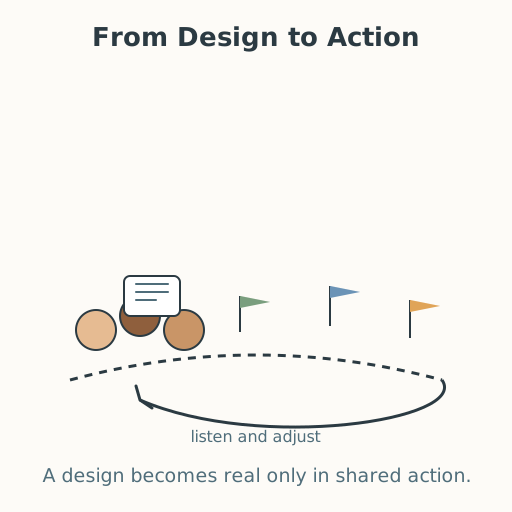
A design that stays on paper helps no one. The moment a plan meets the world — the first conversation, the first task done, the first promise kept — is the moment it becomes real. You have spent this unit learning to talk across difference, to respect consent, to build trust, to understand before responding, to see how empathy and community are shaped by distance, loyalty, and systems. Today you gather all of it and set it in motion: you launch.
Materials
- Launch plan sheet
- Unit reflection sheet
Preparation
- Copy the launch plan and reflection sheets.
- Retrieval: this capstone is the unit’s retrieval — the plan and reflection deliberately ask learners to recall and use every major idea from Lessons 1–9.
Facilitator note
This lesson is written to the learner (“you”). The capstone has two jobs: (1) launch — turn the design from Lesson 9 into a committed plan: a concrete goal, named roles, a short timeline with check-in points, and one first step someone will actually take this week; (2) reflect — retrieval across the unit, so the ideas are recalled, connected, and carried forward (spacing and retrieval, see docs/assessment.md). Keep the launch small and real: the first step should be doable within days, not a grand plan that collapses. The egalitarian lens: check that the plan shares work and power — with the community, not for it (S-345). The ethics lens: cooperation over competition, and care for the people the project touches. The global lens: this same shape — people meeting a real need together — is how communities everywhere have thrived (S-163, S-164). The technology/environment lens: name what tools the project will use and what its effect on the environment will be. End with agency and hope, not exhaustion — the project is a beginning, not a final exam. Celebrate the launch.
Procedure
- Recall the unit (10 min). Quickly name, from memory: the three moves for talking across difference; the five parts of consent; how trust is built; the four steps of empathic inquiry; what distance and media do to empathy; three forms of community; how in-group loyalty builds and limits; and what a system’s rules shape.
- Finalize the plan (15 min). In your group, take your design from Lesson 9 and make it a launch plan: the goal, each person’s role, a short timeline with check-in points, and — most important — the one first step someone will take this week. Use what you learned: decide together, share the work, listen first.
- Present for feedback (12 min). Share your plan with another group. Ask them: is the first step real and doable this week? Is the work and the deciding shared? Do they see a way to make it better? Adjust.
- Commit (8 min). Write the first step with a name and a date next to it. This is your commitment — not to be perfect, but to begin, and to meet again at the first check-in.
- Reflect and connect (8 min). Complete the reflection sheet: which idea from this unit will you carry into your relationships? Which one will you use in your project? What did you learn about how people build community together?
- Close and celebrate (2 min). Share one word for what this unit gave you. A design became a plan; a plan became a promise. Now it is in your hands — and your community’s.
Differentiation
- Support: Provide the launch plan with the goal and timeline pre-stated; learners assign one role and the first step.
- Extension: Add a reflection on how the group will sustain shared decision-making and accountability beyond the first week.
Assessment
- Formative (observation): Can the learner turn the design into a committed plan with a real first step?
- Summative (portfolio): The completed launch plan and unit reflection, kept in the portfolio as the unit’s capstone artifact.
- Self-assessment: The learner writes which unit idea they will carry forward, and how they will know the project is helping.
Home connection
Take the first step this week, and tell someone what you did. Bring back one thing you learned from doing it.
Resources
- On mutual aid as solidarity among equals: Dean Spade (2020), Mutual Aid (S-345).
- On cooperative learning with shared roles and accountability: Slavin (1995), Cooperative Learning (S-147).
- On mutual aid and cooperation as widespread human practice: Peter Kropotkin (1902), Mutual Aid (S-163).
- On relationship skills and social awareness as SEL competencies: CASEL, “Fundamentals of Social and Emotional Learning,” https://casel.org/fundamentals-of-sel/ (S-001).