Lesson 01 — Language, Literature & Argument: Where We've Been, Where We're Going
Learners recall three Grade-8 language ideas — analyzing a speaker's rhetoric, engaging in structured debate, and citing sources — and preview this unit's four strands and eight goals. They meet the unit's organizing idea: a mature mind builds a **synthesis**, shapes an **argument**, and becomes an **author**.
Objectives
Objectives
- D04.S1.09.01 Synthesize information from multiple spoken sources and present a coherent account or argument.
- D04.S1.09.02 Lead or facilitate a discussion, inviting participation and managing disagreement with fairness.
Essential question
What is synthesis and authorship — and where are we going in this unit?
Key vocabulary
Materials
Standard materials
- Unit map sheet · 1 per learner A one-page map of the unit's four strands and eight goals, to mark and return to across the unit
- Recall cards · 1 set per group Cards recalling three Grade-8 ideas — analyzing a speaker's rhetoric, structured debate, and citing sources
Low-tech / no-cost
- A shared board or large paper Draw the four strands and eight goals together; no printed map needed
- Voice and memory Recall the Grade-8 ideas aloud as a group instead of using cards
Enriched / lab & device
- A digital slideshow of the four strands · 1 One image or diagram per strand (listening, reading, writing, multilingual) to preview each
- A wonder box (physical or shared document) · 1 A place to collect every learner's questions about the unit to revisit at the close
Works in different contexts
- large-group Do the recall round as a whole group with ideas recorded on the board, then small groups sort the recall cards
- multi-age Younger learners match each recall idea to an example; older learners state the idea in one sentence and connect it to the new unit
- self-directed A learner reads the unit map, writes three sentences recalling the Grade-8 ideas, and lists one question per strand
- level-grouped Learners ready to extend write a fourth Grade-8 idea not on the cards and explain why it matters here
- outdoor-only Point to the many ways people communicate outdoors — a sign, a song, a story told aloud — and ask which strand each belongs to
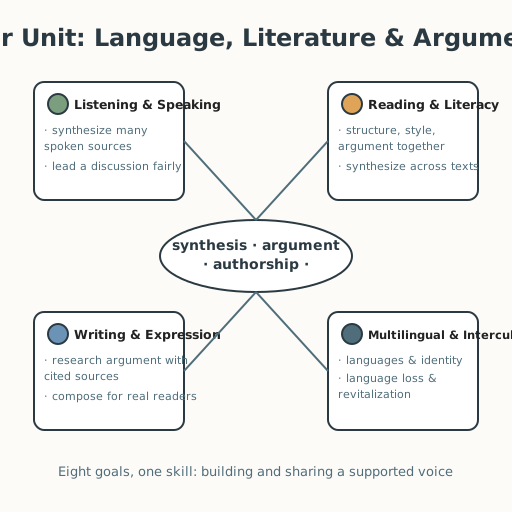
Lesson 1 — Language, Literature & Argument: Where We’ve Been, Where We’re Going
Summary
Learners recall three Grade-8 language ideas — analyzing a speaker’s rhetoric, engaging in structured debate, and citing sources — and preview this unit’s four strands and eight goals. They meet the unit’s organizing idea: a mature mind builds a synthesis, shapes an argument, and becomes an author.
Objectives
- Begin to name the unit’s first goal — synthesizing multiple spoken sources into one coherent account. (D04.S1.09.01)
- Begin to name the unit’s second goal — leading a discussion that welcomes every voice and manages disagreement fairly. (D04.S1.09.02)
Connection
You already do this without noticing. When friends tell you three different versions of what happened at a match or a market, you gather them, notice what they agree on, and decide for yourself what you believe — you synthesize. When a group chat or a family argument starts to split, someone steps in to make sure everyone gets a turn — that person leads a discussion. Grade 8 taught you to analyze one voice and argue one position. Grade 9 turns you into someone who brings many voices together and speaks with a voice that is truly your own. Today we remember what we can already do and see where it is taking us.
Materials
- Unit map sheet
- Recall cards
Preparation
- Copy the unit map sheet and recall cards.
- Retrieval: from Grade 8, recall (a) analyzing how a speaker’s word choice, tone, and delivery shape meaning (rhetoric), (b) structured debate — arguing a position with reasons while listening to opposing views, and (c) citing sources accurately and separating your own words from others’. Today we link those to the new unit.
Facilitator note
This lesson is written to the learner (“you”). It is the unit’s opening and retrieval pass, so the goals are modest: (1) recall three Grade-8 ideas — rhetoric (word choice, tone, delivery shape meaning), structured debate (argue with reasons while hearing opposing views), and citation (honoring others’ words); (2) preview the unit’s four strands — listening & speaking, reading & literacy, writing & expression, multilingual & intercultural — and its eight goals; (3) plant the organizing idea: synthesis (many sources → one account), argument (a supported position), and authorship (a voice of one’s own). Do not try to teach the eight goals today; just name and locate them. The critical-thinking lens: every supported position begins by weighing evidence, not by asserting (philosophy §7). The global lens: the same skills of synthesis and argument are practiced in every literate culture, in every language, from oral epics to digital essays. The ethics lens: honest argument distinguishes what the evidence shows from what we value, and honest authorship names whose words we are using (philosophy §5). The egalitarian lens: the unit holds multilingualism as wealth, never a deficit, and every learner’s home language is honored first (philosophy §4; D04 rationale). The technology & environment lens: the tools of language — writing, print, recording, and now digital media — change who gets to speak and be heard, and a language also carries knowledge of the place and living world it names; the unit returns to both threads in its closing lessons. Keep origins and beliefs open: nothing here is creed (philosophy §11). Spacing note (S-039): this recall pass is what makes the unit’s ideas stick later.
Procedure
- Recall (10 min). In a small group, look at three recall cards: rhetoric, structured debate, citing sources. For each, say in one sentence what you remember from Grade 8.
- Connect the three (5 min). What do all three have in common? (Each is about using language carefully with other people — to persuade, to disagree fairly, to give credit.)
- Meet the map (10 min). Look at the unit map. Four strands: listening & speaking, reading & literacy, writing & expression, multilingual & intercultural. Eight goals — two per strand. Read each goal aloud once; don’t worry about understanding them yet.
- Plant the big idea (10 min). The unit’s idea in one breath: a mature mind synthesizes (brings many sources into one account), builds an argument (a supported position), and becomes an author (a voice of its own). Say it back in your own words.
- Wonder (10 min). Write one question about each strand in the wonder box. Which question do you most want answered by the end of the unit?
- Close (5 min). Today we remembered what we know and saw the road ahead. Next: we synthesize many voices into one account.
Differentiation
- Support: Give sentence starters for the recall round (“Rhetoric is how a speaker’s…”).
- Extension: Add a fourth Grade-8 idea of your own (e.g., how language can include or exclude people) and say why it will matter in this unit.
- Non-speaking / AAC: All recall can be done by writing, pointing to a card, signing, or using a device; “saying it in your own words” means expressing it in your mode, not necessarily aloud.
- Deaf / hard of hearing: Present the strands visually; “synthesis” and “argument” are the same skills in a signed language as in a spoken one, and signed languages are honored among the world’s languages.
Assessment
- Formative (observation): Can the learner recall each Grade-8 idea in one sentence and name the unit’s four strands?
- Artifact: The completed unit map (or the learner’s written recall), kept in the portfolio.
Home connection
Ask someone at home: what is one time you brought several people’s different stories together to figure out what really happened? Bring the story (no names needed) to the next lesson.
Resources
- On the payoff of spaced retrieval: Dunlosky et al. (2013), https://doi.org/10.1177/1529100612453266 (S-039).
- On explicit instruction and worked examples for skills: Kirschner, Sweller & Clark (2006), https://doi.org/10.1207/s15326985ep4102_1 (S-011).