Lesson 02 — Synthesizing Many Voices into One Account
Learners practice **synthesizing multiple spoken sources** into one coherent account, using four short first-person accounts of the same event. They find what the sources share, name where they differ, and compose one account that honors every source before speaking for themselves.
Objectives
Objectives
- D04.S1.09.01 Synthesize information from multiple spoken sources and present a coherent account or argument.
Essential question
How do I bring several spoken sources together into one coherent account or argument?
Key vocabulary
Materials
Standard materials
- Source-synthesis sheet · 1 per learner A four-column organizer — each source's main point and key detail, then a column for "what they share" and "where they differ"
- Four spoken-source cards · 1 set per group Four short first-person accounts of the same event (e.g., a market closing, a new road, a school decision), each with a different stake and partly conflicting details
Low-tech / no-cost
- A shared board or large paper Build the four-column organizer together; learners record each source by ear
- Voice and memory The facilitator reads the four accounts aloud twice, and learners hold each in memory before writing
Enriched / lab & device
- Short audio or video clips · 4 clips Real, brief news clips or recorded testimonies on one local topic to listen to instead of reading cards
- A shared document · 1 per group Collect and merge each learner's synthesis into one shared account
Works in different contexts
- large-group Read the four sources to the whole group once, then pairs each summarize one source and report, and the class merges them on the board
- multi-age Younger learners retell one source accurately; older learners find the overlap and write the merged account
- self-directed A learner reads the four cards, fills the organizer, and writes a one-paragraph synthesis, self-checking that each source appears
- level-grouped Learners ready to extend also name what is *missing* — whose voice is absent from the four sources — and say why it matters
- outdoor-only Ask three or four people nearby (vendors, neighbors, classmates) the same question, then synthesize their answers aloud into one account
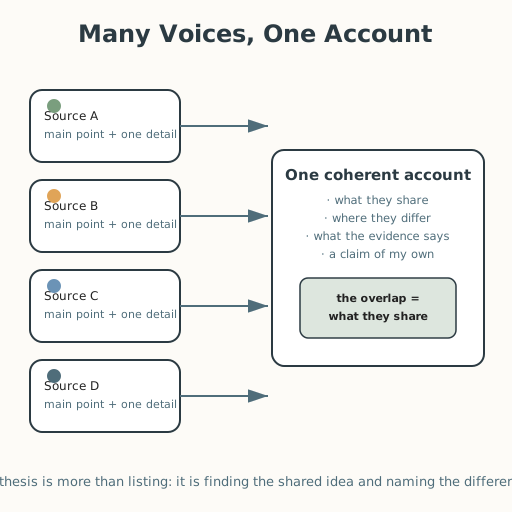
Lesson 2 — Synthesizing Many Voices into One Account
Summary
Learners practice synthesizing multiple spoken sources into one coherent account, using four short first-person accounts of the same event. They find what the sources share, name where they differ, and compose one account that honors every source before speaking for themselves.
Objectives
- Synthesize information from multiple spoken sources and present a coherent account or argument. (D04.S1.09.01)
Connection
Every community meeting, every family retelling, every news story about your neighborhood is made this way: several people saw or felt different pieces of the same thing, and someone has to put the pieces together. If you only listened to one voice, you would have only one slice of the truth. Synthesis is the skill of listening to several voices, noticing what they agree on and where they pull apart, and then telling one honest account that does not pretend the differences are not there. Today you practice that skill.
Materials
- Source-synthesis sheet
- Four spoken-source cards
Preparation
- Copy the synthesis sheet and the four source cards.
- Retrieval: from Grade 8, recall paraphrasing a speaker’s points and distinguishing a main argument from supporting details. Today we move from one source to several.
Facilitator note
This lesson is written to the learner (“you”). The skill to land: synthesis is more than summarizing — it is (1) noting each source’s main point and key detail, (2) finding the overlap (what they agree on), (3) naming the difference (where they conflict), and (4) composing one coherent account that honors both, before stating your own supported judgment. This is a skill, so use a worked example first, then guided practice (explicit instruction carries skills for novices — S-011). Model it: take a simple, non-controversial topic (e.g., “should the school courtyard host a weekly market?”) and show four one-line voices — a student who wants the music, a vendor who wants the income, a neighbor who wants quiet, a teacher who wants the space for study — then show how a synthesis sounds: “Several people value the market for different reasons (income, joy), while others worry about noise and lost space for study; what they share is that the courtyard matters to them, and what they disagree on is how it should be used.” The critical-thinking lens: a synthesis that ignores a conflict is not synthesis — it is smoothing; hold the tension. The ethics lens: each speaker’s stake deserves to be reported faithfully, even the one you disagree with. The egalitarian lens: notice whose voice is missing from the four sources — the person left out of the meeting, the child, the speaker of a minority language — and say so; synthesis is fairer when it names its own gaps. The global lens: this is how councils, elders, juries, and assemblies have made sense of many voices in every culture — oral and written. The technology & environment lens: recording lets a spoken source be re-heard and checked, and the accounts learners merge are often about a shared place — a market, a road, a school — so synthesis is also how a community decides about its shared world. Keep the worked example concrete and the four practice cards short enough to hold in memory.
Procedure
- Recall (5 min). From Grade 8: what does it mean to paraphrase a speaker’s points accurately, and how do you find the main argument among the details?
- Meet synthesis (10 min). Watch the worked example: four one-line voices on one topic, then one synthesis that names the overlap and the difference. Notice it is not just a list — it is a new, single account.
- Read and mark the four sources (15 min). With a group, read (or hear) the four source cards about the same event. For each, note: main point and one key detail.
- Find overlap and difference (10 min). Fill the two columns: what they share (the idea every source agrees on) and where they differ (the point they pull apart on).
- Compose one account (10 min). Write or speak one coherent paragraph: begin with what they share, name where they differ honestly, then add one sentence of your own judgment — clearly marked as yours.
- Peer-check (5 min). Ask a partner: does my account include every source? Did I name a real disagreement rather than skip it? Did I separate my judgment from theirs? Fix what is missing.
Differentiation
- Support: Provide a synthesis frame — “These speakers agree that ___. They differ on ___. Taken together, this suggests ___.”
- Extension: Name whose voice is absent from the four sources, and write one sentence explaining how that absence might change the account.
- Non-speaking / AAC: The synthesis can be composed in writing, by arranging cards, or on a device; the skill is in the merging, not in the voice.
- Deaf / hard of hearing: Run the four sources as written cards or signed retellings; “spoken sources” includes any language, signed or spoken, and synthesis is the same act of merging.
Assessment
- Formative (observation): Can the learner pull one main point from each source, name the overlap and a difference, and state one account that separates their own judgment from the sources’?
- Peer check: Partner confirms all four sources appear and a real disagreement is named.
- Portfolio artifact: The completed synthesis sheet, kept in the portfolio.
Home connection
Tonight, ask two people at home the same question — “what makes our neighborhood good?” — and try to say back, in one sentence, what they agree on and where they differ.
Resources
- On listening as an SEL competency (attention, understanding): CASEL, “Fundamentals of Social and Emotional Learning,” https://casel.org/fundamentals-of-sel/ (S-001).
- On explicit instruction and worked examples for skills: Kirschner, Sweller & Clark (2006), https://doi.org/10.1207/s15326985ep4102_1 (S-011).
- On spaced retrieval: Dunlosky et al. (2013), https://doi.org/10.1177/1529100612453266 (S-039).