Lesson 10 — My Languages, My Identity
Learners map the **languages that make up their identity**, reading two short passages — Ngũgĩ wa Thiong'o on Gikuyu and English, and Gloria Anzaldúa on living between languages — then reflecting on their own multilingual or monolingual experience. Home language is honored first, and multilingualism is held as wealth, never deficit.
Objectives
Objectives
- D04.S4.09.01 Explain how a person's languages are part of their identity, and reflect on their own multilingual or monolingual experience.
Essential question
How are my languages part of who I am — and what is my own multilingual or monolingual experience?
Key vocabulary
Materials
Standard materials
- Language-identity map · 1 per learner A personal map with bubbles for each language the learner uses — where, with whom, and what each carries — plus a line for the language(s) of dreams and feelings
- Two short passages on language and identity · 1 set per group Faithful excerpts from Ngũgĩ wa Thiong'o (Gikuyu and English) and Gloria Anzaldúa (living between languages), each brief and carefully introduced
Low-tech / no-cost
- A shared board or large paper Draw a class language map together — every learner's languages side by side — before each draws their own
- Voice and memory Learners share a word or phrase from their home language aloud, with no paper needed
Enriched / lab & device
- Audio clips of the passages in their languages · 2 Where available, hear Ngũgĩ's Gikuyu or Anzaldúa's Spanish-inflected English to feel language as identity in the voice
- A digital language map · 1 A shared document or map where each learner adds their languages, to see the class's full multilingual landscape
Works in different contexts
- large-group Build one class language map together, then each learner draws their own and shares a single word from a home language
- multi-age Younger learners name their languages and where they use each; older learners also reflect on which language they think and dream in, and what each carries
- self-directed A learner draws their language-identity map, reads the two passages, and writes a short reflection on their own multilingual or monolingual experience
- level-grouped Learners ready to extend compare Ngũgĩ's and Anzaldúa's experiences and say how each author's languages shaped their identity and their writing
- outdoor-only Draw the language map in the open air; share a word or a song in a home language in a circle, and notice how place and language touch
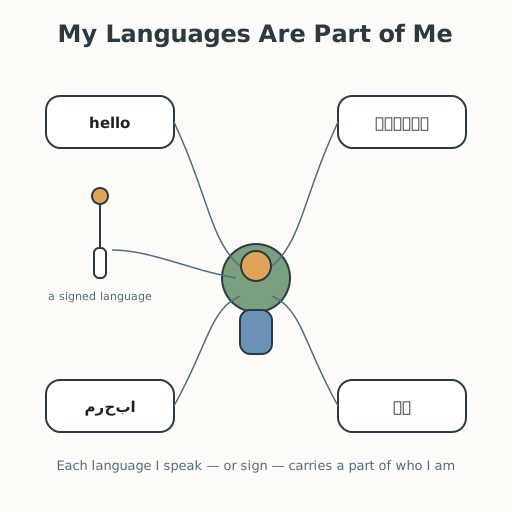
Lesson 10 — My Languages, My Identity
Summary
Learners map the languages that make up their identity, reading two short passages — Ngũgĩ wa Thiong’o on Gikuyu and English, and Gloria Anzaldúa on living between languages — then reflecting on their own multilingual or monolingual experience. Home language is honored first, and multilingualism is held as wealth, never deficit.
Objectives
- Explain how a person’s languages are part of their identity, and reflect on their own multilingual or monolingual experience. (D04.S4.09.01)
Connection
Think of the language you use with the people you love most — the one you were sung to in, scolded in, told “goodnight” in. Now think of the language you use to do schoolwork or to be understood by strangers. Are they the same? Many people live in more than one language, and each one carries a different part of who they are: one for tenderness, one for argument, one for prayer, one for the marketplace. Even being monolingual is an experience worth understanding — it shapes what you can hear and what you cannot. Today you map the languages that made you, and you hear two writers who thought hard about their own.
Materials
- Language-identity map
- Two short passages on language and identity
Preparation
- Copy the language-identity map and the two passages.
- Retrieval: from Grade 8, recall how language can include or exclude people, and how dialect and accent are natural variation, never “wrong” ways of speaking. Today we turn inward: how are my languages part of my identity?
Facilitator note
This lesson is written to the learner (“you”). The idea to land: a person’s languages are part of their identity — each language carries memories, relationships, and ways of seeing, and a learner’s own experience (even monolingual) is worth naming and reflecting on. The two passages: Ngũgĩ wa Thiong’o (Kenya), in Decolonising the Mind (1986), describes how being made to use English instead of Gikuyu distanced him from his home world, and argues that language carries a people’s culture and history (S-424); Gloria Anzaldúa (Chicana, US–Mexico borderlands), in “How to Tame a Wild Tongue” (Borderlands/La Frontera, 1987), writes of living in the between — Chicano Spanish, English, Nahuatl — and of being shamed for her tongue until she learned that her languages are her (S-425). Hold these as invitations to reflection, not as dogma: a learner who is monolingual has a real and worthy experience to reflect on too, and no learner’s language situation is a “deficit” (D04 rationale; philosophy §4). This is concept and reflection, so use inquiry and story, not only instruction. The global lens: multilingualism is widespread the world over — the human norm, not the exception — and UNESCO holds mother-tongue and multilingual education as a shared commitment (S-019). The egalitarian lens: some languages are treated as “important” and others as “lesser”; this lesson deliberately flips that — every learner’s home language is honored first, and a language is never “better” than another. The ethics lens: shaming someone’s way of speaking is an injustice; honoring it is a form of respect. The social-emotional lens: language is intimate — treat learners’ reflections with care, and never require a learner to share more than they choose (facilitation.md). The technology & environment lens: translation tools and a shared digital map can help a learner see and connect their languages, but digital spaces also tilt toward dominant languages — and a language is tied to the place it names. Keep the passages short, faithful, and gently introduced; the excerpts touch on colonial and linguistic harm, so name feelings before facts and keep hope and agency in view (development.md 9–12).
Procedure
- Recall (5 min). From Grade 8: how can language include or exclude people, and why is no dialect or accent “wrong”? Today we turn inward, to our own languages.
- Read the two voices (12 min). Read (or hear) the short passages: Ngũgĩ on being distanced from Gikuyu by English; Anzaldúa on living between languages and learning her tongue is hers. For each, note: what did the writer’s language(s) carry, and how did others treat them?
- Draw your language map (15 min). On your sheet, put each language you use — home language(s), school language(s), any other — and for each, write where you use it, with whom, and what it carries (a feeling, a memory, a kind of talk). If you live in one language, map its parts instead — the way you speak at home vs. at school vs. with friends.
- Name your experience (10 min). Write one short reflection: which language do you think, dream, or feel in? What does each language give you that another does not — or what would you lose if you lost your home language?
- Share a word (8 min). In a circle, offer one word or phrase from a language that matters to you, and what it means — or, if you prefer, share one sentence from your reflection. No one is required to share more than they wish.
- Close (5 min). Look at your map. Your languages are not a list — they are part of who you are.
Differentiation
- Support: Provide a partially filled map (“at home I speak ___”, “at school I speak ___”, “with friends I speak ___”) and let learners complete rather than build from nothing.
- Extension: Compare Ngũgĩ’s and Anzaldúa’s experiences in one paragraph, and say how each author’s languages shaped both their identity and their writing.
- Non-speaking / AAC: A signed language is a language and belongs on the map as fully as a spoken one; a learner maps whatever they use to communicate, including a communication device.
- Deaf / hard of hearing: Center signed languages explicitly — many learners live between a signed and a spoken/written language, which is itself a bilingual experience worth mapping.
Assessment
- Formative (observation/self): Can the learner explain how a language is part of their own identity and reflect on their multilingual or monolingual experience in their own words?
- Portfolio artifact: The completed language-identity map and reflection, kept in the portfolio.
Home connection
Ask someone at home: which language did you grow up speaking, and what do you feel when you hear it now? Bring one thing they said to the next lesson.
Resources
- On multilingualism as the human norm and the value of the mother tongue: UNESCO, “International Mother Language Day,” https://www.unesco.org/en/days/mother-language (S-019).
- On the two passages: Ngũgĩ wa Thiong’o, Decolonising the Mind (1986) (S-424); Gloria Anzaldúa, Borderlands/La Frontera (1987) (S-425).
- On explicit instruction and worked examples for skills: Kirschner, Sweller & Clark (2006), https://doi.org/10.1207/s15326985ep4102_1 (S-011).